 Skip to content



is above all the island of people.
For 15 years, we, the team at Amanaska travel agency, have been designing trips to Bali and throughout the Indonesian archipelago. This first article in our series answers your essential questions: when to visit Bali? How to understand Balinese culture? And above all, how to plan a family trip that is meaningful while creating unforgettable memories?
1. When to Visit Bali? Read the Calendar, Not Just the Weather
Bali enjoys a tropical climate regulated by two main seasons:
Dry season: from April/May to late October, with peak sunshine and temperatures around 27–32°C.
Wet season: from November to March, when rains—often brief but intense—cool the air and green the rice terraces.
“The May-June combination remains the perfect choice: clear skies, fewer crowds, and fluorescent rice terraces.”
Our advice:
- Family trip to Bali: favor the May-June or September-October period; fewer crowds, pleasant temperatures, happy children.
- Visiting Bali for photography: target the end of the wet season (March-April); the light is soft, the rice terraces saturated with water.
- Spiritual journey: watch for Nyepi (Balinese New Year, variable date between March and April). An entire day of silence—deserted streets, closed airport—unique in the world.
If you would like to learn more about all the event-rich periods for discovering Bali, we have a ‘When to Visit Bali’ article waiting for you.
2. A Few Historical Landmarks to Better Savor the Present
Before donning sarong and sash, it is good to know the backstage of the Balinese “theater state” described by anthropologist Clifford Geertz. In Negara (1980), he shows how kings once orchestrated politics through rituals: parades, offerings, kris dances. “To govern was to stage oneself,” he writes.
In the 20th century, the arrival of the Dutch and then the tourism boom following the film Island of the Gods (1932) transformed the economy. Historian Adrian Vickers reminds us that the myth of Bali-paradise is a construction: Art Deco posters, KLM brochures, beach photographs sold to Westerners seeking exoticism. Yet Balinese identity, woven from Hindu rites and village solidarity, has endured.
Today, Bali remains a crossroads:
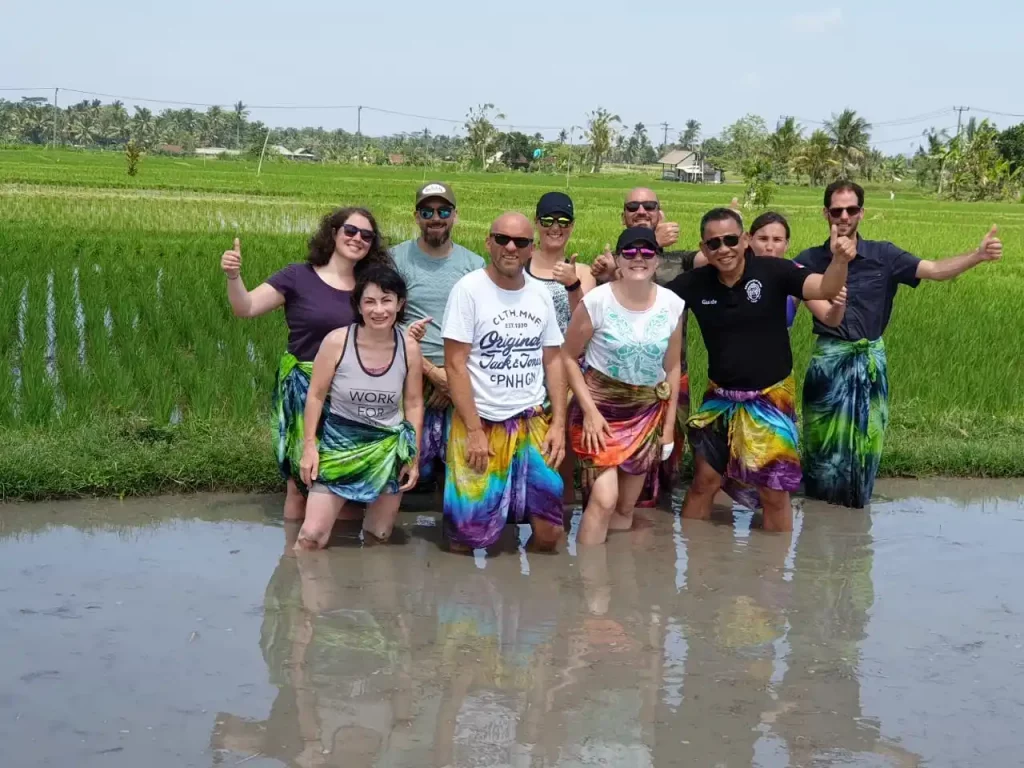
- Living rurality: subak irrigation system inscribed on the World Heritage list (officially recognizing local agricultural wisdom).
- Creativity: contemporary dance, street art in Canggu, fusion gastronomy.
- Inclusive spirituality: whatever your religion, ethnicity, or beliefs, you can attend prayers and ceremonies while respecting local traditions.
3. Essential Cultural Experiences Not to Miss
a) Rituals and Offerings
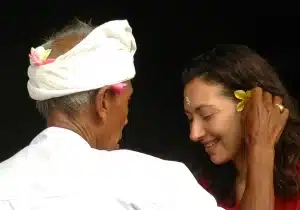
Every morning, canang sari—small baskets of coconut leaves filled with flowers, rice, and incense—bloom on sidewalks and altars. They recall the Tri Hita Karana triad: harmony between gods, humans, and nature. For us travelers, knowing how to greet with a simple om swastiastu (hello) is already a first step.
b) Sacred and Secular Dances
Barong: epic struggle between good (Barong) and evil (Rangda). Ideal for a first evening with children: mythical masks, mesmerizing gamelan.
Kecak: 100 bare-chested men chant a hypnotic cak-cak-cak around a fire. Visually unforgettable.
“Balinese dance is a choreographed prayer,” wrote Miguel Covarrubias in 1937.
c) Everyday Arts
Batiks, wood carvings, silver jewelry: each object carries a symbol. Purchasing directly from kooperasi (cooperatives) supports the local economy—a key element of our ethical tours.
4. Planning Your Trip to Bali: The Amanaska Method in Three Steps
Listening—Video or phone consultation to understand your desires (culture, nature, wellness), your expectations, and the context of your trip. Understanding you better is our priority.
Creation—We design a customized stay in Bali: family-friendly hotels, dedicated French-speaking guide, private air-conditioned transfers.
Support—During the trip, we watch over you to ensure the best experience: real-time itinerary adjustments, 24/7 assistance.
Result: less stress, more meaningful moments.
5. What If All of Indonesia Opened Up to You?
Because a trip to Indonesia can also combine Bali, Java, and the Gili Islands:
- East Java: sunrise over Mount Bromo, visit to the Hindu-Javanese temple of Candi Jawi.
- Nusa Lembongan: peaceful mangroves, diving with manta rays.
- Komodo: trek with the famous Komodo dragons, overnight on a traditional phinisi boat.
Thus, discovering Indonesia extends the enchantment and disperses the crowds while diversifying experiences.
6. Conclusion: Why Choose Amanaska?
Because we were born in Bali—at least in spirit—and a successful trip begins before departure, when you truly understand the local culture.
“To travel is to give meaning to one’s life,” said adventurer Nicolas Bouvier; for Bali as for Indonesia, giving meaning comes through observation, listening, and humility.
Ready to visit Bali? Explore our “Limited Edition” tours and let us guide you. We take care of the rest: all you have to do is open your eyes, your arms… and your memory book. “The real voyage of discovery consists not in seeking new landscapes, but in having new eyes.”