 Skip to content



Let’s be clear: complete improvisation in Bali can lead to experiences that are, shall we say, memorable. You might lose your luggage, your budget, or your way. But with a few good habits – those that Amanaska has compiled in its series of articles Practical Information – you can travel more freely, more lightly, and more deeply.
In an era where you can book a ticket in three clicks but sometimes forget to ask the right questions, preparing your trip to Bali remains an art.
And in Bali, this art takes on its full meaning. The island invites slowness, openness, and listening – but it does not forgive unpreparedness. And even if we excel in the art of organizing your trip to Bali, there are a number of subjects that are up to you… Don’t see these as injunctions to plan everything, but as concrete benchmarks to offer you true freedom once you’re there.
1. Travel Light, But Not Half-Hearted
Frequent travelers know: lightness is a science. And on an island like Bali, where temperatures hover around 30 degrees, where you go from scooter to temple, from rice paddy to beach restaurant in the blink of an eye, the contents of your bag become strategic.
Our dedicated articles on luggage, whether it’s a carry-on bag or checked luggage, distill practical, sometimes counter-intuitive advice: think multi-functional, prioritize breathable fabrics, know how to pack just enough. It’s not a matter of style; it’s a matter of mobility. A poorly packed bag makes for a heavy trip. An optimized bag makes for a smooth trip.
And in case of lost luggage – yes, it happens – it’s best to have enough in your carry-on to survive 48 hours with elegance.

2. Go at the Right Time, for the Right Reasons
The question often arises: what is the best season to go to Bali? The truth is, there isn’t just one. There are times when the weather is more stable, others when the island is calmer, and still others when prices are lower.
What our readers discover through our dedicated article is that the rainy season is not necessarily to be avoided – especially if you want to avoid crowds.
Traveling off-season also opens you up to a more intimate, more accessible Bali. But it requires adapting your itinerary, your pace, and sometimes… your expectations.
3. Budget, Tickets, and Illusions à la Carte
Bali has long been perceived as a cheap destination. This is still true, under certain conditions. Our articles revisit the sometimes surprising discrepancies between expectations and reality: rock-bottom airfares with three layovers, €15 hotels without hot water, “authentic” activities that flirt with tourist folklore.
You’ll learn how to build a coherent budget, factor in invisible costs (insurance, visa, transfers, tips), and book the right flights at the right time. Nothing extraordinary, but enough to avoid unpleasant surprises.
4. Traveling with Family Without Getting Exhausted
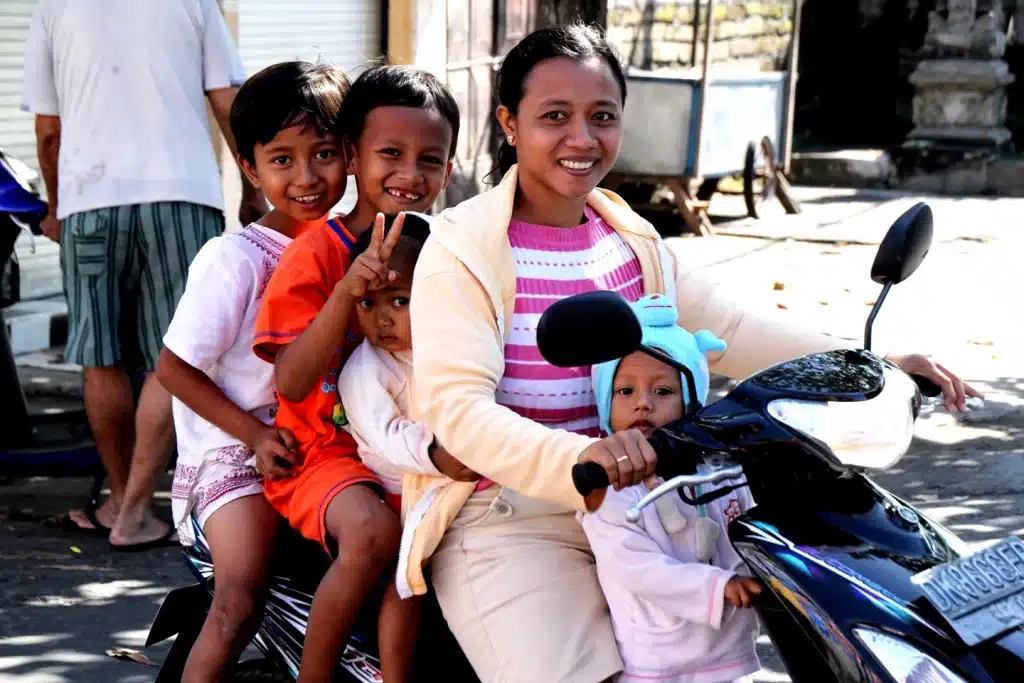
Bali is an ideal island for a family trip to Bali. However, everyone needs to experience it as an adventure, not as constant logistics. In our two articles on families, we address questions of pace, shared activities, suitable accommodations, and group dynamics.
Because, yes, a tired child at noon in a rice paddy can ruin a day. And a disconnected teenager can make everyone lose patience. Traveling with family requires preparation. And it’s in the details that everything plays out: breaks, good compromises, small considerations.
5. Responsibility: The Discreet But Fundamental Keyword
Today, no one can travel without considering their impact. Our articles on ecotourism and daily respectful gestures are not sermons: they offer simple tools to better adapt. Understand local customs, avoid blunders, reduce your plastic footprint, encourage sustainable initiatives.
Bali is beautiful, but fragile. And what you leave behind is also what you take with you: a clear memory, a clear conscience.
Prepare Well, to Improvise Better
Preparing a trip isn’t about freezing the adventure; it’s about providing fertile ground for it. What this series of articles offers you isn’t a soulless to-do list, but a flexible framework so that, once you’re there, you can surrender to the Balinese rhythm without unnecessary stress.
Anticipating doesn’t prevent dreaming. Organizing doesn’t prevent feeling. Planning is simply a way of respecting what you are about to experience.
And if you forget something, it’s not a big deal. You’ll always find a smile, a market, a taxi, or advice. But believe us: those who leave light, prepared, and open are also those who return… enriched in a different way.