 Skip to content



When you arrive in Bali, you quickly feel it: here, spirituality is not a separate “moment.” It is in the air, in the streets, in the houses, in the rhythm of the day. It is not just an island with beautiful temples; it is an island where the sacred organizes daily life, even in the simple gestures you will encounter everywhere.
For many travelers who come to discover Bali, this permanent presence of the sacred can be surprising. However, understanding this spiritual dimension profoundly changes the way one experiences a trip to Bali.
The objective of this article is simple: to provide you with clear reference points, without folklore, to understand why the gods and the invisible world occupy such a concrete place in Balinese life, and how this transforms your perspective as a traveler. Enjoy your reading…
Here, the gods do not live far away; they live with you
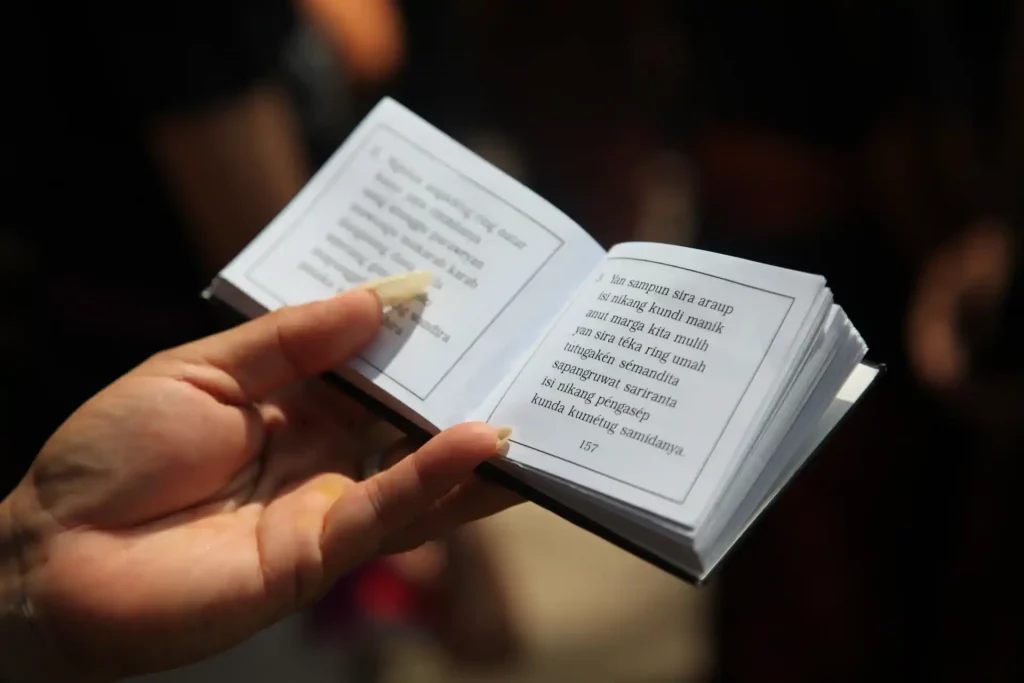
In Bali, speaking of the gods is often a practical way of saying that the divine is present in daily life. In Balinese Hinduism, Agama Hindu Dharma, there is the idea of a supreme divine force named Sang Hyang Widhi Wasa and multiple manifestations, deities, protective spirits, natural forces, or ancestors.
For a visitor preparing a trip to Bali, the important thing is not to memorize all the names, but to understand the logic.
This logic is summarized by a central principle, Tri Hita Karana, literally “the three causes of well-being.” This philosophy connects the spiritual, the human world, and nature.
In other words, in Bali, religion and daily life are not truly separated. One seeks balance between the relationship with the divine, the relationship with others, and the relationship with the environment.
Understanding Sekala and Niskala to Discover Bali Differently
One of the best reference points for understanding Bali is the idea of two coexisting planes.
Sekala corresponds to the visible, concrete world: people, roads, work, rain, or an accident.
Niskala corresponds to the invisible world: energies, spirits, ancestors, or protective forces.
For many travelers who come to discover Bali, this worldview allows for a better understanding of why rituals are so present in daily life.
Daily Offerings: A Symbol Observed During Your Vacation in Bali
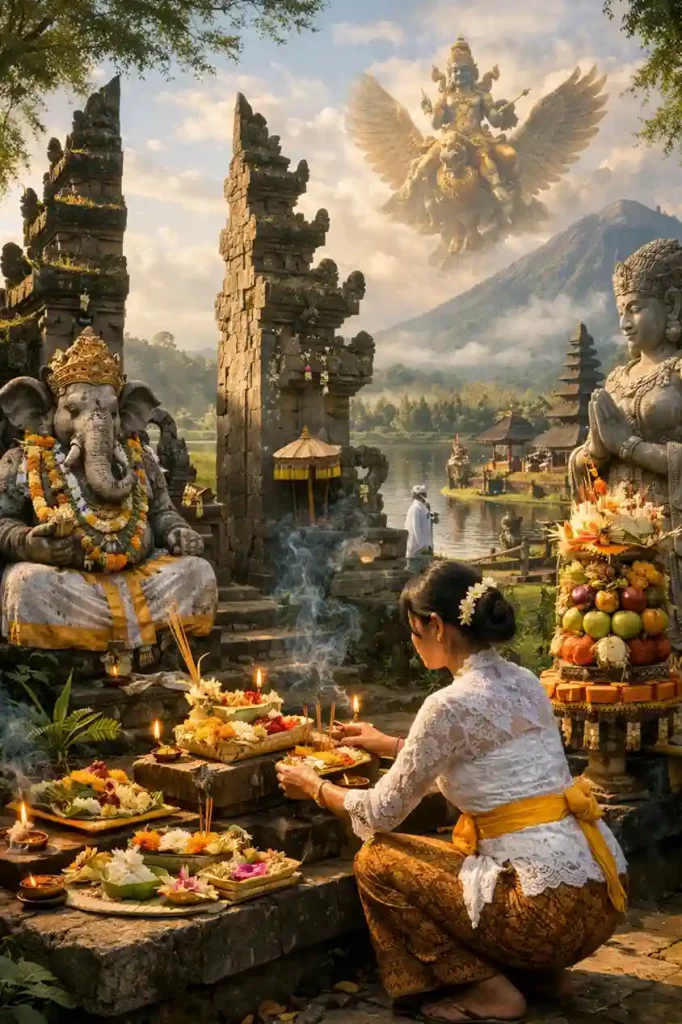
You will inevitably see these small offerings placed on the ground, on a low wall, at the entrance of a shop, or in a temple. These are canang sari.
These small palm-leaf baskets contain flowers, incense, and sometimes a treat or a coin.
The canang sari is a daily offering of gratitude and a gesture to maintain balance with the divine.
During a vacation in Bali, these offerings quickly become a daily landmark.
Space is Sacred: Houses, Streets, Temples—Everything is Organized
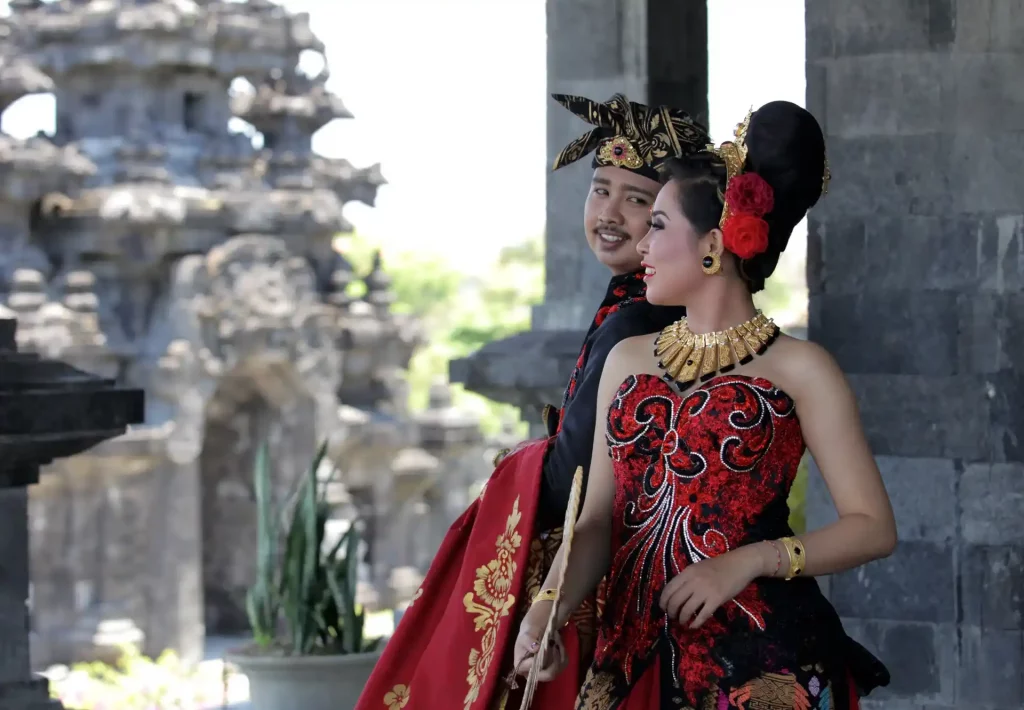
In Bali, the sacred is not only present in a temple. It is also found in the way space is divided.
A very concrete concept, Tri Mandala, divides a place—temple, house, or compound—into three zones according to their level of sacredness.
An outer zone, less sacred.
An intermediate zone.
An inner zone, the most sacred.
Even in a Balinese house, you often see a family altar space. The divine is integrated into daily life.
Sacred Time: An Essential Key to Visiting Bali While Understanding Its Ceremonies
If you have heard that ceremonies take place very often in Bali, that is normal.
The island does not live solely by the Gregorian calendar. There is a ceremonial calendar called Pawukon, based on a 210-day cycle.
This means that certain major festivals occur approximately twice a year.
When preparing to go to Bali, it is not uncommon to come across celebration periods such as Galungan or Kuningan.
The Community Sustains the Sacred: The Banjar
In Bali, spirituality is also a collective matter.
Many ceremonies and organizations go through the banjar, a form of community council for a neighborhood or village.
The banjar helps organize ceremonies, manage mutual aid, and maintain collective life.
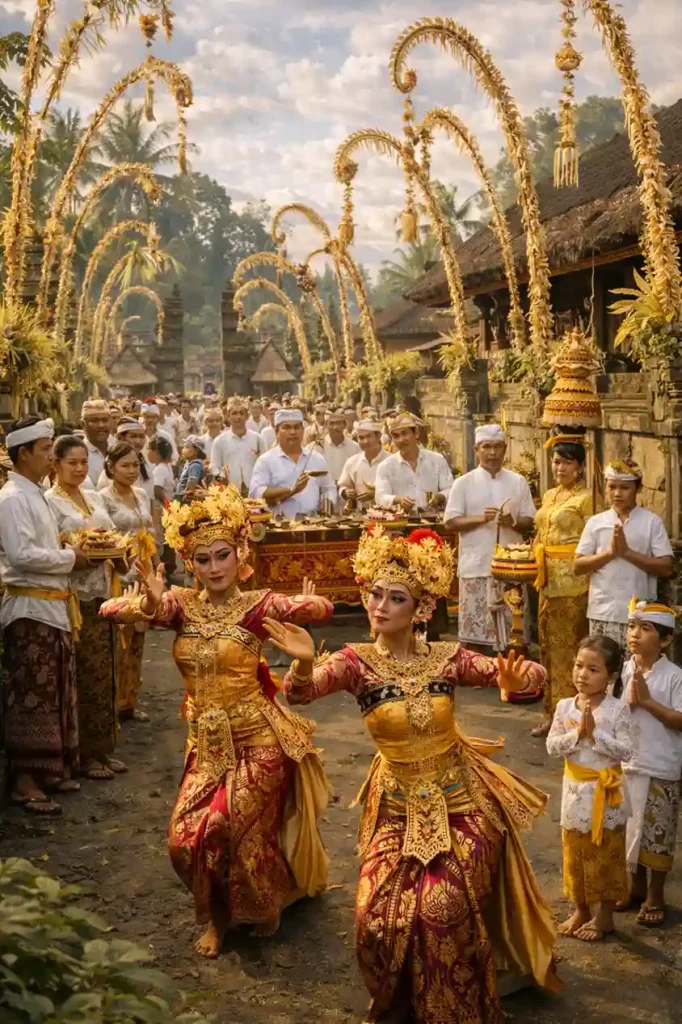
When you see an entire village mobilized, with preparations and decorations, it is not a show. It is social life in action.
Odalan: A Ceremony to Discover During a Trip to Bali
A term you will often hear is odalan, sometimes described as a temple’s anniversary.
On this date, the temple’s protective deity is honored, and the community gathers.
During a trip to Bali, it is not uncommon to encounter this type of celebration.
The Main Categories of Rites: Panca Yadnya
To simplify, remember the framework called Panca Yadnya, often presented as five main families of rites and offerings.
- To the gods.
- To the ancestors.
- To humans and life stages.
- To priests.
- To the forces of nature.
These ceremonies are part of the culture discovered during a family trip to Bali or a trip to Bali with friends.
Melukat: A Spiritual Experience to Live During a Trip to Bali
You will also hear about melukat, a purification ritual using sacred water called tirta.
This ritual aims to symbolically cleanse the body, mind, and energy.
Some travelers discover this practice in well-known places like Pura Tirta Empul during a trip to Bali.
Daily Ethics: Thinking, Speaking, and Acting Rightly
Balinese sacredness is not only ritualistic; it is also moral.
A frequently cited concept is Tri Kaya Parisudha, the idea of aligning thought, speech, and action.
In Bali, spirituality is not limited to ceremonies; it is also found in the way one conducts oneself daily.
Useful Tips for Visiting Bali with Respect
Without trying to be the perfect visitor, a few simple gestures are enough to respect the local culture when you wish to go to Bali.
Watch for offerings on the ground and avoid stepping on them.
Dress appropriately in temples.
Observe ceremonies with discretion.
Respect ritual objects.
These gestures allow for a better discovery of Bali while respecting its traditions.
In Summary: Why the Sacred Transforms a Trip to Bali
When people say Bali is a sacred island, it does not mean everything is mystical.
It means that daily life is based on a simple idea: maintaining balance between the visible and invisible worlds.
Temples, offerings, and ceremonies are only the visible part of a coherent system.
Understanding this profoundly transforms the experience of a trip to Bali.