 Skip to content



In Western culture, we refer to familiar authors and philosophers. We use tales and legends to convey messages and make ourselves better understood. The same applies to Balinese culture, which draws upon the magnificent epic of the Ramayana to teach the young, as well as the village, the importance of good conduct, adopting good manners, and respecting the sacred.
Staying in Bali is not only about discovering new landscapes but also about becoming aware of a different culture that originates from ancient legends.
Let’s discover together this popular legend born in India and imported to Indonesia.
The Ramayana or the March of Rama
The story first tells us about King Daśaratha, who reigned over the kingdom of Ayodhyā, a land blessed by the gods, where inhabitants lived happily and in harmony. He was a king loved by all and respected for his justice and benevolence. However, Daśaratha faced a problem: he struggled to have children, and more specifically, a son who could eventually succeed him.
Following ancestral practices and secret rituals, the king’s wives finally bore him four sons: Rāma, Lakṣmaṇa, Bharata, and Śatrughna. The four brothers were very close and later became strong and just men, in the image of their father. Rāma, the eldest, developed a thousand and one virtues over the years.
The Call of Sage Viśvāmitra
The day came when the sage Viśvāmitra asked the king for help, as he was confronted by a demoness who prevented him from performing ancient rites by interposing herself between him and the other sages. The sage, knowing that Rāma was the reincarnation of the god Viṣṇu, asked him to accompany him to resolve the problem. Rāma accepted and, with the help of his inseparable brother, Lakṣmaṇa, killed the demoness.
The sage then accompanied them to the kingdom of Mithilā, whose king had sworn to offer his most beautiful daughter, Sītā, in marriage to anyone capable of lifting and stringing Śiva’s bow. Rāma accomplished these two feats before an astonished court and king. In return, the king gave him his daughter, Princess Sītā. With a single glance, they fell in love and became soulmates. Thus united was the trio who would give full dimension to the rest of the story: Rāma, his brother Lakṣmaṇa, and Rāma’s wife, Sītā.
The Promise Made to Kaikeyī
As we mentioned at the beginning of this story, King Daśaratha had difficulty conceiving an heir.
He then made a promise to one of his wives, Kaikeyī, who wished to assert her own position in the kingdom’s court. If she conceived a son, he would be crowned king by being named prince-regent instead of Rāma, and the king pledged to exile his own legitimate son to the Daṇḍaka forest for fourteen years. Kaikeyī gave birth to Bharata and, when the time came, reminded the king of his commitment.
Thus, the king of Ayodhyā was forced to keep his promise, after much deliberation and on the advice of his son Rāma himself. In those days, a given word was of paramount importance, exchanged words had a sacred meaning, and curses were irrevocable. Despite his father’s profound sadness, the pleas of the people, and even his own brother Bharata who did not want the throne because he loved Rāma too much – considering him the true heir – Rāma went into exile to uphold his father’s word.
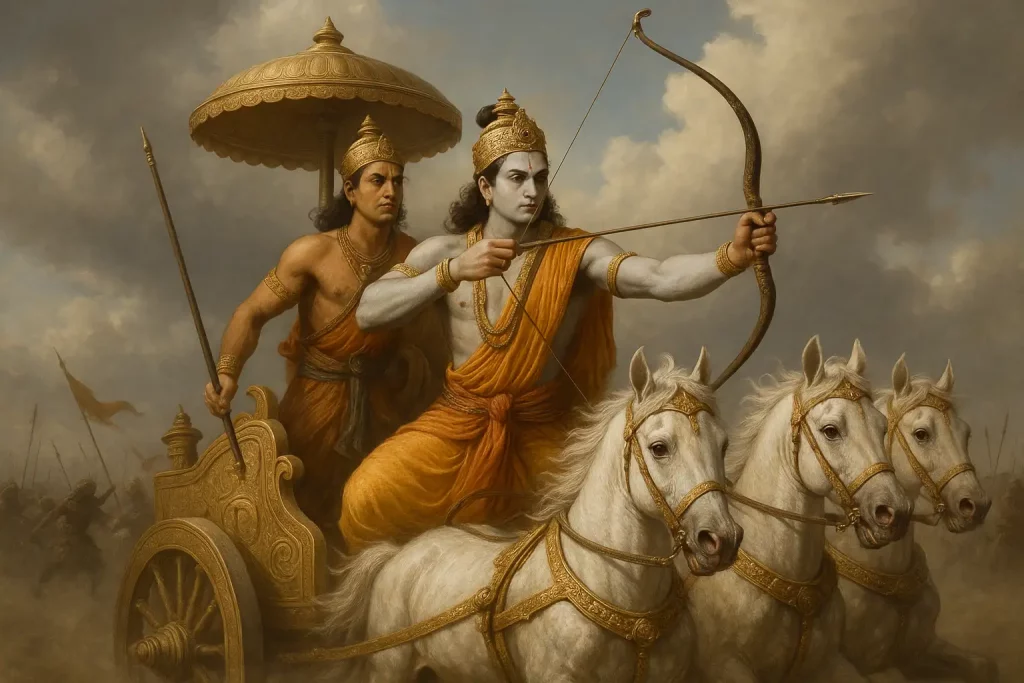
On the way to the immense Daṇḍaka forest, populated by Rākṣasa demons and led by their chief Rāvaṇa, Sītā, his faithful wife, joined him to share his exile. His brother Lakṣmaṇa, unable to be separated from him, joined the couple to live this fourteen-year period in the heart of this magical forest. Thus, accompanied by thousands of Ayodhyā inhabitants, crying and begging Rāma to change his mind, the trio took their first steps towards what would become one of the greatest stories ever written, making Rāma, Sītā, and Lakṣmaṇa heroes for eternity.
The Exile in the Daṇḍaka Forest
For days, they walked south, through a desolate landscape, on barren land once magnificent. The Daṇḍaka forest had become a hostile territory, ruled by Rāvaṇa and his bloodthirsty demons. Sometimes called Daśānana, King Rāvaṇa possessed ten heads and twenty arms, gifts he had obtained from Śiva. Through prayers, sacrifices, and offerings, Rāvaṇa had received a precious asset: he was invincible against all celestial creatures. But in his great arrogance, he had forgotten to protect himself against humans.
Life in Pañcavaṭī
After ten years, Rāma, Lakṣmaṇa, and Sītā arrived at the banks of the Godāvarī River, crossed it, and reached Pañcavaṭī. Beyond lay the fertile forest of Citrakūṭa, still unconquered by demons, where fruit trees, ancient trees, and medicinal plants grew. It was there that Rāma decided to set up his camp. With the help of his brother and wife, he built a hut to await the end of his banishment.
Not far from there lived Jatāyū, a fabulous bird, son of Aruṇa, himself brother of Garuḍa. Appreciating the newcomers, he watched over Sītā while the two brothers went hunting. But this was without counting on Śūrpaṇakhā, Rāvaṇa’s own sister, who, after transforming herself into a beautiful servant, tried to seduce Rāma. He rebuffed her, mocking her, and after seeing her true face, cut off her nose and ears.
The Abduction of Sītā
Śūrpaṇakhā went to complain to her brother Khara, which led to a first skirmish between Khara, his 14,000 warriors, and the two brothers. But the demon army was defeated: Rāma and Lakṣmaṇa were protected by divine weapons. Śūrpaṇakhā then addressed the king of demons, Rāvaṇa, directly to obtain justice. He was very surprised by his brother’s defeat, but even more so to learn that a strikingly beautiful woman, Sītā, lived in the Citrakūṭa forest. He immediately decided to make her his queen and spoke about it with Mārīca, a great magician.
The next day, Mārīca, transformed into a deer with a golden fleece and ruby eyes, approached the camp. After being spotted, he fled into the woods. A long chase separated Rāma from his brother and Sītā. Witnessing the deer’s transformation into Mārīca, Rāma understood that he had been deceived. Lakṣmaṇa, who had remained at the camp, heard Rāma’s voice calling for help. Under Sītā’s pleas, he also left the hut, only to discover that this too was a trap. But it was already too late: with both brothers absent, Rāvaṇa took advantage of their absence to abduct Sītā.
Thanks to a new ruse, he flew away with her on his flying chariot. After fighting and defeating Jatāyū, he resumed his journey back to his kingdom, carrying the now imprisoned princess with him.
The Encounter with Hanumān
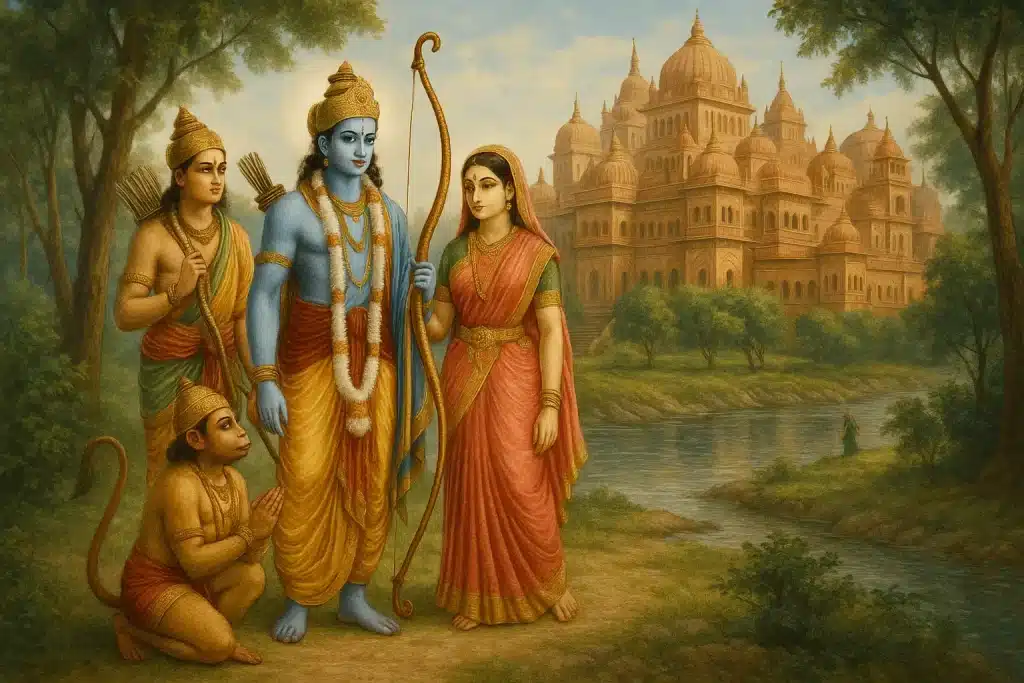
The two brothers set out in search of Sītā, traversing villages and forests for clues. While passing through Kiṣkindhā, the kingdom of monkeys, Rāma met Sugrīva, its king, who promised him help if he helped him reclaim his throne and wife, stolen by his brother, Vāli. Aided by Lakṣmaṇa, Rāma defeated Vāli, restored Sugrīva to the throne, and the latter, as a sign of gratitude, asked the greatest of his warriors to join Rāma: General Hanumān.
Hanumān was the son of the wind god, Vāyu (or Pavana). He had the strength to lift mountains, kill demons, and move faster than Garuḍa himself, Viṣṇu’s mount. Endowed with a noble spirit, Hanumān refused any reward. He only wanted to help find Sītā. An Indian proverb says: “Monkeys cry for others, never for themselves.” Capable of the greatest feats, Hanumān is described by the Indologist John Dowson as having leaped across the ocean to Lanka, uprooting trees, bouncing on clouds, ready for any prowess.
Hanumān in Lanka
Thanks to directions from Jatāyū’s brother, Hanumān managed to locate Sītā, imprisoned in the Aśoka garden, near the royal palace of Lanka. A crossing with the entire army was impossible. But Hanumān, capable of enlarging his body, made a prodigious leap to the island. Resuming human size, he managed to deliver a message from Rāma to Sītā. Subsequently captured by the palace guards, he was condemned by Rāvaṇa to be humiliated. As he could not kill an emissary, the king of demons ordered that the monkey’s tail be set on fire. Hanumān, having grown immense, took advantage of the confusion to set the entire city ablaze before escaping and rejoining Rāma.
The Great War
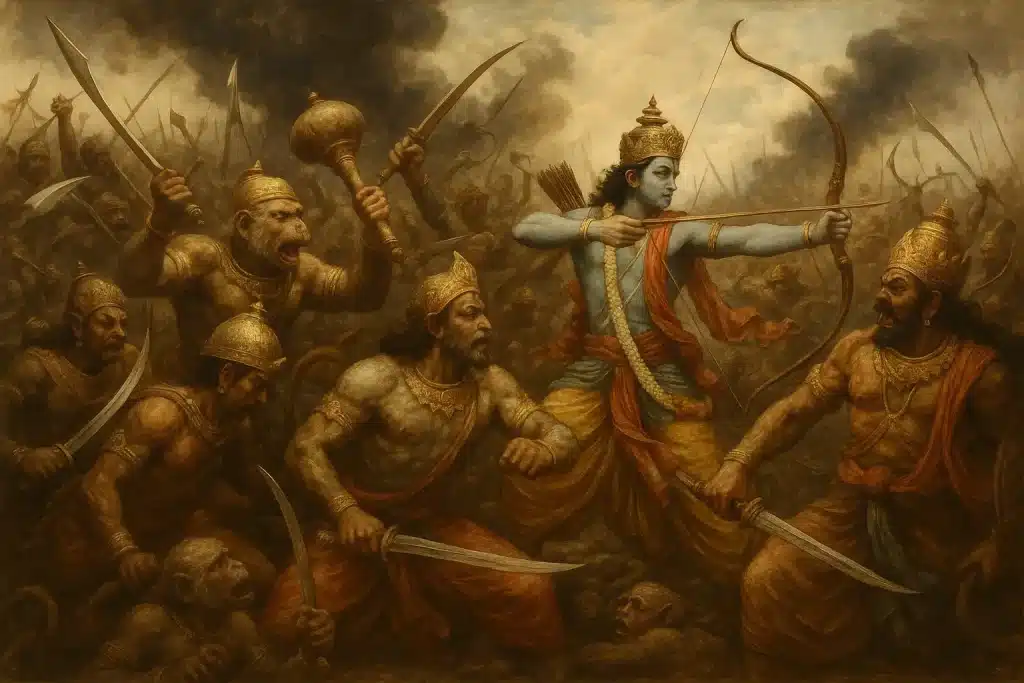
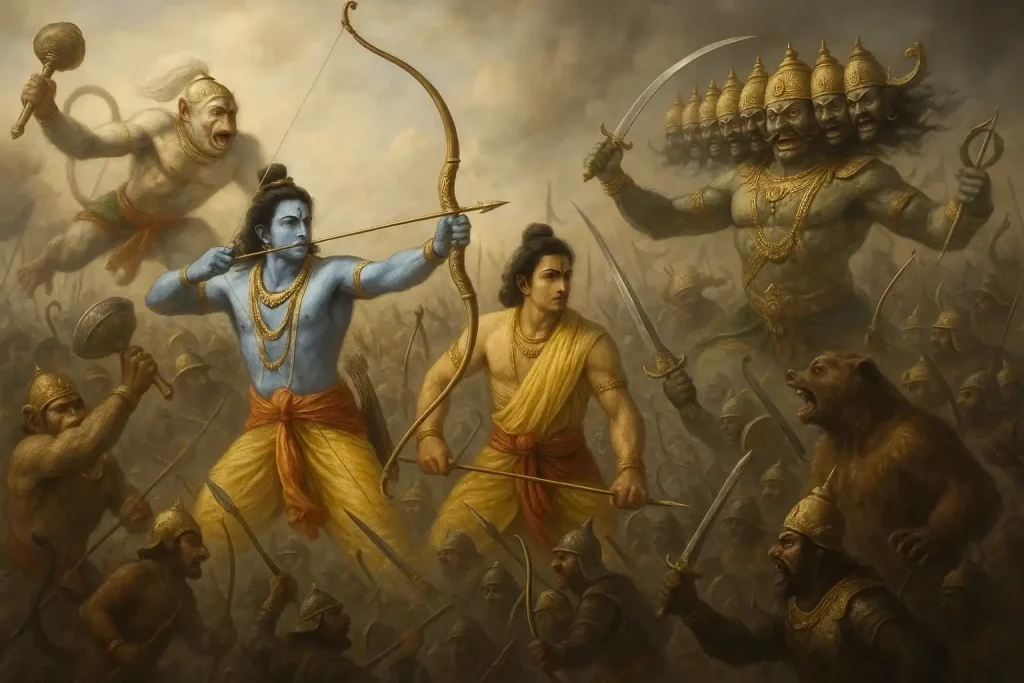
Soon after, Vibhīṣaṇa, Rāvaṇa’s rebellious brother, joined Rāma. Together, and with an army of monkeys and bears, they built a bridge in five days to cross the sea. Once in Lanka, war was declared. It pitted Rāma’s army against Rāvaṇa’s generals and his millions of demons. For each chief killed, another replaced him. Finally, Rāvaṇa, mounted on his chariot, confronted Rāma himself, armed with Viṣṇu’s bow. In a final bloody battle, Rāma pierced Rāvaṇa with infallible arrows. The king of demons was defeated. Sītā, after years of captivity, was finally freed.
Doubt and Sītā’s Exile
But doubt would tarnish this moment of victory. On the way back, in the forest, Rāma tested Sītā: he asked her to cross a pyre to prove her purity. Sītā complied. Back in Ayodhyā, Rāma became king, Sītā queen. But rumors persisted. Fearing for his reputation, Rāma chose to exile his wife again, who was then pregnant. Sītā was sent to the forest, where she gave birth to twin sons.
Years later, Sītā returned to the palace with her children, remaining anonymous. The children sang a poem learned by heart: the Ramayana, the march of Rāma. Hearing his own story, Rāma recognized Sītā and his children, and realized his mistake. He knelt, weeping, to ask for her forgiveness. But Śiva intervened. If Rāma had not been able to believe in Sītā’s love, it was time for her to find peace elsewhere. She opened the earth beneath her feet, which swallowed her, returning her to a better world.
The story does not end there: after ten thousand years of reign in Ayodhyā, Rāma entered the Sarayū River to resume his true and eternal form as Mahāviṣṇu.
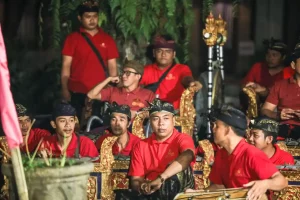
In Indonesia, and particularly in Bali, the Ramayana is much more than a myth: it permeates art, faith, and education. It is found in traditional dances like the Kecak, in temple frescoes, and in sacred theater performances. It teaches essential moral values and sets the rhythm for religious ceremonies. Living and reinterpreted, this narrative guides the Balinese daily, embodying an ancestral wisdom that remains current at the heart of their spiritual and artistic culture. We hope that this discovery of the myth will help you appreciate your stay in the heart of the Balinese islands even more.