 Skip to content



Many travelers ignore or downplay the importance of the Ramayana and Mahabharata poems in Balinese culture. These two fundamental texts, also found in Thailand, Laos, and Malaysia, are ones we invite you to explore before—or even during—your stay in Bali.
Legends are legion in Indonesia, but those of a prince ready to brave a thousand dangers to find his wife kidnapped by the demon king, or of a fratricidal war between the Pandavas and the Kauravas, remain the imaginary pillars that still shape the Balinese landscape: the Ramayana and the Mahabharata.
1. Origin and nature of the two great epics
The precise origin of these two literary monuments remains shrouded in mystery. The most pious Indians say that Ganesha carved the Mahabharata with a single tusk under the dictation of the sage Vyasa; others point out that they are collective works, revised from the 2nd century BC to the 6th century AD, based on an even older oral tradition.
Key takeaways:
- Ramayana: approximately 24,000 stanzas, written in Sanskrit, centered on the exemplary figure of Rama, an incarnation of Vishnu.
- Mahabharata: more than 100,000 stanzas—ten times The Iliad and The Odyssey combined—which detail the conflicts, intrigues, and moral dilemmas of a vast dynasty, and house the famous theological dialogue of the Bhagavad Gita at the heart of Book VI.
These texts are not merely stories; they serve as ethical manuals, political treatises, reservoirs of myths, and aesthetic codes. In this sense, they permeate daily life in Bali far beyond the religious sphere.
2. How did the Indian epics reach Bali?
Between the 4th and 11th centuries, maritime trade linked India, the Malay world, and the Indonesian archipelago. Priests, scholars, and artisans traveled with the ships; they carried these stories in their luggage, gradually adapting them to local languages, animist beliefs, and emerging kingdoms.
In Bali, Hinduism became the matrix of a society of castes, temples oriented mountain-to-sea, and a dense ritual calendar. The two epics then served as references:
- Symbols: Vishnu on the eagle Garuda, Hanuman the white monkey, Arjuna the archer—icons that would later be found in stone or wood.
- Proper names: many Balinese of the warrior caste are named Rama or Arjuna today, proof that the heroes have transitioned from myth into social life.
- Ritual language: Balinese kakawin—poetry in Old Javanese—rewrites entire episodes for the needs of court rituals.
3. The Ramayana: the quest, exile, and the ideal of dharma
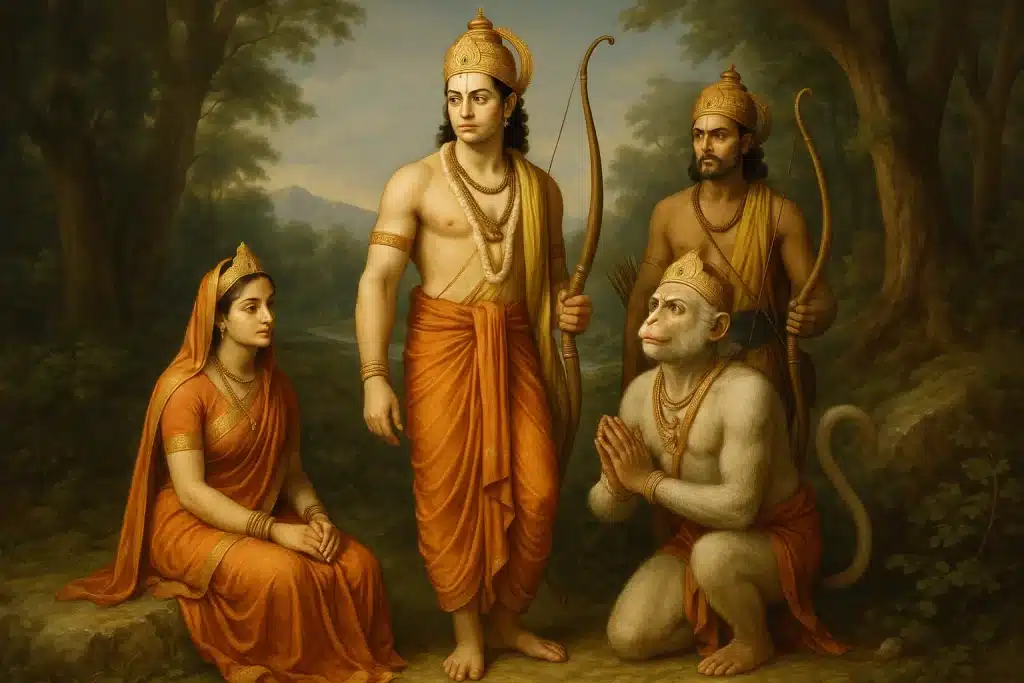
- The kidnapping of Sita by the demon-king Ravana is not just a simple abduction: it symbolizes the rupture of the cosmic order.
- Rama, a virtuous prince, accepts his exile without betraying his oath; he embodies ideal righteousness in the face of adversity.
- Thanks to Hanuman and the monkey army, a stone bridge is cast across the ocean—a union of the natural world and human will.
- The defeat of Ravana restores balance, but Rama must still justify Sita’s purity: the epic thus questions masculine ethics and feminine dignity.
Why do these scenes resonate in Bali?
- Temples dedicated to Rama-Vishnu recall the ideology of the priest-king, once regarded as the guarantee of the “theater state” described by Clifford Geertz.
- At the kecak theater in Uluwatu, rows of singers imitate Hanuman’s horde; knowing the story amplifies the dramatic intensity of the performance.
- Roundabouts from Denpasar to Gianyar feature giant statues of Rama shooting his arrow: a political metaphor for vigilance against chaos.
4. The Mahabharata: loyalty, betrayal, and moral dilemma
The rivalry between the five Pandava brothers and their hundred Kaurava cousins leads to the great Kurukshetra War. If we set aside the thousands of verses dedicated to battles, three moments suffice to understand the Balinese impact:
- The dice game: Yudhishthira loses his kingdom, then his own wife—a reminder of the danger that greed and arrogance represent for the Balinese head of the family.
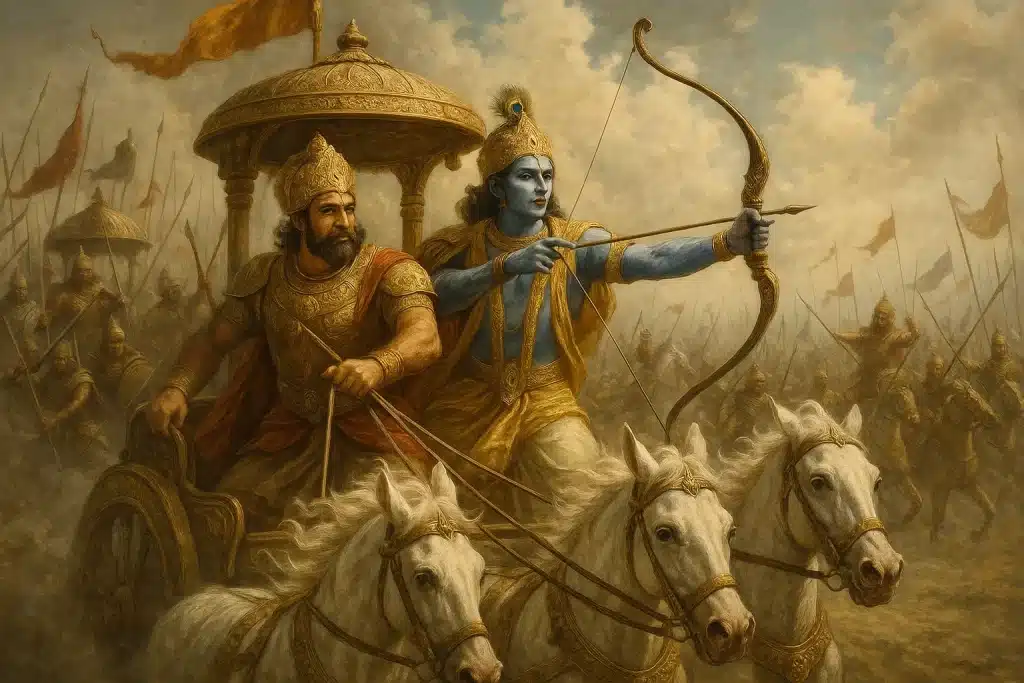
- The Bhagavad Gita: Arjuna hesitates before fighting his relatives; Krishna exhorts him to act according to his duty—a key concept (dharma) that structures the Balinese hierarchy.
- The final victory: the Pandavas survive, but the price is heavy. The epic preaches lucidity: even right action leaves scars.
Traces in the cultural landscape:
- At Tirta Gangga, the pools are guarded by Bhima and Ghatotkacha—a reminder of physical strength and filial loyalty.
- The wayang kulit plays often choose the cunning Krishna as the supreme puppeteer; the underlying lesson: behind the beauty of the shadows, the true light comes from enlightened speech.
- In the wayang wong dance repertoires, the scene of Ghatotkacha’s decapitation highlights the value of sacrifice in Balinese rites of passage.
5. Why do these texts matter to you, the curious traveler?
- Understanding the imagery. Without the Ramayana, a giant white monkey at a crossroads remains just a “big monkey.” When you know Hanuman, you see a strategist, an ascetic, a bridge between man and animal.
- Reading the temples. The bas-reliefs of the Elephant Cave sanctuary in Bedulu are not just decoration; they reenact the struggle between good and evil.
- Engaging with the Balinese. Quoting Arjuna to your driver opens a conversation about justice or family; you transition from the status of a tourist to that of an exchange partner.
- Gauging local ethics. The notions of dharma (duty), karma (consequence), and lila (divine play) drawn from the two epics structure ceremonies, from royal cremations to simple daily offerings.
- Putting the notion of “paradise” into perspective. The Indian tales remind us that even heroes suffer, make mistakes, and atone. Bali, despite its aesthetics, teaches the same wisdom: beauty coexists with pain, light is understood through shadow.
6. Reading or listening tips before (or during) a trip to Bali
- Reading an abridged version—such as those by Daniélou for the Ramayana or P.-S. Filliozat for the Mahabharata—is enough to grasp the plot.
- Watch the animated film Sita Sings the Blues (available free online) to immerse yourself in the bittersweet satire of the Ramayana.
- Listen to the podcast by Indologist Devdutt Pattanaik; his short episodes illuminate each protagonist as a psychological archetype.
- Tuck a booklet of Balinese icons into your suitcase: Hanuman, Rama, Sita, Arjuna, Krishna. Recognizing them in situ becomes a cultural treasure hunt.
Conclusion: Two epics, a hundred gateways to Bali
Without the Ramayana and the Mahabharata, Bali would lose its imaginary backbone. Every procession, every masked dance, every door ornament pulls a thread back to these founding stories.
Knowing them means:
- Strengthening your critical perspective rather than collecting clichés;
- Respecting a living heritage rather than merely sampling exotic curiosities;
- Feeling the intimacy between myth and daily life in a society that never separates the sacred from the mundane.
In short, if you are planning a trip to Bali—whether it is a simple relaxing family stay, a themed tour in Bali, or a broader exploration of Indonesia—take the time to leaf through these two epics.
You will never again look at a statue of Hanuman or a Barong mask as a mere decorative object; you will see the persistent trace of millennial stories that still speak to the very current dilemmas of loyalty, justice, and the search for meaning.