 Skip to content



Historical origins of this Balinese tradition: when fire opens the soul’s path
In Balinese Hinduism, death is seen as a simple stage in samsara, the cycle of rebirths. To free the soul (atma) from the body and help it join its ancestors (pitra), the five elements—water, fire, air, earth, space—that make up the body must be definitively separated. This “dissolution” takes the form of Ngaben (“to turn to ashes”).
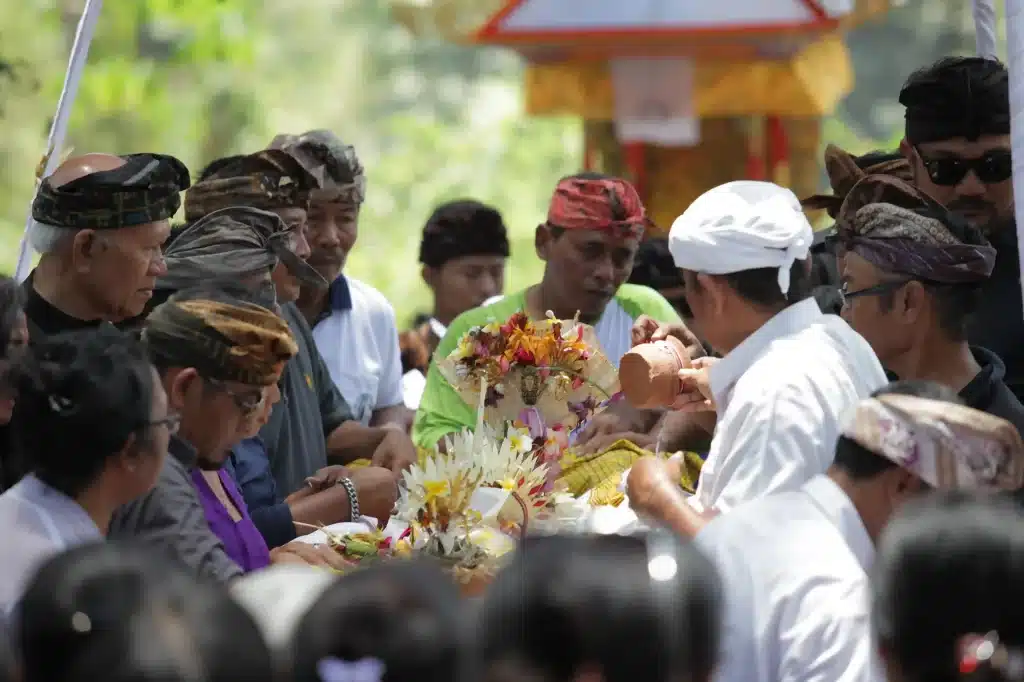
Old Balinese inscriptions (9th–11th centuries) already mention the practice: during royal funerals, several bade (cremation towers) were used to burn the sovereign and his favorite wives. Dutch archaeologist H. Kern notes that in the Gelgel kingdom’s Geligit era (15th century), concubines and honor warriors were sometimes sacrificed: each offered a final service by voluntarily entering the blaze, after releasing a dove symbolizing the soul. French orientalist G.-P. Rouffaer reports that in 1689, at the funeral of a prince of Klungkung, eleven women chanted a farewell mantra before throwing themselves into the flames.
These acts, inspired by the Indian satī, disappeared in the 19th century under pressure from the Dutch authorities and Balinese reformers such as Ida Pedanda Made Sidemen; the white dove is now replaced by a palm-leaf bird figurine that the officiant releases symbolically.
Structure of a Ngaben, a contemporary rite
Exploring Bali, whether as a family or alone, still offers the opportunity to attend these cremations—modernized, certainly, but still spectacular. They take place in five stages:
Ngening – waiting period
For lack of immediate funds, the family may keep the deceased in a temporary grave or mummified in the home (for up to several years in mountain villages). Anthropologists Clifford and Hildred Geertz note that a lull in the agricultural calendar is often used to organize a collective cremation, reducing costs.
Pembuatan bade and lembu – construction
- Bade: multi-tiered funeral tower, up to 25 m for royal lineages.
- Lembu: bull-shaped sarcophagus (linked to Shiva).
Carpenters and decorators compete; an average adult costs around IDR 50 million, while a prince can exceed IDR 3 billion.
Prosesi pengusungan – procession
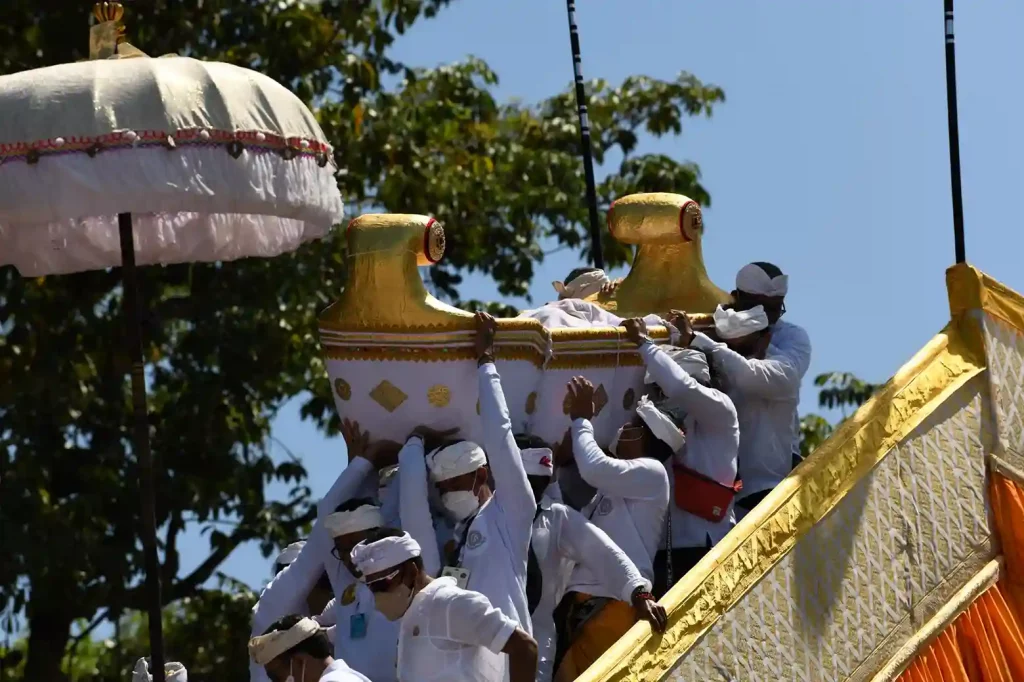
The tower is carried by dozens of men; at each crossroads (a favorite place for demons), they suddenly turn three times to throw off negative spirits. The women lead the way, placing segehan on the ground.
Pembakaran – cremation
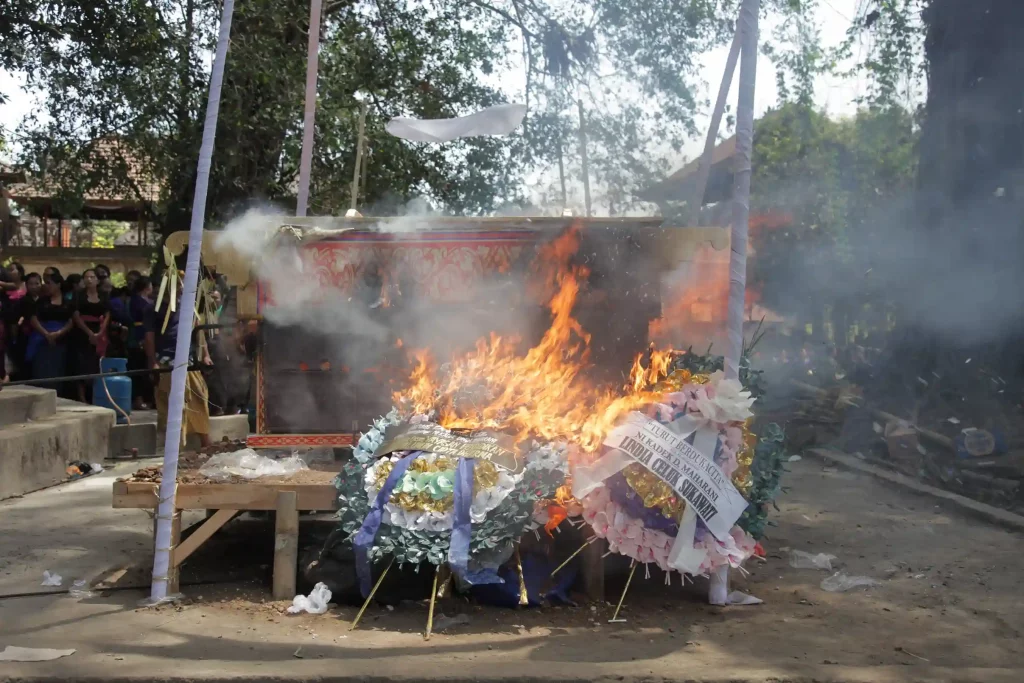
After a final farewell, the body is transferred from the bade to the lembu. The Brahmin priest pours tirtha (holy water), then a gas torch replaces the wood fire of the past. The public keeps its distance but may take photos—discreetly.
Ngasti and nyekah – purification and the sea
The next day, the family collects the remains, crushes them, and disperses them into the ocean. In Sanur or Petitenget, these white processions can regularly be seen bathing at dawn.
Organizing funeral rites in Bali: who pays, who decides?
- The nuclear family pays the personal share (around 30% of the budget).
- The banjar (neighborhood council) provides labor, gamelan instruments, and the coordination tent.
- The subak (irrigation cooperative) sometimes suspends water to free up rice fields for the procession route, especially if you are traveling as a family in Bali in July–August.
- The pekaseh checks that the date does not conflict with agricultural work.
The exact day is chosen by a Brahmin priest using the pawukon almanac; dark cycles (Tilem) are avoided, and the bright days of the Sasih lunar calendar are preferred.
Visitor etiquette: can you attend the Ngaben rite?
Yes, provided you follow four rules:
- Attire: sarong, sash at the waist, shoulders covered.
- Distance: never obstruct the procession; photos without flash.
- Offering: a small canang sari is sufficient, handed to the committee at the entrance.
- Language: avoid loud laughter and never touch the priest.
To plan your trip to Bali around a public Ngaben, keep an eye on local newspapers (Bali Post) or ask your guide. The Ubud, Klungkung, and Bangli areas are the most active.
Key points for Amanaska travelers
When to go to Bali to see a cremation?
During the dry season (May–October): more processions, passable roads.
Is it suitable for a family trip?
Children can attend; prepare them for the smell of smoke and the sound of gamelan.
Specialized tours and stays in Bali: some agencies offer a “Old Balinese religion” day including a Ngaben (voluntary donation required).
Symbolic aspect: why burn?
Fire releases the elements but also serves to erase physical identity, preventing the soul from clinging to the past. Michel Picard, a historian of tourism, reminds us that Ngaben is as much for the living as for the deceased: “Cremation turns a painful event into a community spectacle, binding society together around a rite of passage.”
Cremation, a Bali tradition that reflects a living heritage
Attending a Balinese cremation is not macabre voyeurism, but a discovery of Bali at its deepest: the collaboration between village, family, and divinity.
For those who want to discover Bali beyond its beaches, understanding Ngaben sheds light on the values of solidarity, shared beauty, and faith in the cycle of life.
Whether you dream of an immersive stay in Bali or are planning to visit Bali simply out of curiosity, take the time—if the opportunity arises—to observe this rite. You will leave with a lesson in culture, respect, and balance: in Bali, even death forms a bridge between people, the gods… and the sea.