 Skip to content



Melasti, a Balinese tradition that intrigues and fascinates in many ways.
Have you ever seen an entire village close its shops at dawn, load its statues onto flower-adorned stretchers, then walk in silence to the ocean?
Why, three days before the Balinese New Year, do thousands of men, women, and children drop everything to immerse their gods in salt water—as if the sea held the key to a massive “reset” button?
“In Bali, religion is not what people believe, but what they do together.” — Clifford Geertz, Religion of Java.
What does this “great spiritual cleansing” called Melasti truly mean?
Where does the ritual come from, how is it organized, what can you see (and not see) from the beach? Can you participate during a trip to Bali or a family tour without being disrespectful?
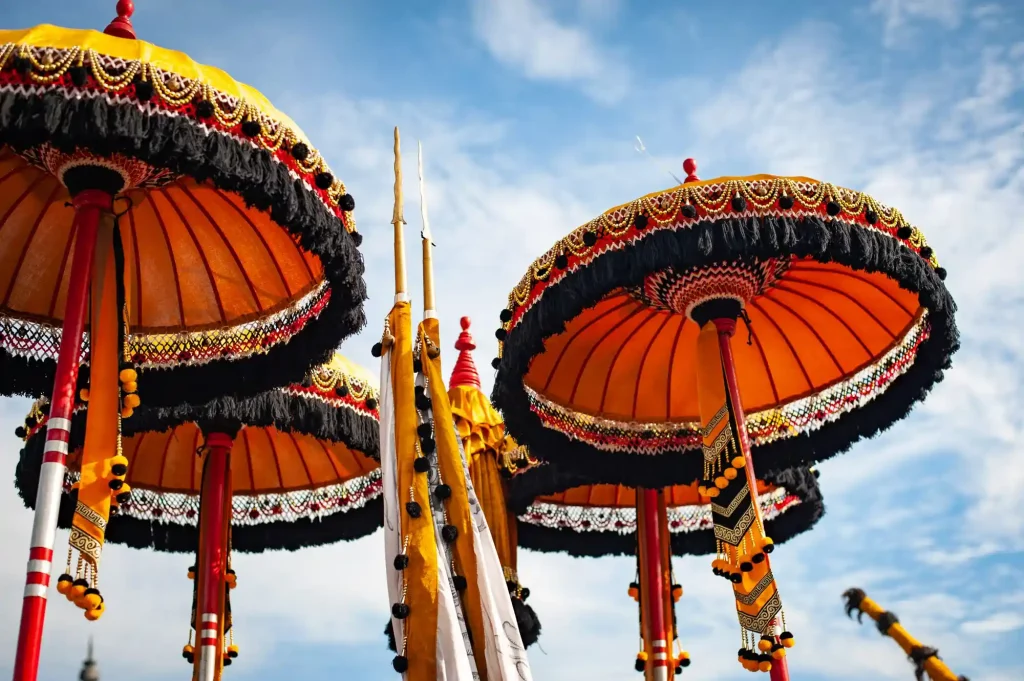
Even before your stay in Bali, you will discover here the historical origin of Melasti, its ancient calendar, the symbolism of white parasols and colorful gebogan, as well as the crucial role of Pura Ulun Suwi temple and the Mapag Toya prayer.
Ready to understand why Bali purifies itself before immersing in 24 hours of silence? Let’s dive in together: the sea is already awaiting its offering.
Religious Origin: From Ancient India to the Bali-Hindu Calendar
Melasti (sometimes spelled Melis or Melasti Mekiyis) is the purification ceremony that precedes Nyepi, Bali’s silent New Year.
The reference Hindu texts—primarily the Javanese Tantu Pagelaran (14th century) and the Balinese Lontar Dewa Purana Bangsul—already describe a ritual of “bringing back the sacred sea” (segara amerta) to the village to renew cosmic balance.
According to ethnologist Clifford Geertz, this liturgy migrated from South India in the first millennium, then adapted to the island’s geographical constraints: almost every kingdom bordered the ocean or a crater lake, both sources of “water of life.”
In the Saka lunar calendar, Melasti falls three days before Nyepi, during the month of Kesanga (March-April).
This date is never modified: it is believed that the world’s reset must strictly follow the astral rhythm, or risk weakening the purifying power of the New Year.
The Procession: Setting an Entire Village in Motion
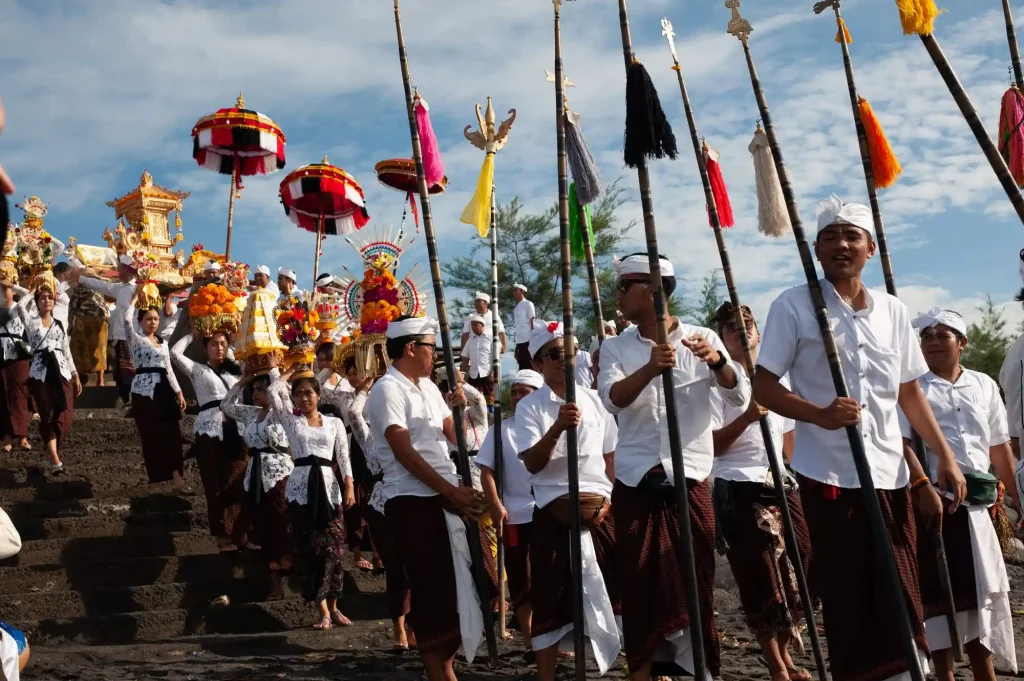
In current practice, Melasti begins before dawn. The residents of the banjar (neighborhood council) gather at the village temple (Pura Desa). Brahmin priests prepare the sacred objects: miniature thrones, barong, ancestral kris, statuettes (pratima) representing tutelary deities.
Everything is wrapped in white cloth: white indicates that good (dharma) precedes the march.
Around six o’clock, the procession sets off. At the front:
- a white and gold parasol, symbol of Shiva Purusa;
- a black flag, recalling Vishnu and the continuity of life;
- a kendang drum setting the rhythm for the bearers.
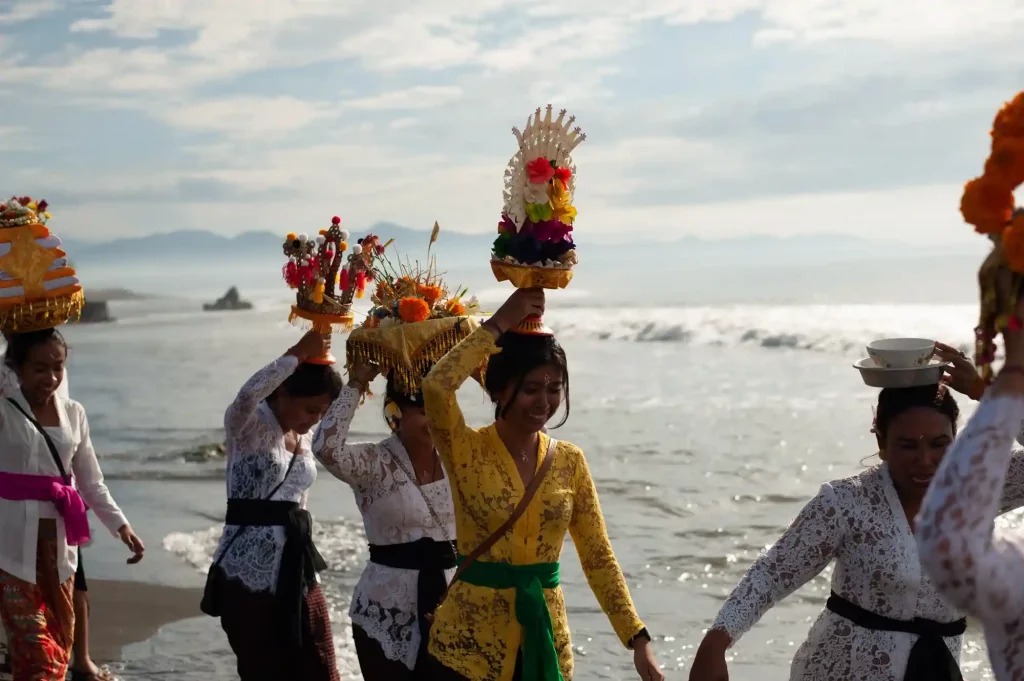
The sacred objects are placed on tall stretchers. Men take turns every hundred meters; women carry on their heads offering trays (gebogan) composed of fruits, yellow rice, and jaja cakes, carefully stacked in a cone shape.
In coastal areas—Kuta, Sanur, Nusa Dua—the procession takes the main road, blocked by police. Inland, they walk toward a lake or spring: in the village of Tegalalang (north of Ubud), they descend to the water reservoir of Pura Tirta Empul; in Kintamani, they reach the shores of Lake Batur.
Rituals at the Water’s Edge: Contact, Immersion, Return
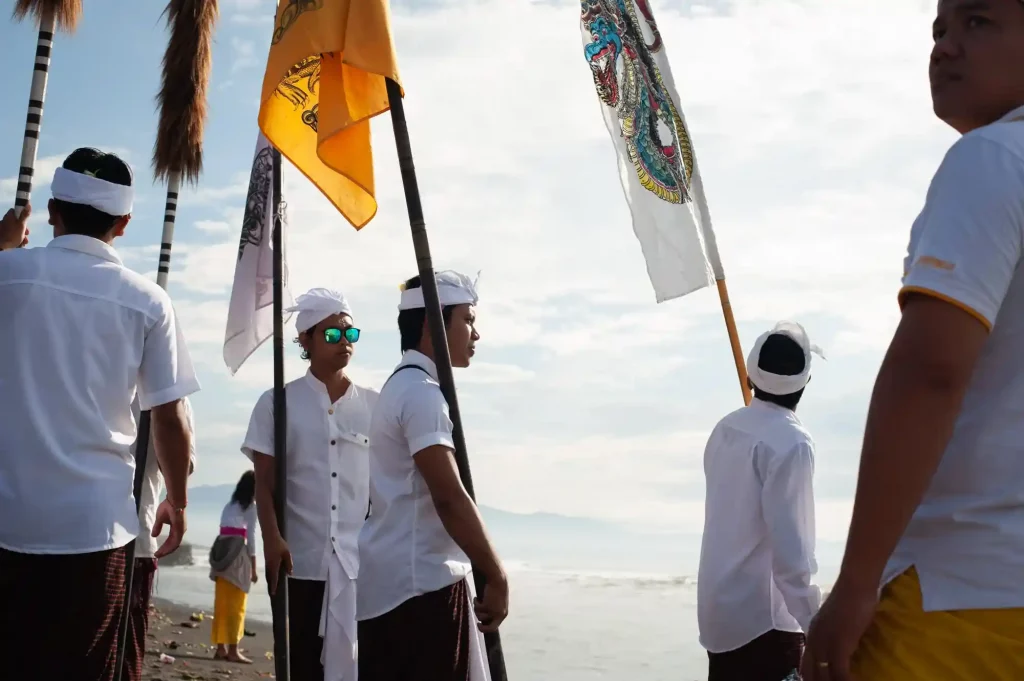
Upon reaching the shore (or spring), the head priest sets up an offering table facing due east. Three acts structure what follows:
Nunas Tirta Segara
The priest fills three containers with seawater (or lake water), traces the sacred character Om with turmeric, and recites the Trimurti mantra. The water is considered the essence of Tirtha Amerta, the drink of immortality.
Pembersihan Pratima
Each effigy or kris is sprinkled with fresh water, then wiped with a yellow cloth. The operation is concrete: dust, traces of ointments, or insects are actually removed. The belief is that the gods only dwell in clean symbols.
Melarung (Casting Offshore)
Small baskets containing wilted leaves, fallen petals, or worn fabric scraps are thrown into the sea—”the impure part.” A young man often swims a few meters to carry this bundle beyond the surf; he represents the departure of impurities toward infinity.
After the prayers, a distributor pours three drops of sacred water into each worshiper’s palm: two are drunk, the third is passed over the forehead.
The group then takes the road back, to the high-pitched sound of the suling (flute): the outward journey was dominated by masculine drums, the return gives way to softer music, a sign of a pacified spirit.
Symbolism and Social Importance
For the Balinese, Melasti has three complementary objectives:
- Purify the material universe: by washing statues and kris, “dust” is eliminated—that is, negative vibrations accumulated over 210 days.
- Renew the community bond: all the logistics—preparing offerings, carrying stretchers, shared cooking—mobilize the banjar. Tourism sociologists, led by Michel Picard, emphasize that this collective work reaffirms village solidarity.
- Mentally prepare for Nyepi: the walk, sea air, and light fasting (only vegetarian snacks are consumed) constitute a spiritual transition before the day of absolute silence.
In the Tri Hita Karana doctrine, Melasti balances the relationships Human–Divinity (through prayer), Human–Nature (through conscious return of water), and Human–Human (through shared work).
Modern Organization: Chants and Road Safety
Since the 1990s, provincial authorities have coordinated traffic: a free shuttle service drops off processions from Denpasar on the beaches of Sanur or Kuta before nine o’clock to avoid traffic jams. Municipal loudspeakers broadcast announcements in Balinese and Indonesian, reminding tourists to stay behind the barriers.
With schools closing the day before, teenagers join their voices to the Sekaa Shanti (religious choir); they recite verses from the Bhagavad Gītā throughout the march.
Since 2015, several villages have introduced collection bins to prevent offering baskets from polluting the sea—a compromise between tradition and ecology.
Key Points for the Amanaska Traveler’s Itinerary
In creating our local travel agency in Bali, we wanted to share with as many people as possible the incredible richness of Balinese culture and traditions. Melasti is certainly one of those moments we love to help you discover.
- When to Visit Bali to See Melasti?
Check the date of Nyepi (the Balinese New Year changes each year); Melasti falls three days before. - Discovering Bali with Family
The walk lasts between 30 minutes and 2 hours. Bring a hat and water, but know that there are no shouts or shocking scenes. - Organizing Your Trip to Bali
If you are staying in Ubud, head to Masceti Beach (15 km); in Seminyak, Petitenget Beach is the arrival point for four local banjar.
What Conditions Apply to Attend the Melasti Ritual?
Visitors are welcome if they:
- wear a sarong and sash (priests often lend the equipment for a voluntary donation);
- avoid obstructing the flow, especially during rotations at intersections;
- never touch the effigies or women carrying the gebogan;
- remain discreet during prayers (avoid drones and flash photography).
Photography is permitted; it is better to ask for a smile of authorization from a bearer.
To capture the sonic dimension, record a few seconds of gamelan: the pounding of the kendang is distinctive.
Notable Melasti Ceremonies in Recent Years
- Sanur Melasti (2017): 25,000 participants, four coastal villages united; Italian tourist Chiara Favilli filmed a viral sequence with 2 million views.
- Tabanan Melasti (2020): first entirely “zero plastic” procession—compostable baskets, cups made from banana leaves.
- Royal Ubud Melasti (2023): the sacred objects of Puri Saren palace were moved in a seven-tiered bade, escorted by the traditional Pecalang guard.
Conclusion: Why Melasti Remains a Central Tradition for Balinese Identity
At first glance, Melasti is a simple ritual walk to the sea. But upon closer examination, it is a concentrate of Balinese culture: collective engineering (route planning), aesthetics (parasols, gebogan), theology of the triad (water, prayers, offerings), and community pedagogy (children repeat the mantras).
For travelers who truly wish to discover Bali, attending Melasti illuminates the strength of a social system capable of mobilizing an entire village without police enforcement, simply through religious duty and a sense of harmony.
The next day, when Nyepi plunges the island into silence, one will then understand that this apparent calm is not a suspension of life, but the culmination of a perfectly oiled collective machine… purified by the sea.