 Skip to content



Balinese ceremonies: between grandeur and intimacy during a trip to Bali
In Bali, you might walk past an offering without paying attention… then, after a few days, realise you have seen them everywhere:
- at the foot of a tree
- in front of a shop
- on a scooter
- at the entrance to a house
- at the edge of a crossroads
And then one thing becomes obvious: here, the sacred is not reserved for temples.
It spills out into the street, into the kitchen, into the organisation of time, and into the way people live together.
That is also why many travellers misread what they are seeing.
They see ceremonies the way they would watch a show:
- costumes
- music
- processions
- flowers
- smiles
Whereas, from a Balinese point of view, this is not entertainment.
It is a social and religious language.
A system that connects:
- people
- ancestors
- invisible forces
- the community
… in everyday life.
And this system has two faces:
- grandeur, what is visible and brings people together
- intimacy, what is repeated and anchors everyday life
Researchers who work on Bali also explain very clearly that Balinese religion is understood first and foremost through practices and ritual gestures.
For many travellers who come to discover Bali, understanding this logic completely changes the way they look at ceremonies.
Understanding ceremonies during a trip to Bali: a religion that is practised
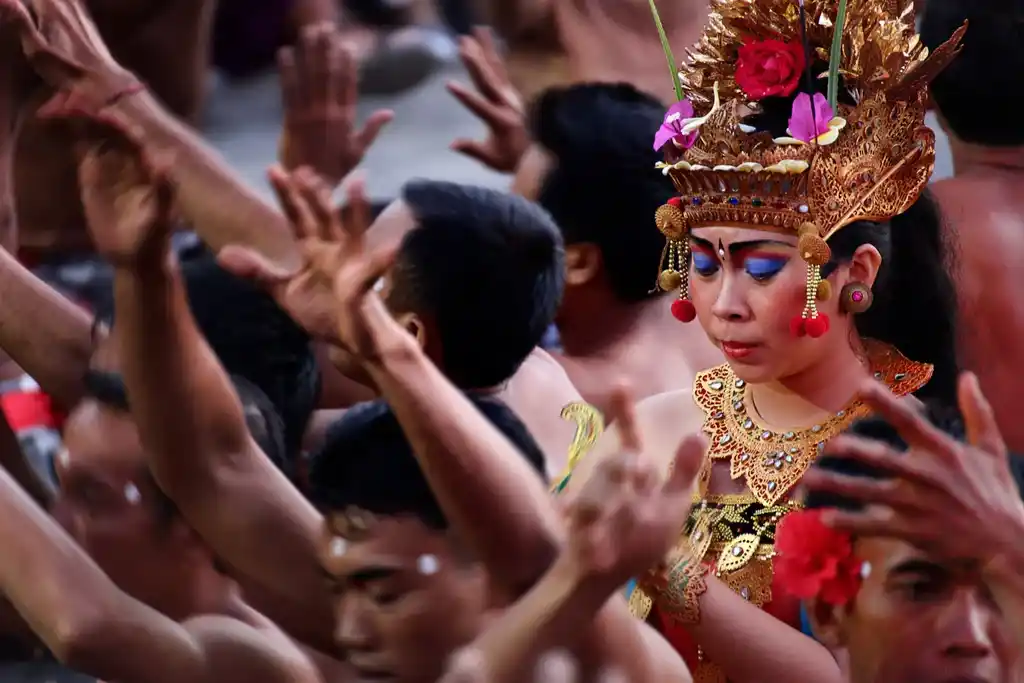
In studies on Balinese Hinduism, visitors are often described as struck by:
- the frequency of rituals
- their aesthetic dimension
- the constant involvement of local people
This is not anecdotal.
Ethnobotanist Wawan Sujarwo and his co-authors point out that Balinese attention focuses strongly on the correctness of ritual behaviour—orthopraxy—more than on doctrinal orthodoxy.
A very useful framework for understanding ceremonies is called Panca Yadnya.
It brings together five major families of rites.
Without turning this into a theology lesson, here is the essential:
- Dewa Yadnya: ceremonies for the gods and temples
- Pitra Yadnya: rites linked to ancestors and cremations
- Manusa Yadnya: rites linked to the stages of human life
- Bhuta Yadnya: rites of balance with invisible forces
- Rsi Yadnya: rites linked to priests and religious transmission
For travellers who wish to go to Bali, this framework helps to understand that ceremonies touch family life as much as major collective events.
Balinese grandeur: when ceremonies become visible during a Bali holiday
Balinese grandeur is real.
And it is intentional.
Anthropologist Clifford Geertz showed that ritual staging can also express the Balinese social and symbolic order.
In major ceremonies:
- the streets are decorated
- families wear traditional outfits
- offerings become more elaborate
- music accompanies the processions
And above all:
The whole community takes part.
The temple as the centre of gravity of Balinese life
Many ceremonies are organised around the temple.
But the preparations go far beyond the temple itself.
People cook.
People prepare the offerings.
People rehearse the music.
Tasks are assigned.
Studies on the Balinese calendar also remind us that the Pawukon, a 210-day cycle, plays a central role in organising ritual cycles.
That is also why, somewhere on the island, something is almost always happening.
Odalan: temple ceremonies discovered during a trip to Bali
Odalan corresponds to the ritual anniversary of a temple.
Many odalan follow the Pawukon cycle and therefore return every 210 days.
For travellers, it is often the most spectacular moment:
- processions
- music
- crowds
- monumental offerings
But this grandeur is above all an offering and a community act.
During a trip to Bali, attending an odalan often helps to understand the central place of the temple in local life.
Ngaben: an impressive rite during a stay in Bali
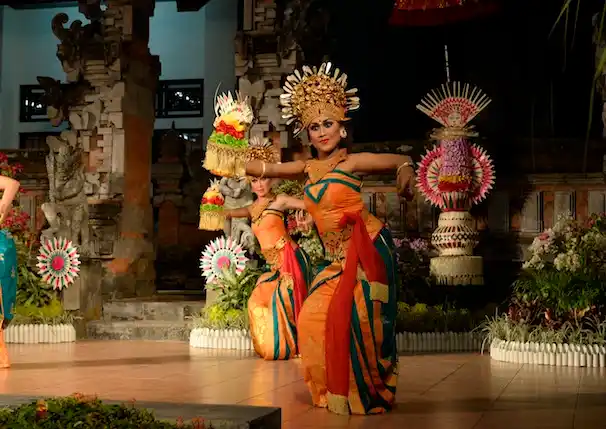
The Balinese cremation rite, called ngaben, belongs to the ancestor rites, Pitra Yadnya.
In the tourist imagination, it is often the big spectacular ceremony.
Yet anthropological sources remind us that it is first and foremost a family, community, and spiritual moment.
Yes, it is impressive.
But it is not organised like a show.
During a family stay in Bali, understanding this completely changes the way you look at these ceremonies.
Daily offerings: the intimate Bali discovered differently
Alongside the big processions, there is another Bali:
- a person alone placing an offering
- incense lit at daybreak
- a discreet gesture of respect
This is probably the truest image of the island.
Balinese offerings: an everyday language during a Bali holiday
An academic article by Richard Fox asks a simple question:
Why do Balinese people make offerings?
His answer is interesting:
Offerings do not have a single function.
They can be:
- religious
- social
- relational
- protective
- community-based
Small daily offerings, often called canang sari, are an integral part of Balinese life.
Going to Bali—it is often these tiny gestures that reveal local culture most deeply.
Sekala and Niskala: understanding Bali differently through the visible and the invisible
An essential ethnographic distinction exists between:
- sekala, the visible world
- niskala, the invisible world
Academic work explains that rituals and offerings serve precisely to connect these two dimensions.
This idea helps to understand why the sacred seems present everywhere in Bali.
The boundary between everyday life and ritual is far less separated there than in the West.
The banjar: what holds Balinese ceremonies together
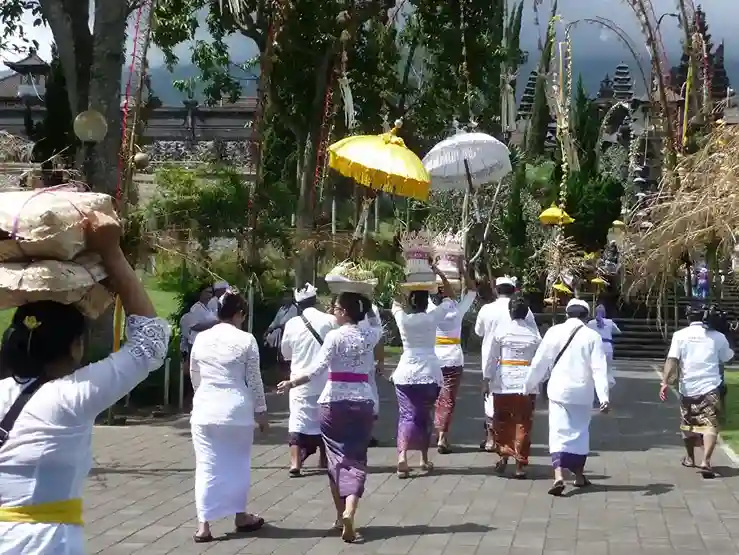
Grandeur and intimacy both rest on the same structure:
The community.
Recent research describes the banjar adat as a neighbourhood organisation based on shared social and ritual responsibilities.
Other studies also highlight the importance of local customary rules, the awig-awig.
Without this community organisation, it would be impossible to maintain such an intense ceremonial rhythm.
How to observe ceremonies respectfully during a trip to Bali
The main rule is simple:
A Balinese ceremony is not an Instagrammable moment.
It is a moment of connection and respect.
A few essential habits:
- respect sacred spaces and processions
- wear appropriate clothing in temples
- use a sarong and sash when requested
- avoid stepping on offerings
- ask before photographing people up close
- keep some distance during prayers
For travellers who go through a travel agency in Bali, understanding cultural rules often makes it possible to experience these moments with far more depth and accuracy.
In short, the real luxury in Bali is understanding what you are looking at
Balinese grandeur immediately catches the eye.
But Balinese intimacy touches you differently.
It reveals an island where the sacred is lived as a way of maintaining connection:
- with the gods
- with the ancestors
- with the community
- with the invisible world
Researchers who study Bali remind us that ceremonies are not isolated events, but a thread that organises time and social life.
And that is exactly why simply seeing Bali is not always enough.
You also have to learn to feel what you see.