 Skip to content



You can come to Bali at any time of year… but you will not experience the same island depending on the season, the region and the altitude.
And if you are planning a trip to Bali, especially with family, this is exactly the kind of detail that makes the difference between “we loved it” and “we endured the heat, the rain or the driving times”.
As a local travel agency based in Bali, we are particularly well placed to explain:
- how Bali’s climate works
- what the seasons change
- why the terrain—volcanoes, mountains and coasts—directly influences your experience
1) Bali’s climate: understanding a tropical island before you stay there
Bali is close to the equator: this means warm temperatures all year round, high humidity, and seasonal variations mainly linked to monsoon winds.
Some sources indicate typical temperatures of around 20 to 32°C depending on the areas and periods, with humidity often high.
The takeaway is simple:
- you are not going to look for “summer”
- you are mainly going to choose between less rain or more rain
- and between the coast or higher altitude
For travellers who want to go to Bali, understanding this nuance changes a lot when planning the itinerary.
2) The two main seasons during a trip to Bali
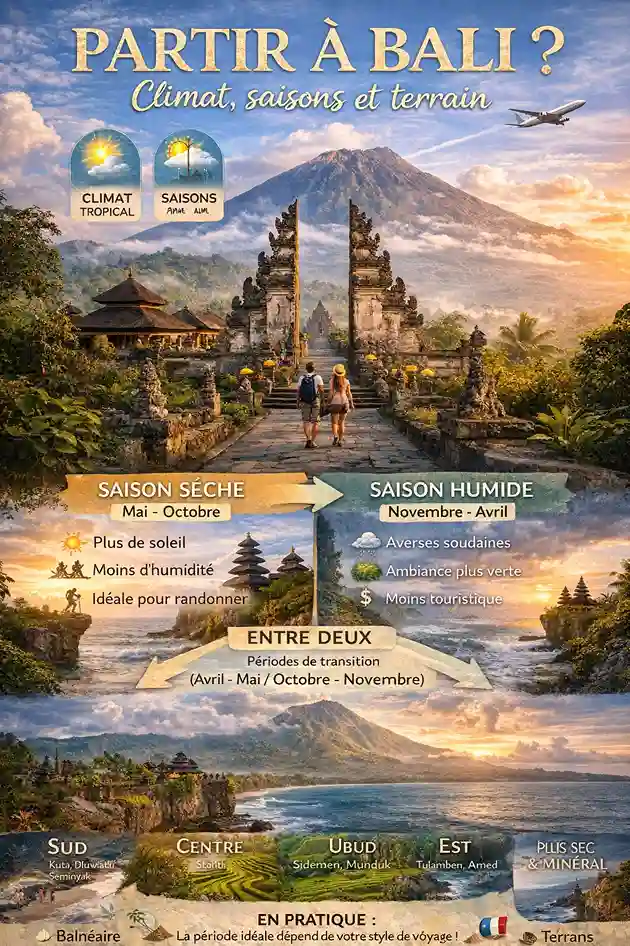
The dry season (generally from May to October)
Several sources describe the southeast monsoon period as the driest, broadly between May and November.
In real travel terms, this often means:
- fewer showers
- a less heavy feeling
- more stable days for getting around, hiking or linking stages
The wet season (generally from November to April)
It is monsoon season, so it can rain heavily… but not necessarily all day.
A common description mentions intense, sometimes sudden downpours, alternating sunshine and rain.
To give you an idea, some climatological data indicate around 1,700 mm of rain per year in Bali, with a peak between December and February.
3) Dates change from year to year, an important point for discovering Bali
If you are looking for a fixed rule like “from May 1st the weather is nice”, you may be disappointed.
The seasons in Bali remain relatively regular, but the transition between the dry season and the wet season can vary.
The most reliable approach is still to consult the official BMKG bulletins, the Indonesian weather agency.
For travellers coming to discover Bali with specific constraints—baby, pregnancy, long drives or hikes—checking the weather trend before departure can really help avoid unpleasant surprises.
4) The transition months, often the best compromise for a holiday in Bali
In practice, many successful stays take place during the transition periods:
- end of the wet season around April or May
- end of the dry season around October or November
Why?
Because you often get:
- beautiful light
- fewer crowds
- greener vegetation
- an overall pleasant climate despite a few possible showers
It is often an excellent strategy for enjoying a holiday in Bali that is more balanced and less touristy.
5) Bali’s volcanic terrain creates microclimates
You understand Bali better when you see its backbone: an island shaped by volcanic relief.
The volcanoes that structure the island:
- Mount Agung rises to 3,031 metres
- Mount Batur reaches 1,717 metres
- the Batur UNESCO Global Geopark region lies between around 920 and 2,152 metres above sea level
Why does this matter?
Because altitude changes:
- temperature
- fog
- rainfall
- fatigue
- travel times
6) Climate by region: the best season also depends on your Bali itinerary
South coast: hotter and more humid
Around Denpasar and the coastal areas, you are in a hotter, more humid Bali, especially during the rainy season.
Central areas and foothills: more temperate and greener
Regions such as Ubud or Sidemen are often seen as easier to breathe in and more lush.
They give access to a Bali of rice fields, valleys and villages.
Highlands: cooler and more humid
Areas around Kintamani, Bedugul or Munduk are known for being cooler, especially at night.
On a family stay in Bali, this completely changes the type of experience and even what you pack.
East Bali: drier and more mineral
East Bali, around Amed in particular, is regularly described as more arid due to the influence of the volcanic relief.
The offshore islands: a different atmosphere
Nusa Penida is not Bali in miniature.
The terrain, the wind and the open sea create a feeling that is often wilder and more spectacular.
7) What the climate and terrain change in practical terms during a trip to Bali
Driving times are not measured in kilometres
In Bali, the terrain, village crossings and traffic make some journeys much longer than expected.
For a family trip to Bali, it is often better to have fewer stops, but better planned.
Activities depend heavily on the seasons
- volcano hikes are often more comfortable in the dry season
- waterfalls are more powerful in the wet season
- some trails become slippery with the rain
The wet season is not to be avoided; it is to be planned for
If you come in the wet season, the mistake is to stack days that are entirely outdoors.
A good pace often means:
- planning active mornings
- keeping afternoons more flexible
- choosing accommodation that is pleasant even when it rains
Some sources also indicate that January and February can bring more waste onto certain beaches due to rain and currents.
8) Quick pointers for choosing the best time before going to Bali
There is no perfect month.
There is, above all, a period that suits your plans.
- you want to maximise weather stability: lean towards the dry season
- you want a greener Bali that is often less busy: look at the transition periods
- you are often looking for better prices: the wet season can work very well if the travel pace is adapted
9) Smart packing for a stay in Bali
I will keep it simple and useful:
- always: light, breathable clothing, mosquito repellent and sun protection
- wet season: light rain jacket or poncho, quick-drying sandals
- highlands and volcanoes: a warm layer for mornings and evenings
- shoes: a proper pair if you are doing volcanoes, waterfalls or rice fields
Conclusion: the right time to discover Bali mainly depends on your itinerary
Bali is not just beach and sunshine.
It is a volcanic island with relief, altitude, microclimates and two very clear seasons, but never completely fixed.
The same dates can offer two completely different experiences depending on whether you are on the coast, in the rice fields or in the mountains.
Understanding this makes it possible to build a trip to Bali that is much more coherent and enjoyable.