 Skip to content



Travel to Bali, and discovering Bali is an endless journey where everything raises profound questions, with a desire to return to the origins of Balinese culture. This is all the more true of Balinese religion, which could fill entire books. Nevertheless, we will try to summarize its origins and inspire you to discover it for yourself.
Balinese religion is, in itself, a cultural exception—difficult to grasp, sometimes even for practitioners themselves—who, even today, may interpret it differently from one village to another. The fundamentals are there, but nuances and influences can vary. Thus, certain ceremonies or practices may be specific to a region or a village. This does not trouble the Balinese in any way; they accommodate these differences by allowing everyone the freedom to practice the religion according to their own codes.
In the time of the Dutch East Indies, founded in 1800, the Dutch themselves, wishing to name Balinese religion, took the time to study many manuscripts but remained focused on the fundamentals: the Balinese are organized according to a four-caste system, they worship the same gods as Indians, therefore they are Hindu. This was undoubtedly true for royalty and Brahmins, but far less obvious for the people. At that time, if a Balinese person was not able to explain the meaning of their belief, they were considered pagan… and converted to Catholicism.
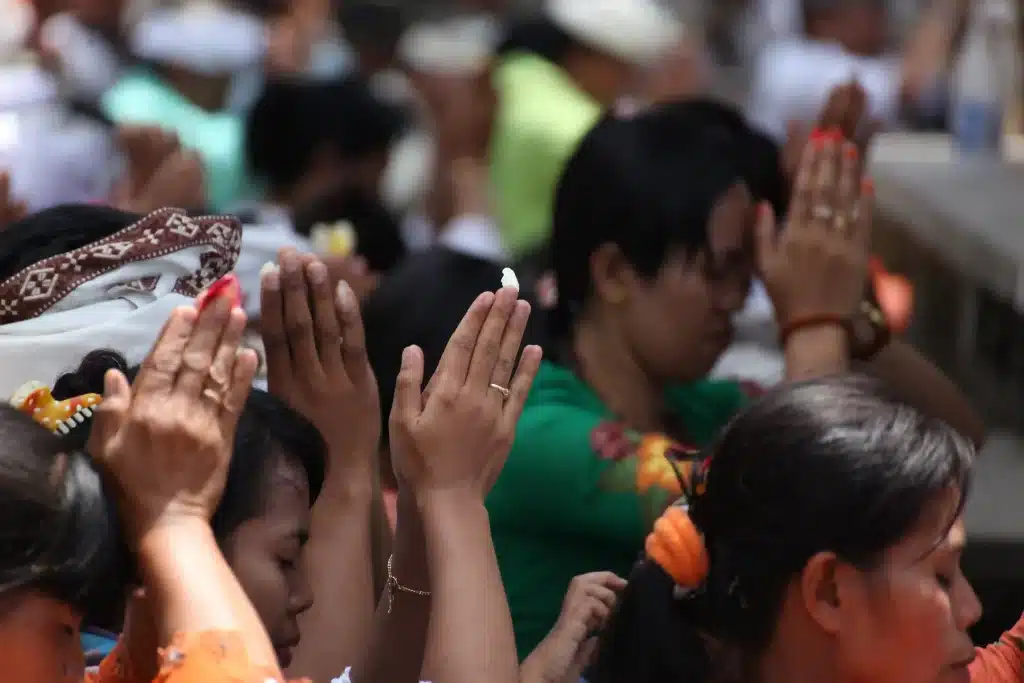
Anthropologists, in seeking traces of Hinduism as practiced in Bali, often—wrongly—translated Balinese Sanskrit words to conclude that the people of the Island of the Gods were Hindu. And the Balinese, not particularly inclined to contradict on this point, did not say otherwise. Yet, to be more precise, “Balinese Hinduism,” if it can be called that, is in fact a set of beliefs based on the Shaivite sect of Hinduism, Mahāyāna Buddhism, and animism.
The origins of Balinese religion
Dang Hyang Nirartha, a Javanese Hindu pilgrim, came to settle in Bali in 1537. He landed near Negara and took a long rest under a ficus tree, which later became the site of the Pura Gede Ancak temple. Continuing on to a small temple west of Medewi, he offered a lock of his hair to protect the villagers. Placed at the heart of the sanctuary, this site, known as Pura Rambut Siwi, or the “Temple of the Venerable Hair,” became a sacred place that still attracts many pilgrims today.
Later, after other adventures, Nirartha became the chief advisor to King Dalem Baturenggong of Gelgel (Klungkung region), to whom he promised to bring spirituality and teaching. It was at this time that he became the founder of the main rituals, reformed Hinduism, and, in response to Islam’s monotheism, created the Padmasana, the altar of the supreme god.
One god, a thousand faces
If Bali is the island of a thousand gods, it is also the island where a single god reigns: Acintya, in Sanskrit “the inconceivable” or “the unimaginable,” also known as Sang Hyang Widhi Wasa, meaning “the divine order,” or Sang Hyang Tunggal, “the divine unity.”
All gods and goddesses are manifestations of this solar god. Acintya is the beginning and the end, the origin of the world; all other deities are representations of his greatness and powers. Ceremonies, prayers, sacrifices, and offerings are not dedicated to him directly, but to Shiva, Brahma, Vishnu—who are parts of himself.
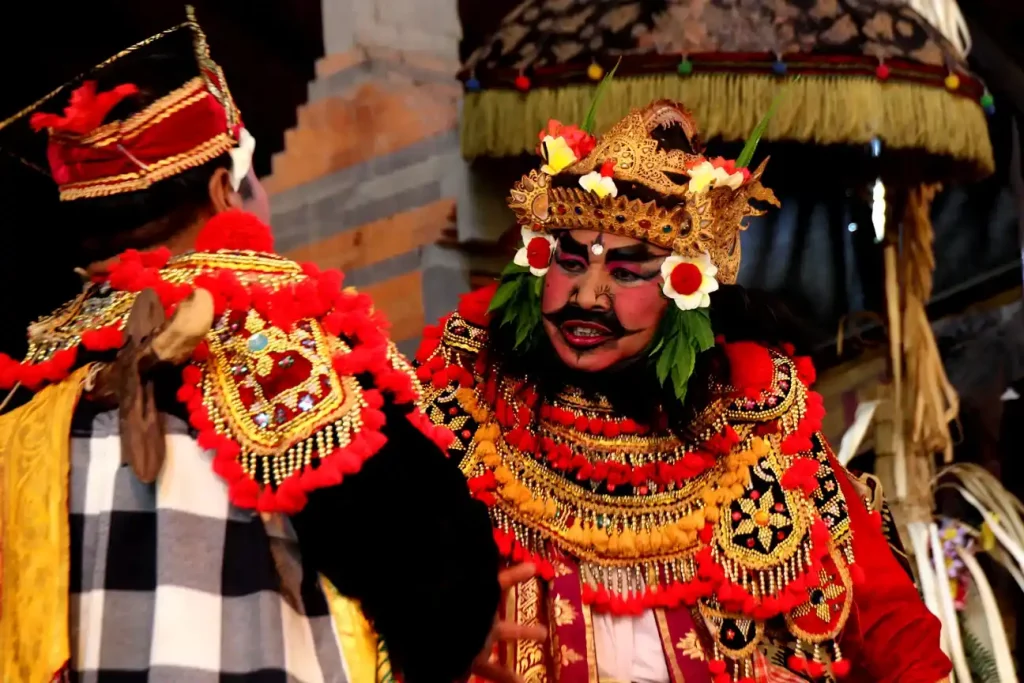
Acintya, the almighty, is often absent from representations. When he appears, he is depicted in human form surrounded by flames, associated with the Sun god. Inside Balinese temples, his presence is symbolized by an empty throne set on a pillar: the Padmasana, the lotus throne. This throne was truly integrated into places of worship in the 16th century, as part of a Hindu reform movement led by Nirartha.
A living religion, meaningful architecture at the heart of Bali
Nirartha also established a three-temple system for each village: to the north, a temple dedicated to Brahma; in the center, one to Vishnu; to the south, a temple dedicated to Shiva. The temples are built from volcanic lava stone from Mount Agung—the abode of Shiva. This fragile rock requires frequent renovations, thus reminding people of impermanence and the need to practice regularly.
Balinese cosmogony: the birth of Bali
At the beginning of all things, the one god Sang Hyang Widhi Wasa entered deep meditation. According to the ancient texts of Raja Yoga (11th–12th centuries), he practiced Amanaska, a meditation in which breath and thought cease, and the soul merges with the Whole.
From this meditation was born Bedawang Nala, the sacred turtle tasked with stabilizing the earth. Coiled around its legs, the dragon-serpents Naga Basuki and Naga Anantaboga reassure the turtle. When it stirs, causing earthquakes, the serpents tighten their grip to calm it. Thus, during earthquakes, the Balinese shout “hidup, hidup!” to awaken the serpents.
The dried mud gave birth to the earth and the mountains. The sky, clouds, rain, the sun, the moon, and then the stars followed in turn. Beyond lies Moksha—the final liberation—the realm of ancestors and spirits. The higher one rises, the closer one comes to the divine. Conversely, the bowels of the earth shelter demons and flesh-hungry creatures.
The supreme god, realizing that he no longer had a place for the man and woman he had just created, then chose a great fish (a Mola Mola according to some), which he froze and placed on the black lava stone (the world) set on the turtle’s back. The shape of Bali would come from this fish: Mount Agung would be its eye, Lake Batur its gills, and the rest of the island’s geography would correspond to its morphology.
Thus, Bali became the center of the human world, under the benevolent gaze of the gods and the threat of demons lurking beneath the earth.
If you feel like discovering this culture with its rites, its people, and its myths, we can only recommend that you use a Bali travel agency with a strong local presence and a love of sharing its wonders… In short, choose us: Amanaska.