 Skip to content



In Bali, a temple is not a “monument.” It is a living place, used, maintained, and experienced every day through simple gestures: an offering, a quick prayer, a blessing before a departure, or a thank you after good news.
When you visit a major Balinese temple during a trip to Bali, you enter a spiritual geography: the mountains, the water, the sea, the directions, the ancestors, the agricultural cycles—everything is connected.
To understand these temples, keep one idea in mind: many Balinese shrines do not only represent the divine; they organize a relationship. A relationship between humans and the sacred, but also between humans and nature, water, volcanoes, or the forest.
It is precisely this link between spirituality and territory that UNESCO highlights when describing the subak system—networks of temples that ritually manage water across entire watersheds.
Reading the spiritual map of Bali to discover Bali differently
Bali is also understood through directions: toward the mountain, often associated with the sacred; toward the sea, often linked to forces of dissolution; and according to the cardinal points.
Certain major temples are explicitly attached to a direction and a function of protection or balance.
Keep these markers in mind:
- mountain = origin, elevation, stability
- water = purification, circulation, fertility
- sea = boundaries, protection, powerful forces
With this, the major temples become much more legible for travelers coming to discover Bali.
Pura Agung Besakih, the mother temple at the heart of Balinese spirituality
Besakih is not a single temple: it is a vast complex located on the slopes of the sacred volcano Gunung Agung.
The official site presents it as a symbol of unity for Balinese Hindus, linked to the presence of the volcano, which is considered a carrier of spiritual force.
The complex comprises 26 temples and is based on the philosophy of Tri Hita Karana—harmony between humans, the divine, and nature.
Spiritually, Besakih represents the idea of a center connecting the different levels of the world.
Pura Luhur Lempuyang, the spiritual ascent of your trip to Bali
Lempuyang is often associated with a simple but important experience: the climb.
Spiritually, this progression is not insignificant. One does not simply consume the place; one earns it through effort, breath, and rhythm.
The temple is regularly cited among the major shrines of eastern Bali and is one of the island’s great directional temples.
For many travelers who travel to Bali, Lempuyang symbolizes the idea that access to the sacred requires a form of inner progression.
Pura Luhur Uluwatu, the cliff and the forces of the sea
Uluwatu is not only spectacular.
The Badung Department of Culture clearly explains its place in Bali’s ritual orientation. Uluwatu is located in the southwest and serves for the worship of God in the form of Batara Siwa Rudra.
The temple is also linked to Dang Hyang Nirartha, a major figure in Balinese Hinduism.
Spiritually, Uluwatu represents the boundary between the human world and the immense forces of the ocean.
Pura Tanah Lot, the sea temple during a holiday in Bali
Tanah Lot is one of the island’s most famous sea temples.
The official Indonesian tourism site explains that it is associated with Dang Hyang Nirartha and the spiritual protection of the Balinese coasts.
Here, the sea is not decorative. It represents a power that must be reckoned with.
During a holiday in Bali, Tanah Lot often allows for an understanding of the deep relationship between the Balinese and the ocean.
Pura Goa Lawah, the cave and the underworld
Goa Lawah is famous for its cave inhabited by bats.
Indonesian cultural sources describe this temple as a place associated with an inner world, dark and powerful.
Spiritually, Goa Lawah serves as a reminder that in Bali, not all forces are solely luminous, and that ritual serves precisely to maintain balance.
Pura Ulun Danu Batur, the water temple at the heart of the subak system
If you were to remember only one temple to understand Bali in depth, it would likely be this one.
UNESCO describes Ulun Danu Batur as the “Supreme Water Temple,” considered the source of springs and rivers.
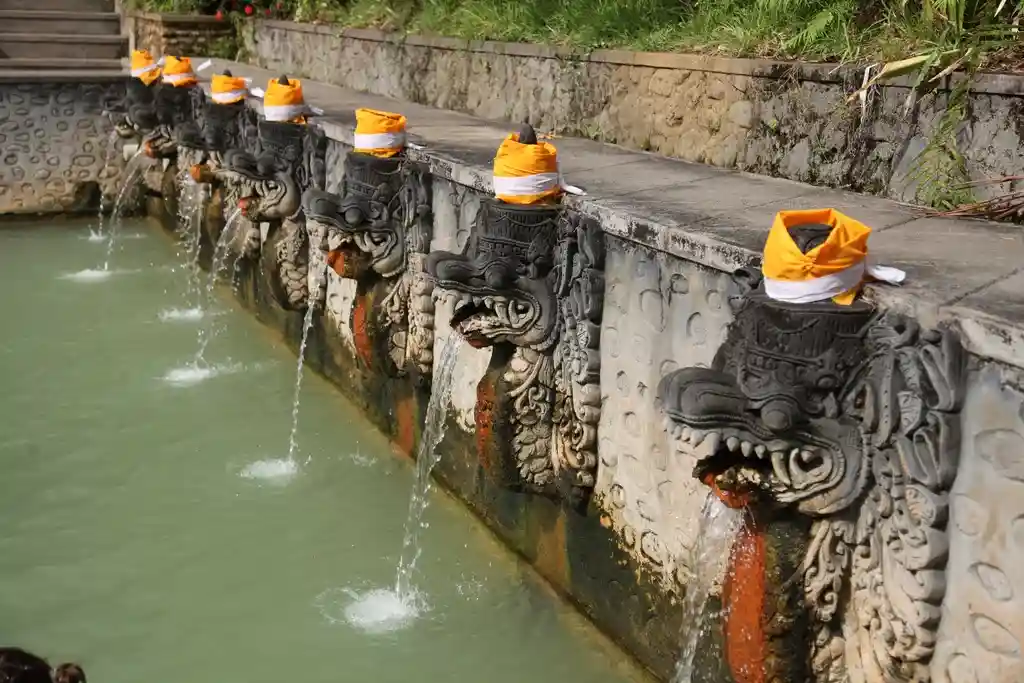
Water temples participate directly in the governance of water within Balinese agricultural landscapes.
During a family stay in Bali, understanding this temple allows one to grasp the spiritual importance of water in Balinese culture.
Pura Taman Ayun, the royal temple and sacred water
Taman Ayun is a major temple linked to the former kingdom of Mengwi.
The official Balinese tourism site indicates that it was built in 1634 as a place of worship linked to royal ancestors.
UNESCO documentation also describes Taman Ayun as a royal water temple playing an important role in the distribution of sacred water to the subaks.
Spiritually, Taman Ayun connects power, agriculture, and the sacred.
Pura Ulun Danu Beratan, fertility and sacred lakes
This is one of the most photographed temples in Bali.
Its spiritual function is nonetheless very precise: it is a water temple associated with Dewi Danu, the goddess of water and fertility.
Lake Bratan represents an essential water reserve for mountain crops.
Tirta Empul, purification through water during a trip to Bali
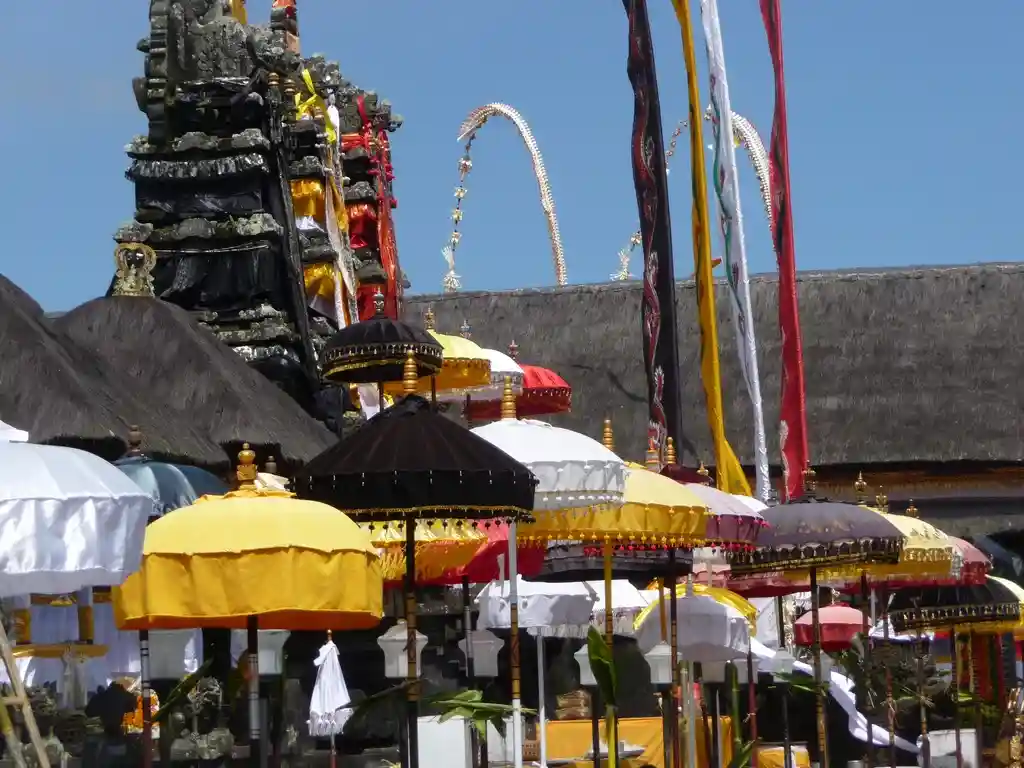
Tirta Empul is one of the most well-known temples for the purification experience it offers.
The Balinese tourism site indicates that the sacred water of Tirta Empul is considered capable of purifying both body and mind.
For many travelers on a trip to Bali with friends or family, this temple represents a very concrete spiritual experience.
Goa Gajah, ancient Bali and the memory of rites
Goa Gajah is both a religious and archaeological site located in the Gianyar region.
The place is associated with an atmosphere of retreat, silence, and ancient spirituality.
Spiritually, Goa Gajah evokes a more internal, ancient, and meditative Bali.
Gunung Kawi, a rock-cut shrine in the heart of the valley
UNESCO documentation describes Gunung Kawi as a complex of rock-cut monuments dating back to the 11th century.
The site is linked to water channels carved into the valley.
Spiritually, Gunung Kawi connects royalty, water, rituals, and landscape.
Pura Luhur Batukaru, the mountain and the protection of western Bali
The UNESCO landscape of Batukaru describes this temple as being located in the forest above the rice fields, at the summit of the sacred Batukaru system.
Mount Batukaru is one of the protective mountains linked to water and springs.
For travelers who wish to travel to Bali to discover a more spiritual and natural island, Batukaru offers an experience very different from the coastal temples.
How to visit the temples without missing the essentials during a trip to Bali
- Enter slowly.
In Bali, the threshold is already a spiritual practice. - Watch the gestures before the stones.
Offerings, incense, movement, silences. - Respect local rules.
For example, the official Besakih site specifies that certain areas remain forbidden during menstruation according to rules of ritual purity. - Understand the logic of mountain, water, and sea.
This is the key that connects Besakih, Ulun Danu Batur, Tirta Empul, Tanah Lot, and Uluwatu. - Accept that not everything can be translated.
In Bali, spirituality is also an experience of rhythm and place.