 Skip to content



Do you know why the number three structures Balinese life?
Balinese Hinduism stems from a simple observation: reality only stands firm when it balances three complementary forces. This idea is applied everywhere: three times of day for prayer (tri sandhyā: dawn, noon, dusk), three successive courtyards in each temple (profane outer, ritual courtyard, sacred sanctuary), three sanctuaries in each village (Pura Puseh for the original ancestors, Pura Desa for community life, Pura Dalem for death).
Even the landscape follows this logic: sacred mountain to the north, residential area in the center, sea to the south; this principle is called kaja–kelod (high–low) and kangin–kauh (east–west). Socially, the search for harmony involves the Tri Hita Karana doctrine: adjusting three relationships—person/divinities, person/fellow beings, person/nature. All these trinities are variations of the great theological triad: the Trimurti.
The Trimurti: Siwa, Brahma, Wisnu
In the Balinese version of Hinduism, the three divine poles are named Siwa (Shiva), Brahma, and Wisnu (Vishnu). Each god expresses a moment of the cosmic cycle; none is superior to the others, all are necessary.
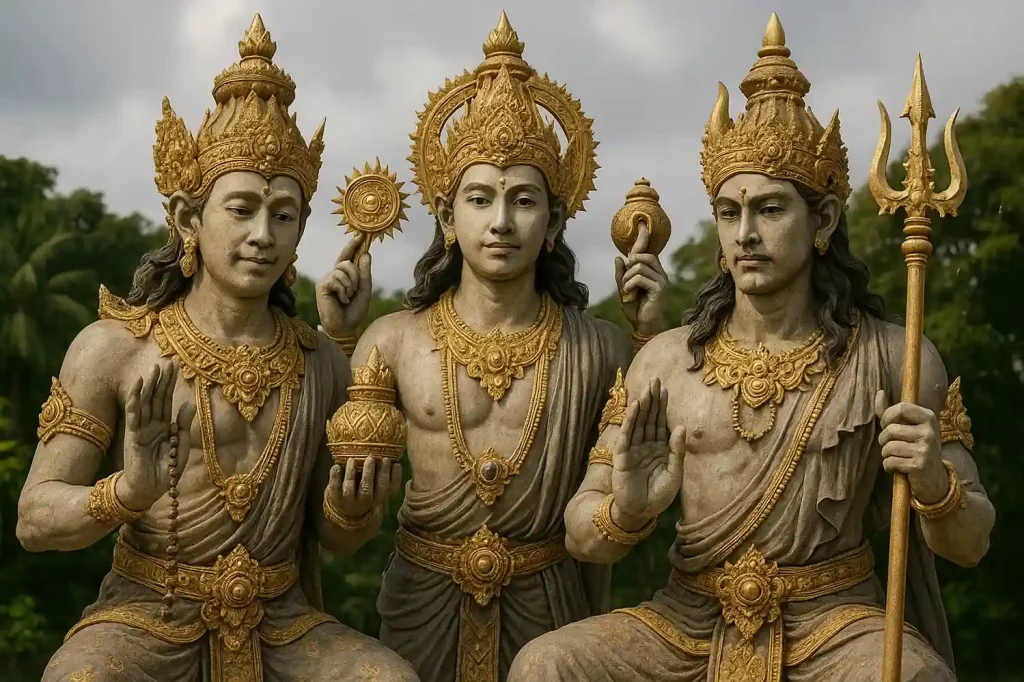
- Siwa – dissolution and rebirth. He is prayed to for closing one stage and opening a new one. His ritual color is white, his symbol the lingga (a simple vertical stone). The great sanctuary of Pura Besakih, located on the slopes of Mount Agung, is dedicated to him; it is there that royal mortuary rites and the Panca Wali Krama festival take place (once every hundred pawukon cycles).
- Brahma – creative impulse. In local iconography, he appears red, with four faces and four arms. His small shrines are often found in the southern corners of temples, built of red brick (the color of the original fire; he is honored with menyan resin flames). Villagers invoke him before clearing a new plot of rice field or starting a construction project.
- Wisnu – preservation and balance. Associated with the color black or dark blue, he sometimes holds a conch or a disc. Devotion to him culminates during the Melasti processions: effigies of Wisnu are taken to the sea to be bathed before the Nyepi New Year. He is credited with the popular avatars in Bali: Rāma from the Ramayana epic and Krishna from the Mahabharata.
Daily prayer reflects this triad: three pinches of flowers are raised successively to the head, face, and chest; each gesture marks the acceptance of the creation–preservation–transformation cycle.
The female triad: Durga, Saraswati, and Dewi Sri
In Balinese balance, masculine power requires a feminine counterpoint; hence a second tripod of goddesses.
- Durga (often assimilated to the warrior form of Parvati) protects the southern boundaries of temples. On the nights of Kajeng Kliwon, when negative influences are said to be at their peak, Durga masks are brought out for the ritual play Calon Arang: the dramatic performance symbolically neutralizes black magic. Her essential representation: eight arms, a lion, and the trident.
- Saraswati, goddess of intellect and the arts, is celebrated every 210 days (Pawukon cycle). On this day, libraries, painting workshops, and dance studios close; books are sprinkled with holy water and offerings are placed on desks to remind us that knowledge remains a divine loan. The most visited temple: Pura Taman Saraswati in Ubud, built by the sculptor Nyoman Lempad.
- Dewi Sri, the incarnation of fertility and rice, reigns over the verdant terraces. Before the harvest, farmers make the Cili straw doll and place it in the last cut square; the figurine signals that the goddess is resting before the next season. The oldest sanctuaries are Pura Beji (Buleleng) and Pura Maduwe Karang (North Bali).
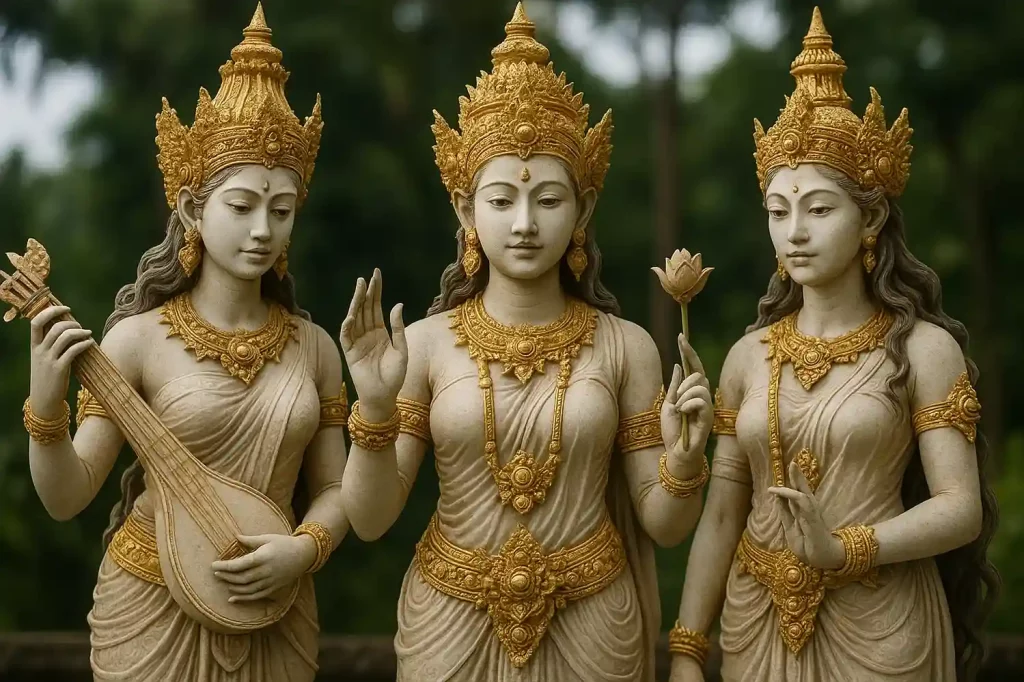
The two triads are intertwined: Siwa/Durga, Brahma/Saraswati, Wisnu/Dewi Sri, illustrating that every masculine power finds its nurturing or protective counterpart.
Colors, directions, and materials: how to recognize each principle
The Balinese encode the Trimurti into visual life:
- White (Siwa): ashes on the foreheads of priests, white umbrellas in front of the central altar.
- Red (Brahma): bricks of southern gateways, red flower offerings, red checkered cloths on the main day of house construction.
- Black (Wisnu): black parasols during Melasti processions, rice grains dyed with charcoal in baskets intended for the protector.
These colors are repeated in the dancers’ attire and on the offering towers (gebogan). The faithful therefore do not need an image: the chromatic code is enough to suggest the divine presence.
The triad in sacred topography
A standard Balinese village has three main temples:
- Pura Puseh (foundations and ancestors), oriented toward the mountain; protector: the Siwa–Durga couple.
- Pura Desa or Bale Agung (civic life), in the center; associated with Brahma–Saraswati.
- Pura Dalem (death and regeneration), toward the sea; affiliated with Wisnu–Dewi Sri.
On the scale of a house, the outer courtyard hosts profane activities; the middle courtyard corresponds to social relations; the inner courtyard, accessible only in ritual attire, houses the family altar. Each symbolizes, on a small scale, the three spheres of the universe: bhurloka (terrestrial world), bwahloka (intermediate world), swahloka (celestial world).
Rites and offerings specific to each member of the Trimurti
- Siwa: he is offered white flowers, coconut milk, and areca nut. On cremation days (ngaben), a Shaivite priest traces the aksara (sacred character) on the cloth wrapping the body.
- Brahma: offerings of red flowers, a pinch of saffron, and incense fire in a triple flame. At the beginning of the agricultural cycle, a Brahmin lights three torches in his name on the main irrigation dike.
- Wisnu: dried fish, blue or black flowers, and water drawn from a mountain spring; during Melasti processions, an effigie of Wisnu is immersed to recharge his protective power.
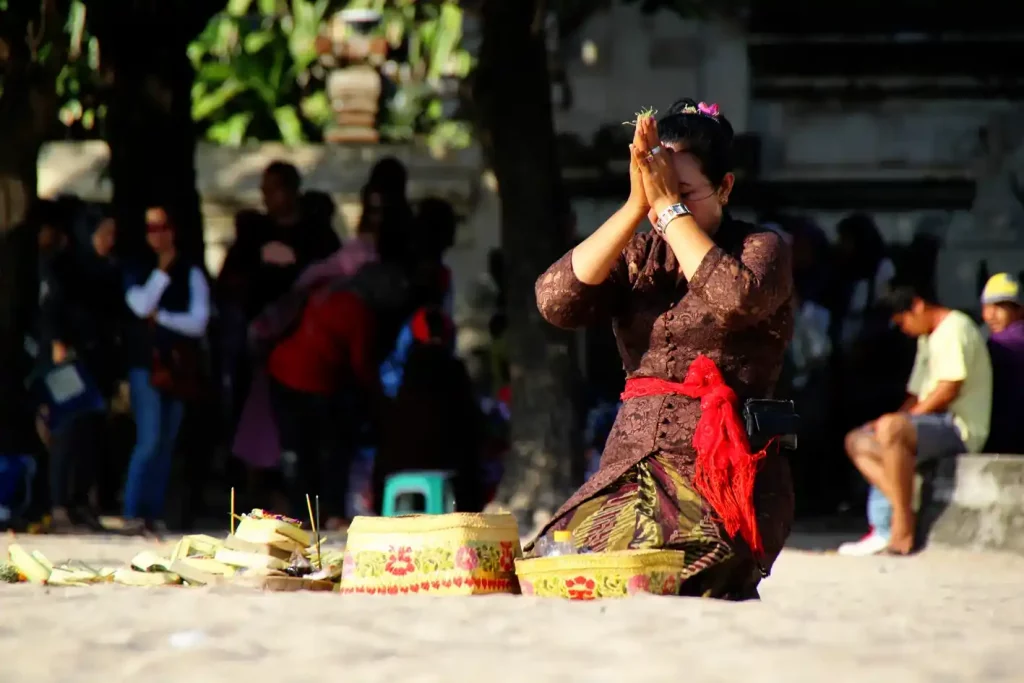
Each of these offerings concludes with three libations of holy water: on the right hand (action), left hand (intention), and forehead (thought).
Tripartite thought in daily life
- Prayer: the Tri Sandhyā calls for reciting the Gayatri Mantra at dawn, noon, and dusk.
- Calendar: the Balinese year combines the solar (Saka, 365 days) and the 210-day cycle (Pawukon), creating a double rhythmic reference; to this is added the Sasih lunar calculation. Three chronometries are thus used to set the festivals.
- Education: three phases of life are highlighted: 0-42 days (period of maternal impurity), 42-210 days (connection to the subtle worlds), after 210 days (full contact with the earth).
- Cuisine: a typical meal aligns three basic flavors: sweet (rice), spicy (sambal), salty (dried fish); it is believed that nutritional balance reflects cosmic balance.
What to see to experience this triple organization?
- Pura Besakih: a life-sized reading of the universe in three successive terraces, crowned by the Siwa sanctuary. Please note that this temple is, unfortunately, a victim of its own success and local organization prioritizes tourism, making it a temple that is certainly culturally interesting but very crowded.
- Taman Ayun Temple (Mengwi): three enclosures of water, garden, and then multi-roofed altars; each requires stricter attire and increased silence.
- Gianyar Market, early morning: stacked baskets; look for the red–white–black flower layering in the canang, ready to be distributed to different altars.
- Jatiluwih Rice Terraces: explanatory panels indicate how each Subak divides the calendar into three flooding periods, three fertilization times, and three drying periods.
Why does this triad interest the curious traveler?
Knowing the Trimurti allows travelers and the curious visiting Indonesia to avoid three frequent misunderstandings:
- Believing that Balinese “pray to statues”; in reality, they activate forces symbolized by color, orientation, and gesture.
- Thinking that Shiva “destroys” through simple violence; for the faithful, he prepares the field for new planting, like a regenerative slash-and-burn.
- Confusing Dewi Sri with a simple agricultural deity; she completes Wisnu and guarantees the local equivalent of food security.
Our summary for your trip to Bali:
Going to Bali is not just about discovering a country or an island, but rather understanding a spirit that is found throughout the entire island.
Bali constantly applies the rule of three: three main gods, three great goddesses, three cosmic zones, three prayer times, three domestic courtyards, three village sanctuaries.
The goal is not the multiplication of rites, but the balanced distribution of energies: create, preserve, transform. The visitor who learns to identify these trios—a white-red-black parasol, three successive gateways, or three strikes of a gong—enters the ordinary language of the island: one that makes every gesture a permanent reminder of the universal cycle.
So for your trip to Bali, do not forget to look for this balance and to find the number 3 in everything that surrounds you.