 Skip to content



There is a scene that many travellers never forget.
The day before, Bali is loud, vibrant, sometimes even electric.
And then, the next morning, everything shifts:
- empty streets
- curtains drawn
- dimmed lights
- unusual silence
As if the island were holding its breath.
This is called Nyepi, the “Day of Silence”.
But it is not just a cultural curiosity, nor a zen day for tourists.
Nyepi is a major rite of Balinese Hinduism, an extremely codified collective moment, part of a much broader ritual cycle.
For many travellers planning a trip to Bali, Nyepi often becomes a memorable experience because it completely transforms how the island is perceived.
We will look at this in detail:
- what Nyepi means
- how it is prepared
- what is actually required
- what it involves when you are in Bali at that time
What exactly is Nyepi?
Nyepi marks the Saka New Year, the Śaka or Caka calendar used in Balinese tradition.
The date changes every year.
An academic source explains that Nyepi falls at the beginning of the new Saka year, the day after the new moon of the ninth Saka month, sasih kesanga.
Important point:
Nyepi never comes alone.
It is part of a broader ritual sequence including:
- Melasti
- Tawur Kesanga
- Pengerupukan
- Ngembak Geni
Recent academic work clearly describes this succession of rites.
The 4 rules of Nyepi during a trip to Bali
At the heart of Nyepi are the Catur Brata Penyepian, four major abstinences.
Several academic sources present them consistently.
- Amati Geni: No fire or light. Today, this corresponds to a major reduction in lighting and a form of voluntary austerity.
- Amati Karya: No work.
- Amati Lelungan: No travel.
- Amati Lelanguan: No entertainment, no noise, no leisure activities.
For travellers coming to discover Bali, it is often a very powerful experience. This framework is religious, but it has massive social effects: it is a collective discipline that creates a real, lived, observable silence.
Before Nyepi: the build-up in intensity you discover during a holiday in Bali
If you only look at Nyepi itself, you miss a large part of its meaning.
The preparation is extremely important.
1. Melasti: purifying before resetting the world to zero
Melasti is a purification rite performed before Nyepi.
Academic studies present it as an essential step in spiritual preparation before the transition into the new year.
The objective is clear:
- purify
- rebalance
- prepare for silence
2. Tawur Kesanga: reharmonising visible and invisible forces
On the eve of Nyepi, Tawur Kesanga or Tawur Agung Kesanga takes place.
Academic publications describe this ritual as an attempt to restore harmony between the elements of the world and invisible forces.
Indonesian media also explain that it fits within the logic of Bhuta Yadnya, intended to neutralise negative elements before Nyepi.
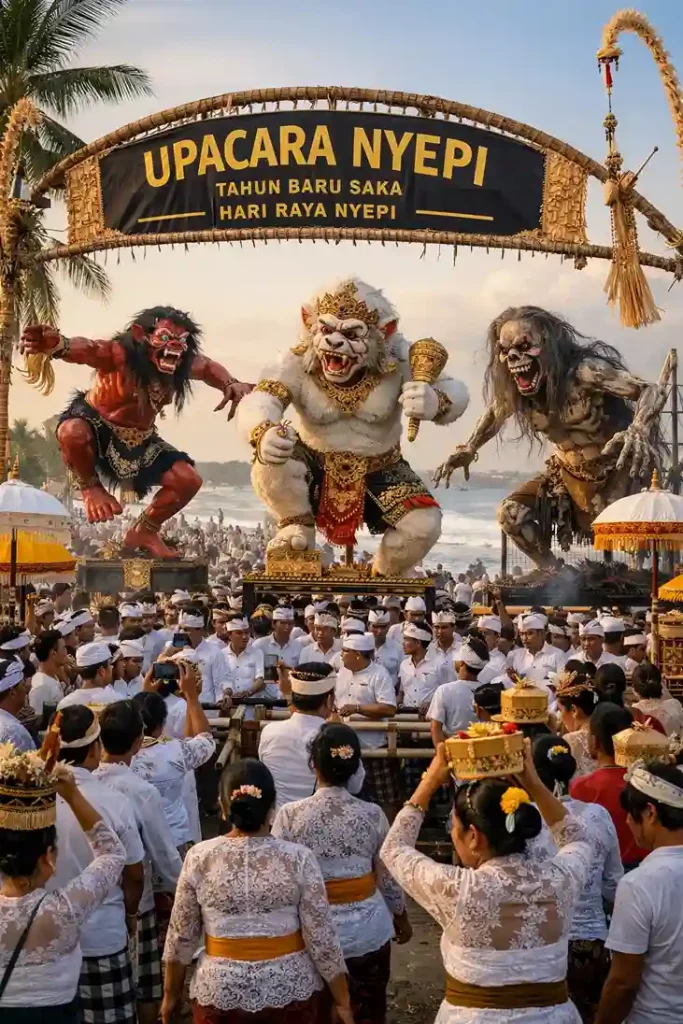
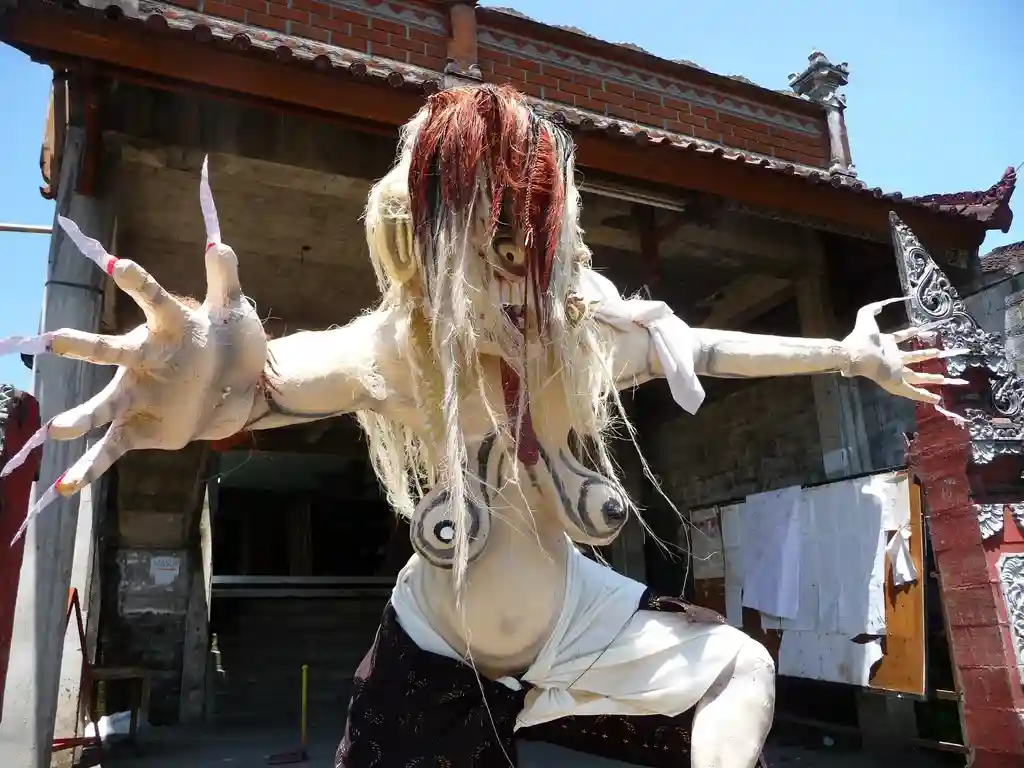
- Pengerupukan and the ogoh-ogoh: making noise to… prepare for silence The evening before is often associated with Pengerupukan and the famous ogoh-ogoh.
These large effigies generally represent negative or unbalanced forces.
Research shows how these processions have gradually become integrated into Nyepi’s ritual cycle.
Some studies also explain that after the procession, these figures can become symbolically protective during Nyepi.
For many travellers spending a holiday in Bali at this time, this evening creates a spectacular contrast with the silence of the next day.

Nyepi day: silence as a collective act
Nyepi is often presented as a day of introspection.
But academic research also mentions:
- preserving nature
- social harmony
- collective rebalancing
Some research even analyses Nyepi as a moment when reduced human activity produces visible environmental effects.
The pecalang: those who oversee the silence
Silence is not spontaneous.
In Bali, ritual and community order is ensured in particular by the pecalang, a form of traditional security linked to customary villages.
Academic publications explain that they are responsible for maintaining order and security during Nyepi.
For travellers who wish to go to Bali during this period, it is important to understand that the rules are taken very seriously.
What really stops during Nyepi on a stay in Bali
Nyepi has very concrete consequences. Yes, it really brings the island to a halt.
- travel stopped
- obligation to stay in your accommodation
- activities greatly reduced
- limited lighting
And above all:
I Gusti Ngurah Rai International Airport closes completely for around 24 hours.
Tourists must stay in their accommodation and follow local instructions.
In some years, restrictions on mobile internet have also been observed depending on the context.
Ngembak Geni: rekindling the social flame after Nyepi
The day after Nyepi is called Ngembak Geni.
Consistent descriptions present it as a time when social relations resume, sometimes associated with forgiveness and reconciliation.
The cycle then becomes coherent:
- silence
- reset
- reopening to others
Our simple rules for experiencing Nyepi wisely during a trip to Bali
If you are on holiday during Nyepi, you need to adapt (even if, let’s be honest, it is not always easy when travelling to Bali as a family with young children…).
And it is not about losing a day.
It is about going through a major cultural moment.
Our guidelines:
- Do not plan any flights during Nyepi.
- Choose your accommodation with full awareness.
- Prepare the day before:
- water
- snacks
- quiet activities
- reading
- quiet games for children
- Respect the silence:
- no music
- no gatherings
- no discreet outings
- Always follow local instructions and those of the pecalang.
For travellers using a Bali travel agency, planning for Nyepi properly often helps turn this logistical constraint into an exceptional cultural experience.
What Nyepi reveals about Bali at a deeper level
Nyepi tells us something rare:
A society capable of agreeing on a collective stop for spiritual, social, and cultural reasons.
Academic research highlights the philosophical depth and the social cohesion function carried by Nyepi.
For many travellers, Nyepi becomes a gateway to a much deeper understanding of Bali:
- the relationship to time
- the relationship to silence
- the place of the collective
- the balance between the visible and the invisible
And once you understand that, you no longer look at Bali in the same way.