 Skip to content



If you are fortunate enough to be on the archipelago for the Galungan festival, your day will begin in a completely different atmosphere. A more colorful and much more folkloric atmosphere. It is also a special moment for those discovering Bali, as this festival reveals the island’s deep soul.
A perfect opportunity to fully immerse yourself in Balinese culture. Be aware that Galungan begins very early for the Balinese. Their preparations have already started at the beginning of the week, and it is not uncommon for travelers accompanied by a Bali travel agency to be invited to observe or even participate in these preparations in the village.
On Monday, “Penyajahan Galungan” is dedicated to preparing cakes that will serve as offerings during the festival. On Tuesday, “Penampahan Galungan” is a day dedicated to preparing the festive dinner and finalizing the offerings.
This is notably the day when men slaughter pigs and cook, while women finalize the offerings. Galungan always falls on a Wednesday. It is one of the most celebrated days by Hindus. But you are probably wondering: what exactly is this famous Galungan festival?
Symbolism of the Galungan Festival
Galungan symbolizes the “opening” of the new year. Hindus commemorate the victory of good over evil, of dharma over adharma, as well as the creation of the universe.
This festival therefore takes place every 210 days, corresponding to the rhythm of the years according to the Pawukon calendar which defines their religious activities. This year, the Galungan festivities fell on April 23rd and November 19th.
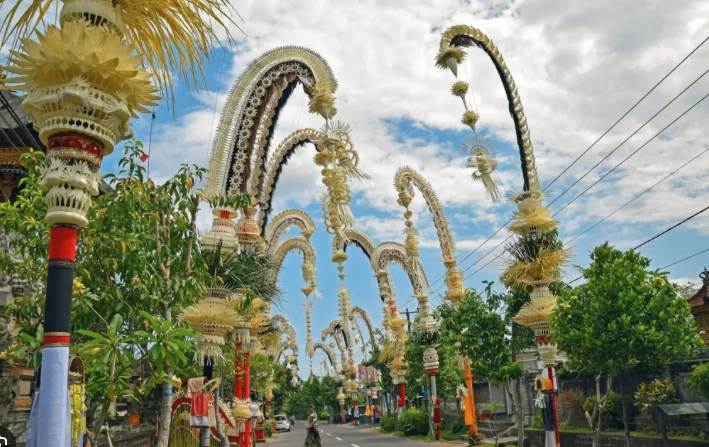
Most shops, warungs, and schools are closed, as it is a highly anticipated family holiday. On this day, you can observe the famous penjors. These are large bamboo arches placed in front of houses a few days before Galungan, symbolizing prosperity. They are decorated with coconut leaves or palm leaves for better preservation. Each family then adds its personal touch.
You will see flags, string lights, fruits, fabrics, and offerings of all kinds to show gratitude to the gods. Below the penjor, you can also spot a small, beautifully decorated shrine that is filled with offerings from dawn. Some Bali travel agencies will take you to observe penjors ranging from the simplest to the most majestic, depending on the family’s wealth. Their creation often represents a significant portion of the monthly budget. For the Balinese, every element of the penjor has a deep religious meaning.
Two interpretations of the penjor, each as imaginative as the other, reveal the creativity and folklore of Balinese rites. The first explains that the penjor is the symbol of the dragon Ananthaboga, which represents the earth, and Basuki, which symbolizes security. The base of the bamboo would represent the head and body of the dragon, and the thin tip, the tail.
The second interpretation sees it as a representation of Mount Agung, the sacred mountain where the gods reside. The arch represents the mountain, the bamboo stalk the river flowing down from it, and the elements attached to the end of the bamboo symbolize the fruits of the harvest.
Regardless of the interpretation, the penjor serves to bring down the gods and ancestors so that they may settle in the family temple.
What to expect during Galungan if you travel to Bali at this time?
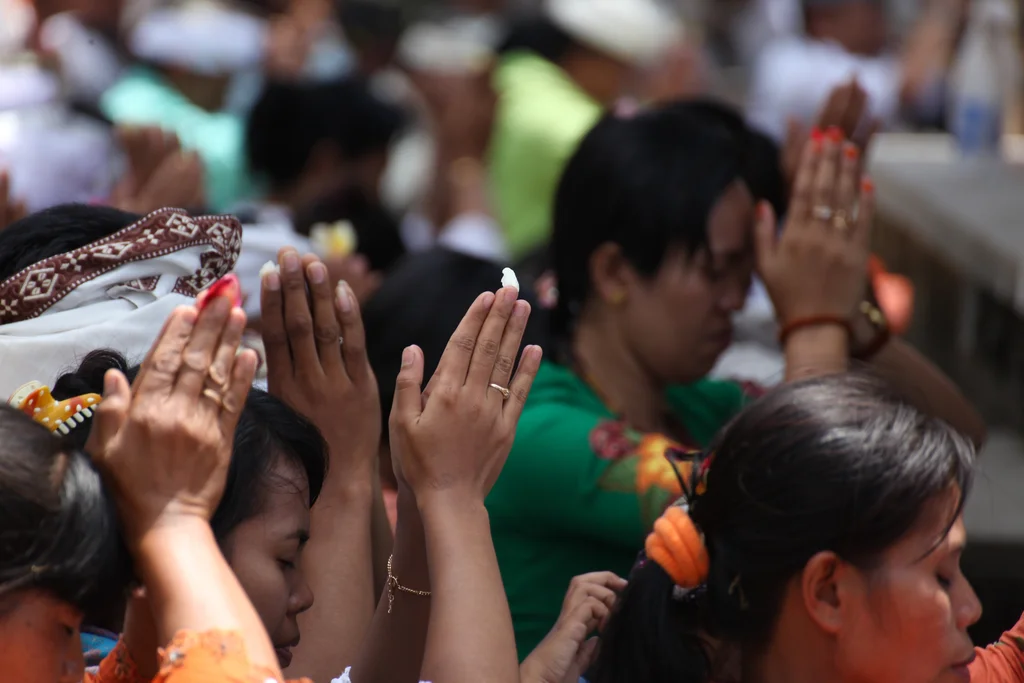
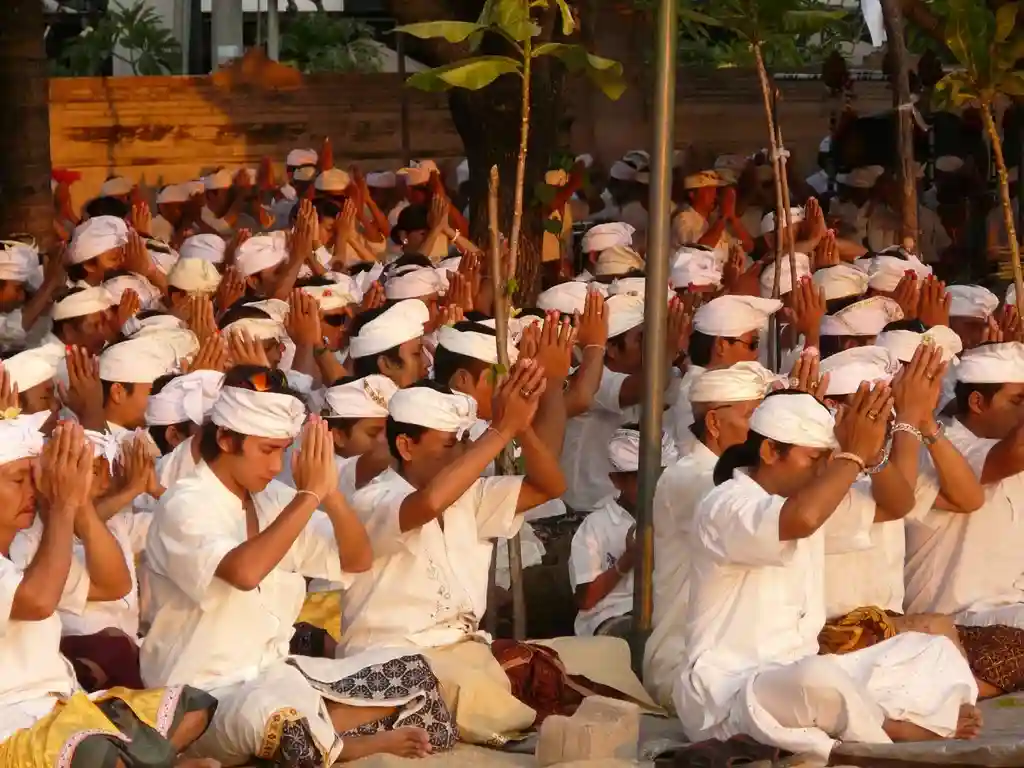
The entire day of Galungan is punctuated by prayers and ceremonies. You will see locals in the streets dressed in their traditional attire. Women wear beautiful lace shirts in yellow, red, white, purple… Men are recognizable by their turbans, the udeng. On this day, the towns are vibrant with colors and activities.
You will find a lot of yellow and white in the outfits and temple decorations. White represents the sun, while yellow represents the moon. The entertainment is often performed by children, who parade through the streets dressed in frightening costumes and equipped with musical instruments such as drums or kongs. Ceremonies last until 7 PM. The day ends with family, while the total celebration extends for another ten days, until Kuningan, when the ancestors peacefully depart.
In Bali, an island of festivals, the entire year is punctuated by ceremonies and religious holidays. The most celebrated festivals by Hindus are Galungan and Kuningan.
The Balinese New Year festivities last ten days. Indonesians use the Pawukon calendar, which defines their religious activities. Their years are composed of six months of 35 days, making a complete cycle of 210 days.
Approximately twice a year, Bali celebrates Galungan, and the streets are transformed with magnificent penjors, often 4 meters high, erected in front of each house. They symbolize prosperity. The penjor is made from a bamboo arch decorated with coconut or palm leaves for better preservation. Each family customizes its penjor with flags, garlands, coconuts, bananas, and offerings of all kinds, to express gratitude to the gods.
On Galungan day, always a Wednesday, the gods and ancestors descend through the penjors into the family temples. Prayers begin in the family temple and then continue in public temples for three days. Schools and businesses close to allow everyone to celebrate.
Ten days later, on a Saturday, Kuningan concludes the festivities. This is the day the ancestors depart. The Balinese perform chants, purifications, and cockfights. Kuningan offerings include yellow rice, a symbol of joy, life, and prosperity. The meal is then shared with family. The penjors remain in front of houses for a month after Galungan.
These two festivals are of paramount importance in the Hindu religion. The ten days of celebration are filled with joy, conviviality, and colors, visible throughout the island of Bali.
What do the Galungan festivities truly mean for the Balinese?
Victory of Dharma over Adharma
- Galungan symbolically celebrates the triumph of good (dharma) over evil (adharma). It is said that on this day, negative forces are momentarily subdued, and the universe regains its proper balance.

Return of Ancestors Home
- Balinese believe that family spirits (the pitara) descend to earth to visit their descendants. Each household cleans its domestic altar (sanggah kemulan) and prepares offerings to welcome the ancestors and ask for their blessing.
210-day Cycle (Pawukon Calendar)
- Galungan always falls on a Wednesday (Buda Kliwon Dungulan) and occurs every 210 days. It initiates a ten-day ritual sequence that ends with Kuningan, when the ancestors return to the divine world.
Penjor: The Visual Emblem of the Festival
- In front of each gate, a tall, curved bamboo pole decorated with coconut leaves, rice, and cakes is erected. The penjor represents Mount Meru, the axis of the universe, and recalls the prosperity granted by the gods.
Rituals and Conviviality
- Eve of Galungan (Penampahan): traditionally, a pig is slaughtered, its meat used to prepare lawar (a mixture of vegetables, coconut, spices, and fresh blood).
- D-Day: prayers at the village temple, family visits, sharing of dishes.
- The next day (Manis Galungan): a more relaxed day, dedicated to loved ones, sometimes with recreational outings.
Central Message for the Balinese
- To remember that moral balance must be continuously maintained; to honor ancestors who protect the family; and to thank the deities for the abundance of the earth.
In short, Galungan is not just a “holy day”: it is a semi-annual reminder that Balinese life rests on a triple bond—with the gods, with ancestors, and with the living community. We find the importance of the number 3, which you may have discovered in our article: Understanding why “everything comes in threes” in Bali
Now you know almost everything, and if you want to know more, to travel to Bali, to discover this magnificent Island of the Gods, let us accompany you to make your trip to Bali unforgettable.