 Skip to content



Setting off to discover Bali is not simply about planning your stay in Bali to see the must-sees. Nor is it about wanting at all costs to explore the country off the beaten track. Above all, it is about truly understanding the spirit of Bali, its reason for being… and that is what we offer you here with one of the pillars of Balinese culture: the Mahābhārata.
We are at the heart of a war rooted in a conflict between two branches of cousins who claim the same throne: that of the Kurus. On one side are the Pandawa, sons of Pându, king of Hastin: Yudhisthira, Bhîma, Arjuna, and the twins Nakula and Sahadeva. On the other are the Kaurava, descendants of Kuru—the hundred sons of Dhritarâshtra, the blind king, whom he had with his wife Gāndhārī, who chose to blindfold herself so as to share her husband’s darkness.
Pându, the king of Hastin, was struck by a curse: if he fathered children, he would die immediately. However, his first wife, Kunti, blessed by a sage, received the power to invoke gods. Before performing the incantations on her husband’s behalf, she wished to try it herself, invoked the Sun god (Sūrya), and gave birth to a boy. As she was not yet married, and faced with this delicate situation, Kunti decided to abandon the newborn, placing him in a basket that she set adrift on a river.
The child was taken in by a family of charioteers, who named him Karna and raised him as their own son, unaware of his divine and royal origins. He would become a central figure in the epic.
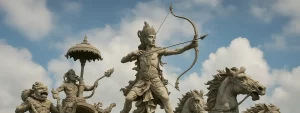
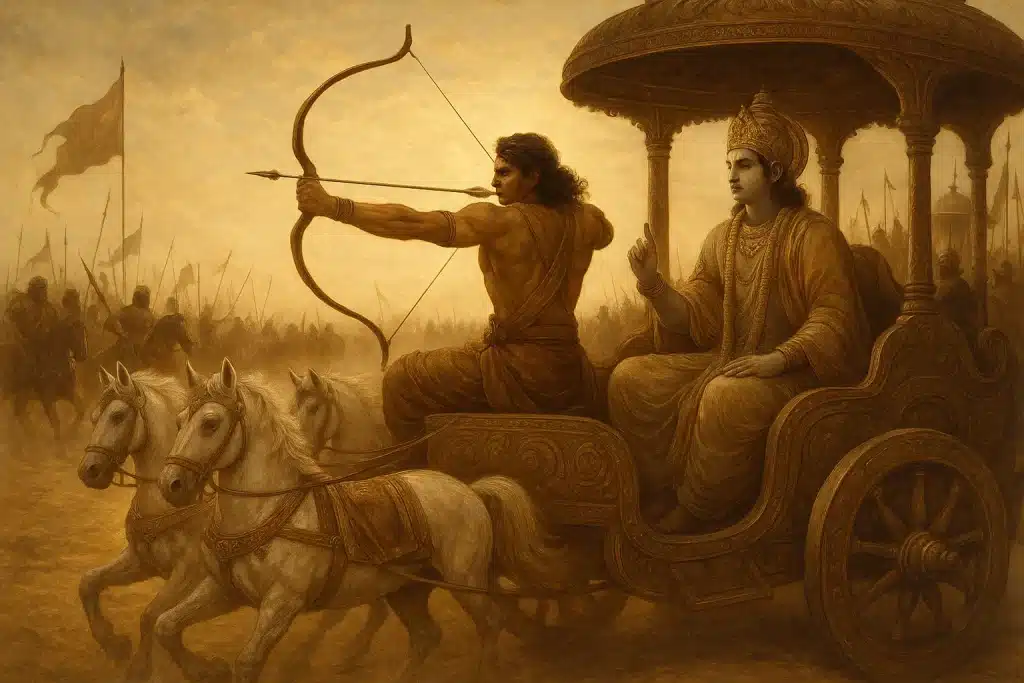
Let us return to the birth of the Pandawa: Kunti therefore invoked the gods. Dharma, embodying justice and the natural order, gave her Yudhisthira. Vâyu, the god of Wind, gave her Bhîma, and Indra, king of the gods, fathered Arjuna, a great archer and one of the Mahābhārata’s major heroes. Using the same mantras, Mâdrî, Pându’s second wife, gave birth to the twins Nakula and Sahadeva, born of the twin gods Ashvin, celestial physicians and protectors of horses.
The birth of Dhritarâshtra’s hundred sons is no less unusual. Gāndhārī, blessed by the rishi Vyāsa, had to wait two years before giving birth… to a shapeless mass of flesh. Devastated, she was about to dispose of it when Vyāsa intervened. He ordered her to cut it into a hundred portions, which she placed in a hundred jars, with a hundred-and-first added for the daughter she longed for. Two years later, Suyodhana emerged from the first jar, who would become Duryodhana (“difficult to fight”).
The sage Vidura advised abandoning him, predicting that he would bring ruin and desolation. Gāndhārī and Dhritarâshtra refused. The other children followed, until the birth of the only daughter, Duhśalā.
The number of years is of crucial importance: Yudhisthira was born before Duryodhana, and as the eldest, he was therefore the rightful heir to the throne.
From childhood, the cousins competed in disciplines such as archery, wrestling, horse riding, hand-to-hand combat, interpreting sacred texts, and the art of diplomacy.
During a tournament, Karna demonstrated abilities equal to Arjuna’s. However, he could not face him directly, as he was considered of low caste.
Duryodhana then elevated him to the rank of king of the kingdom of Anga, but the fight did not take place. This gesture sealed the friendship between the two men, making Karna a loyal ally of the Kaurava—although he was, originally, the eldest brother of the Pandawa.
Pându died, succumbing to Mâdrî’s charms, leaving his sons orphaned. Power returned to Dhritarâshtra, strongly influenced by Duryodhana, jealous of his cousins and ready to do anything to eliminate them.
He attempted to burn the Pandawa alive by locking them in a house of lacquer. They narrowly escaped and went into hiding. Later, they attended incognito the svayamvara of Draupadî, daughter of King Drupada. This contest, intended to allow the princess to choose her husband, required an archery feat that only Arjuna accomplished. He won Draupadî’s hand. Karna, also capable of succeeding, was humiliated by the princess, who refused to marry a charioteer’s son.
Returning with Draupadî, Arjuna announced to his mother Kunti that he had “brought back a treasure”. Without knowing what it was, Kunti told him to share it with his brothers. Thus, Draupadî became the common wife of the five brothers. She bore a child to each of them: the Draupadeya.
The Kaurava, frustrated, demanded the division of the kingdom. They kept wealthy Hâstinapura and left the Pandawa an arid land. But the Pandawa, brave and virtuous, made their kingdom prosperous. Yudhisthira was then able to organize the râjasûya, a royal ritual to which he invited all the sovereigns.
Duryodhana’s jealousy reached its peak. He invited Yudhisthira to a game of dice. Knowing his weakness for gambling, he had him face his uncle Shakuni, a notorious cheat. Yudhisthira lost everything: his wealth, himself, his brothers, and even Draupadî. He played again, lost again, and the Pandawa were forced into exile for twelve years in the forest, followed by a thirteenth year of anonymity, on pain of starting over.
During the exile, Draupadî reproached her husbands for their weakness. The Pandawa travelled and met sages. Arjuna received celestial weapons from Shiva and Indra. In the thirteenth year, each adopted a secret role: Arjuna, rendered impotent by a curse, became an effeminate dance teacher; Yudhisthira, a brâhmane gambler; Draupadî, a hairdresser; Bhîma, a cook; Nakula and Sahadeva, grooms. They remained incognito.
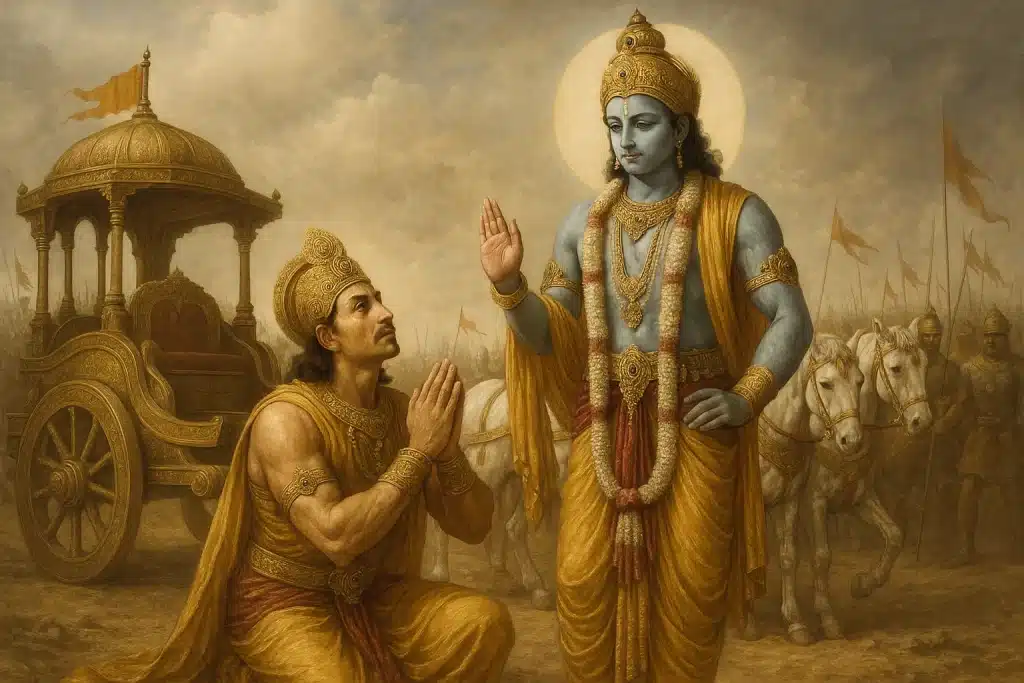
At the end of the exile, the Pandawa demanded their kingdom. Duryodhana, influencing his father, refused. Even Krishna failed to convince the Kaurava. Faced with their stubbornness, war was declared.
It lasted 18 days. Each day saw bloody battles, titanic duels, heroic deaths: Bhîma killed Duryodhana, Arjuna faced Karna, Ashvatthâman massacred the Pandawa’s children. In the end, the Pandawa were victorious, but at the cost of immense losses.
Dhritarâshtra, Gāndhārī, and Kunti withdrew into the forest, became hermits there… and immolated themselves in the flames.
Legends: an anchor point for enjoying your holiday in Bali
This legend helps us better understand both human relationships and the place of the gods in mythology, but it also serves as a pillar in the education of Balinese children, helping them make good decisions and providing examples to use in their daily lives. We hope you enjoyed this legend and that it will help you appreciate your stay in Bali even more, because here every temple, every dance, every name draws on history and mythologies of which the Mahābhārata is a part. And if you would like to enjoy an authentic holiday in Indonesia, rich in meaning, please feel free to contact us. We will be delighted to help.