 Skip to content



When travelers think of discovering Bali and Balinese rites, they often picture Barong dances, Melasti processions, or flamboyant Ngaben cremations. Yet, there is a more intimate and equally essential ceremony that still eludes most visitors: the Mesangih, often called Potong Gigi (“tooth cutting”).
This tradition reveals a deeply human facet of Balinese culture.
This symbolic filing of the incisors and canines marks the transition from adolescence to adulthood. Unlike a Western birthday or an exam, it operates on two levels: spiritual (protecting the soul from impurity) and social (announcing that the young person is now eligible for marriage). If your trip to Bali offers you the chance to attend, you will witness a blend of solemnity, family tenderness, and very human touches of apprehension.
An analysis across ten themes to help you understand and, perhaps, be invited to experience this key moment, which is often included in the experiences offered by a travel agency in Bali specializing in cultural immersion.
The Origins of Mesangih: Chasing Away the Six Inner Enemies
Tradition links the Mesangih to Balinese Hindu texts (lontar Tutugon Sang Hyang Aji Swamandala). These texts state that six animal passions—anger, jealousy, lust, confusion, intoxication, and greed—symbolically reside in the tips of the upper teeth. Filing them down means curbing the influence of these inner demons (sad ripu) and allowing the soul to shine. Historically, only children of noble castes were entitled to it; however, since the 20th century, the practice has involved almost all families, whether they are Brahmins or simple farmers.
The Chosen Moment: Just Before Marriage, Sometimes in Groups
Traditionally, teeth are filed shortly before the wedding, a sign that the betrothed present themselves “purified” before their gods, ancestors, and society. In villages, families on a small budget often wait for another household in the same banjar to organize the ceremony: several adolescents are then grouped together to share the officiant and the offerings. In Denpasar or Ubud, urban families choose an auspicious date according to Pawukon astrology, even if the marriage is still far off, to take advantage of school holidays and gather relatives who have moved away.
Preparations: Offerings, Dentist, and Banjar Couriers
A Mesangih is sometimes prepared six months in advance. It begins by bringing together two elements:
- The offerings (banten mesangih): pyramids of fruit, rice cakes (jaja), flowers, incense, and a sugar pig figurine symbolizing defeated gluttony.
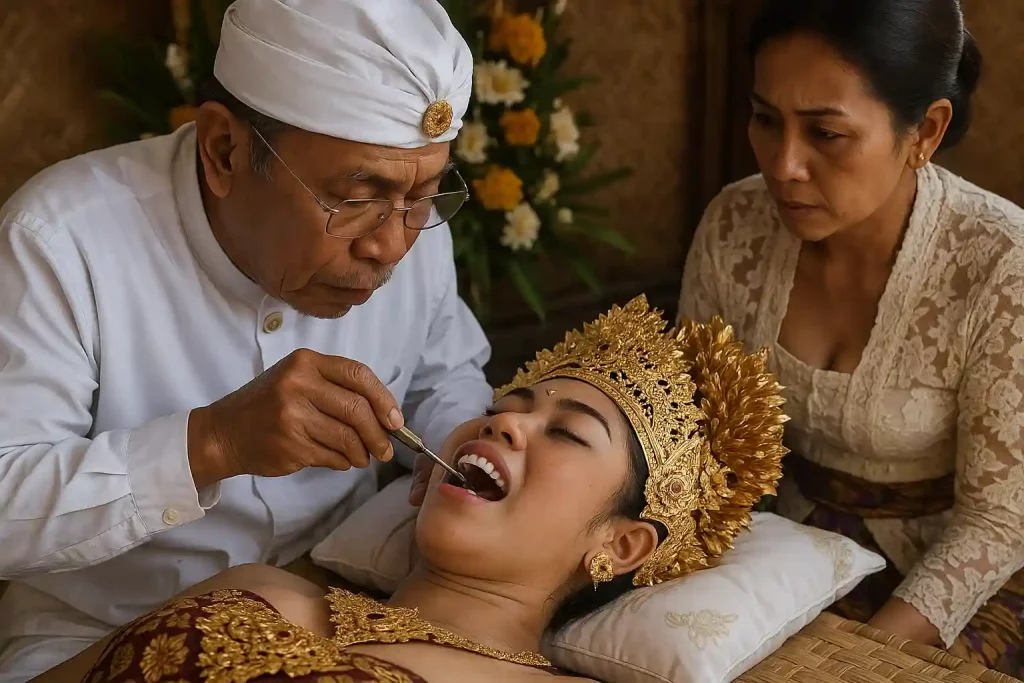
- The practitioner: often a sangging, a religious specialist trained in filing, who works with a sterilized metal file. In the city, the family first consults a dentist to ensure there are no cavities or infections.
The banjar (neighborhood council) lends tables, gamelan, and hands for decoration. All of this serves as a reminder that an individual never enters adulthood alone: they are supported by their clan.
The Setting: Ceremonial Pavilion Transformed into a Sacred Dental Salon
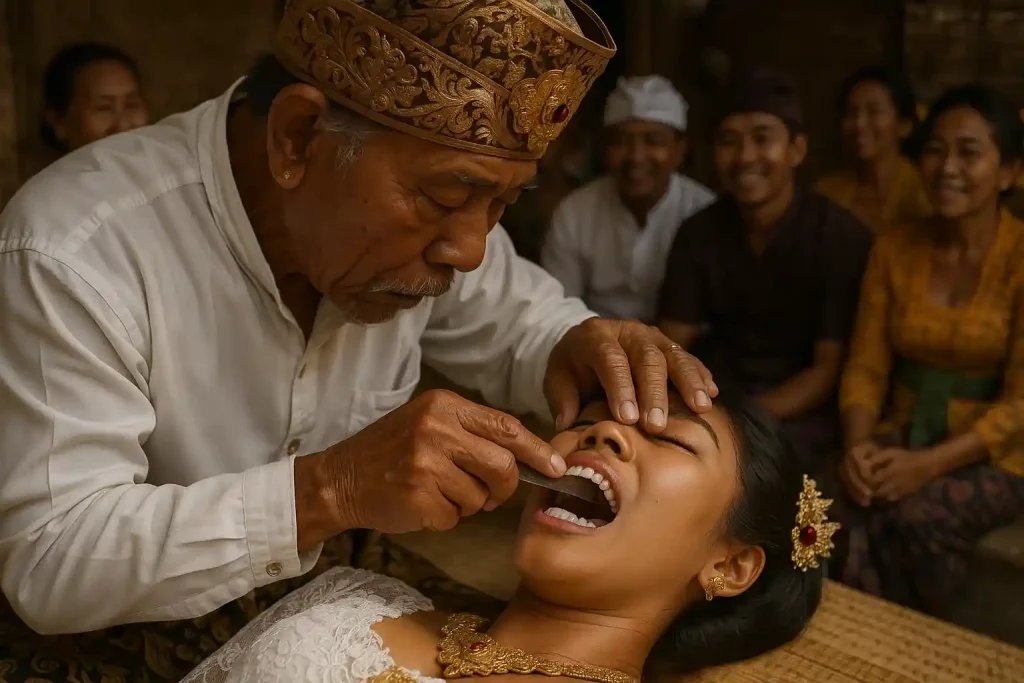
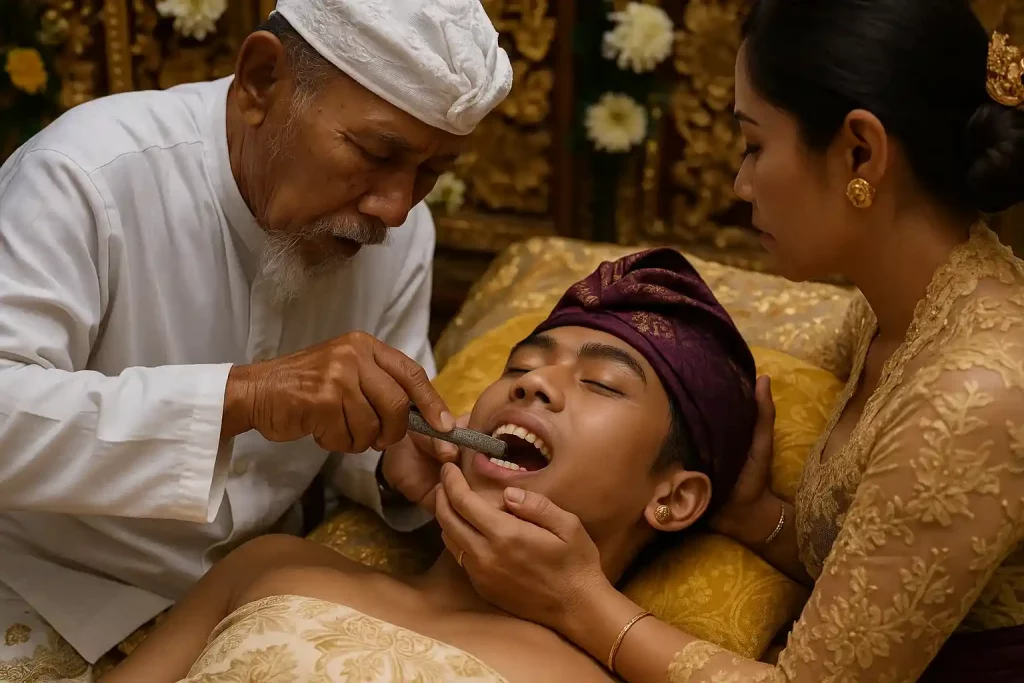
On the morning of the rite, the family courtyard is covered in white and yellow draperies. In the northeast—the sacred direction linked to the gods—a low bed covered with a mat and a pillow is set up. This is where the candidate will lie down, with their head toward the mountains. Parasols (tedung) in the colors of the Trimurti (white, red, black), planted all around, symbolically protect against negative influences.
The Critical Moment: Six Strokes of the File and a Mirror
First sitting cross-legged, the adolescent joins their hands, receives a blessing of scented water, and then lies down. The sangging gently files the tips of the six upper teeth; they remove only half a millimeter, just enough to round the edges. The sensation feels more like a vibration than pain.
The rite ends when the officiant presents a mirror: the young person discovers their new smile, while relatives applaud. The shyer ones blush; the extroverts brandish the mirror like a trophy.
Emotions: Pride, Fear, and Relief
Even if the pain is minimal, the apprehension is real: it is rare to find someone whose hands are not clammy before the filing. Fathers try to be jokers, while mothers sometimes shed a tear. The emotional peak is reached when the enamel dust flies: it is collected on a small cloth and burned, a final gesture to dissipate animal passions.
The Banquet and Socialization: A Meal of Transition
Once the filing is complete, a festive menu is served: saffron yellow rice, sate lilit, lawar with fresh spices, pork (or chicken) skewers, and coconut juice with ginger. No hard foods are served here; peanuts and chips are avoided to let the teeth adjust to their new shape. Guests offer a gift in an envelope (50,000 to 100,000 IDR) to cover part of the expenses. For the first time, the young adult moves from table to table, thanking everyone and taking selfies: they assume their social role, now a “complete” interlocutor for the community.
Social Implications of Mesangih: Marriage and Decision-Making
Officially, a Balinese person who has not undergone tooth filing remains “incomplete.” Some families refuse to marry their daughter to a boy who has not performed the Mesangih. In the business world, it is said that a new employee carries more credibility—especially in banks or traditional hospitality—once they have passed this rite. More subtly, the young person can now participate in banjar meetings and vote.
Modern Adaptations: Private Clinics, Local Anesthesia, Instagram Live
In Denpasar and Sanur, dental clinics offer a “Mesangih package”: anesthesia, single-use sterile files, a certificate, and even a mini-buffet. Urban parents appreciate the hygiene, but some grandparents regret the loss of the sacred dimension. On social media, the hashtag #potonggigi has thousands of videos. Priests are not troubled by this: publishing the rite, they say, can inspire other families to perform it.
Advice for Travelers on Vacation in Bali: How to Attend with Respect
During your vacation in Bali with friends or family, the opportunity to participate in a Mesangih may arise. A few tips on proper conduct are therefore welcome if you wish to enjoy it with respect and authenticity.
- Attire: Sarong and sash for everyone, arms covered for women.
- Gift: Prepare a discreet envelope with 100,000 IDR to be placed in the designated box.
- Photos: Always ask for permission; no flash or close-ups of open mouths.
- Behavior: Avoid making faces or showing excessive pity; pride takes precedence.
- Tasting: Accept at least a portion of yellow rice, a symbolic gesture of sharing.
Discovering Bali through Mesangih, a Gateway to Balinese Culture
The Mesangih reveals the discreet grace of Balinese rites: little spectacle for the hurried tourist, but a profound inner resonance. It serves as a reminder that, on the Island of the Gods, the beauty of a smile is not merely aesthetic; it becomes a mark of self-mastery, responsibility toward the clan, and a readiness to love.
Watching a Balinese adolescent leave the ceremonial cushion, their tooth tips newly rounded, is to see a metaphor: passions are polished, the being softens, ready to embrace life with a fresh perspective. It is a lesson that the traveler carries long after their stay in Bali.
So if, during your next tour in Bali, you hear gamelan echoing in a courtyard and are invited to attend a Mesangih, do not refuse: you will have the chance to glimpse one of the essential rites of passage of this culture, where enamel and soul meet to mark a luminous entry into the adult world. Selamat jalan!