 Skip to content



A shared soul: why Balinese culture is the key to a truly authentic trip to Bali
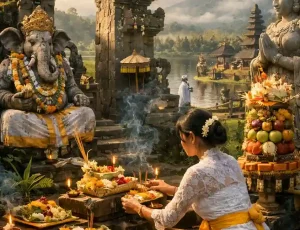
Far from the world’s hurried roads, there is an island that breathes differently. An island the rushed holidaymaker passes through as one brushes against a dream—without grasping it—while the attentive traveller learns to listen. That island is Bali. Not the postcard Bali, but the one of subtle incense, age-old rituals, temples that whisper to the wind, and volcanoes that rumble with ancient truths. Bali, the Island of the Gods, does not reveal itself at first glance: it must be tamed, it must be earned. And for anyone seeking more than a stay—seeking an encounter—there is no other gateway than understanding its culture and traditions.
Amanaska Bali, as a faithful guide to emotion, offers far more than tours. We invite you to awaken, to a poetic experience, to that slow descent into oneself that often begins with an ascent… toward the other. The third pillar of our editorial line, entitled Culture and traditions, was born of this conviction: you must understand in order to love, and love in order to be fully immersed.
Knowing, not only to see, but to understand
The introductory article in this series—The true history of the island of Bali—is a fresco, a historical breath. It is not about reciting dates, but about understanding how the island was shaped: by lava, by the sacred, by the exile of Javanese Hindus, and by the blending of beliefs. Here, history is not fixed: it dances, it is recited at the edge of the rice fields, it slips into everyday gestures, into the names given to children according to their birth order.
Because in Bali, traditions are not relics; they are living roots. In The mystery of Balinese names, you discover that every human being already carries, in their name, a story. A rank, a role, a place in the world. Nothing is left to chance in a society where harmony prevails over the individual. The aim is not to stand out, but to be in tune.
Rites to express the invisible
In this collection of articles, ceremonies take centre stage. Not for their apparent exoticism, but for their symbolic power. Starting with Melasti, the great Balinese purification, a procession to the water to cleanse souls and sacred objects; or Mesangih, the tooth-filing rite, a passage into adulthood, like an inner polishing of the soul. Far from being anecdotal, these ceremonies are the breath of the Balinese people, a collective heartbeat.
Every festival, every offering, every dance is a message addressed to the invisible world. Read Galungan, between gods and ancestors, to understand this suspended time when the spirits of the dead return to visit the living. You grasp the permeability between worlds, the beauty of a society that has not broken with its dead, but celebrates them, listens to them, welcomes them.
And what about Makepung, the buffalo races in the rice fields? It might seem rustic, anecdotal. In reality, it is a poem of the earth, a tribute to effort and to the strength shared between human and animal. Here again, everything is ritual, everything is offering.
Volcanoes, temples, and the breath of the gods
Balinese culture is not limited to its rituals: it is embodied in its landscape, shaped by the gods themselves. Mount Agung, in its unsettling majesty, is revered as the centre of the Balinese world. Mount Bromo, though on Javanese soil, illustrates the same earthly sacredness: where the ground rumbles, the divine reveals itself.
In this series, volcanoes are not described as simple hiking spots. They are characters. Gunung Merapi, Kawah Ijen, Mount Batur… all are steeped in myth, bearers of lessons, and above all reveal a relationship with the world marked by humility. You do not climb them; you bow to them.
In the same way, temples are not cold monuments. Better understanding Balinese temples means understanding the living fabric of society, where every stone is a vow, every courtyard a world. The temple is not outside life; it is its centre—and often its stage as well.
An inspired way of life, a music of the world
Finally, no cultural panorama of Bali would be complete without mentioning the gamelan. This otherworldly orchestra, made of gongs, metallophones, and bamboo, seems to play the thoughts of the ancestors. The article The secrets of Balinese gamelan explores its harmonics, but also its philosophies: here, music is not a technical display; it is fusion, listening, prayer.
And that is, perhaps, the secret lesson of this series: Balinese culture is not external knowledge, but a way of life in which you learn to listen. To listen to the elders, the spirits, the forests, the winds, the silence. To fall silent in order to receive more fully.
A prerequisite for wonder
Thus, these articles are far more than preparatory reading. They are keys. Keys to travelling differently. To not only take photographs, but to feel. To not consume a place, but to inhabit it, even for a brief moment.
Here, everything is symbolic. At Amanaska, we believe you must know these symbols for your trip to Bali to become a rite of passage. Because Bali’s true beauty cannot be seen. It is understood; it is learned. And when you understand it, it transforms you.