 Skip to content



In Bali, there is a scene that almost everyone experiences in the very first hours: these small arrangements of leaves, flowers and incense, placed in front of a door, at the foot of an altar, on a low wall, sometimes even on a pavement. Many travellers see them as part of the scenery.
And that is where you miss what matters most.
Because in Bali, an offering is not an extra touch of folklore. It is a language.
A silent language, repeated, precise, codified.
A language that:
- says thank you
- asks for protection
- marks a threshold
- restores balance to a tension
- opens an everyday action
- closes a stage
And above all:
A language that connects.
Researchers who have studied Balinese ritual practices insist on one important point: understanding Bali is not only about understanding beliefs; it is about understanding practices—what people do, make and offer every day.
For many travellers who come to discover Bali, offerings are one of the most valuable keys to understanding the local culture.
So we will keep it simple, but serious: set out the vocabulary, understand what these gestures create in Balinese life, and give you the keys to look at them with respect and insight.
Banten and canang sari: the offerings you discover on a trip to Bali
In many descriptions, including in museums, banten is presented as the generic term for offerings in Balinese Hinduism.
These offerings can be very simple or extremely elaborate depending on the ritual context.
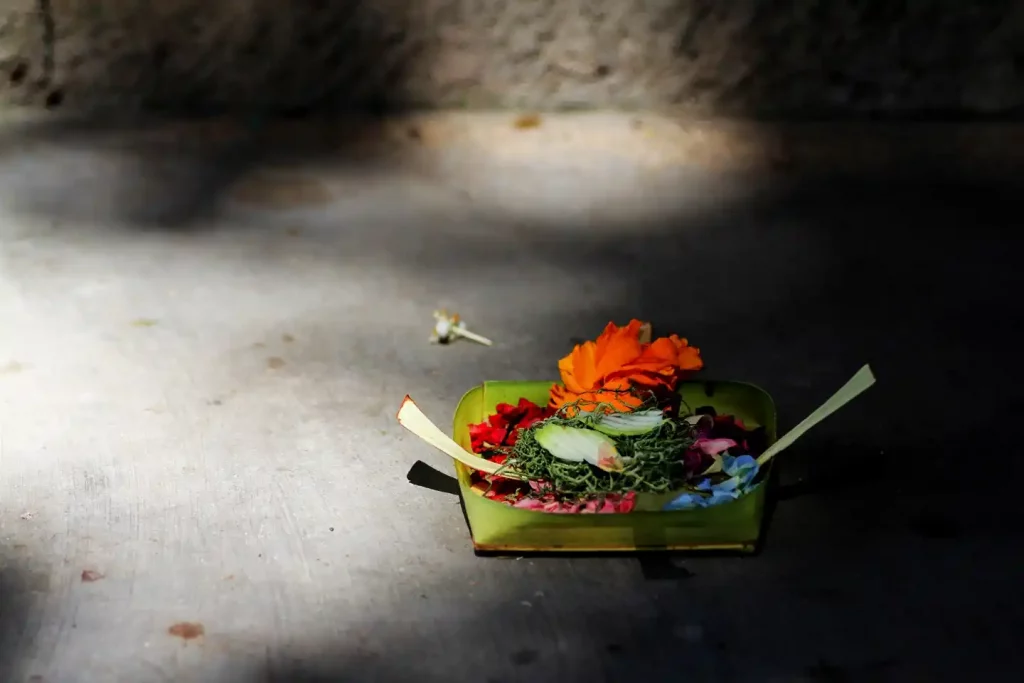
Among them, there is one form that travellers see everywhere: the canang sari.
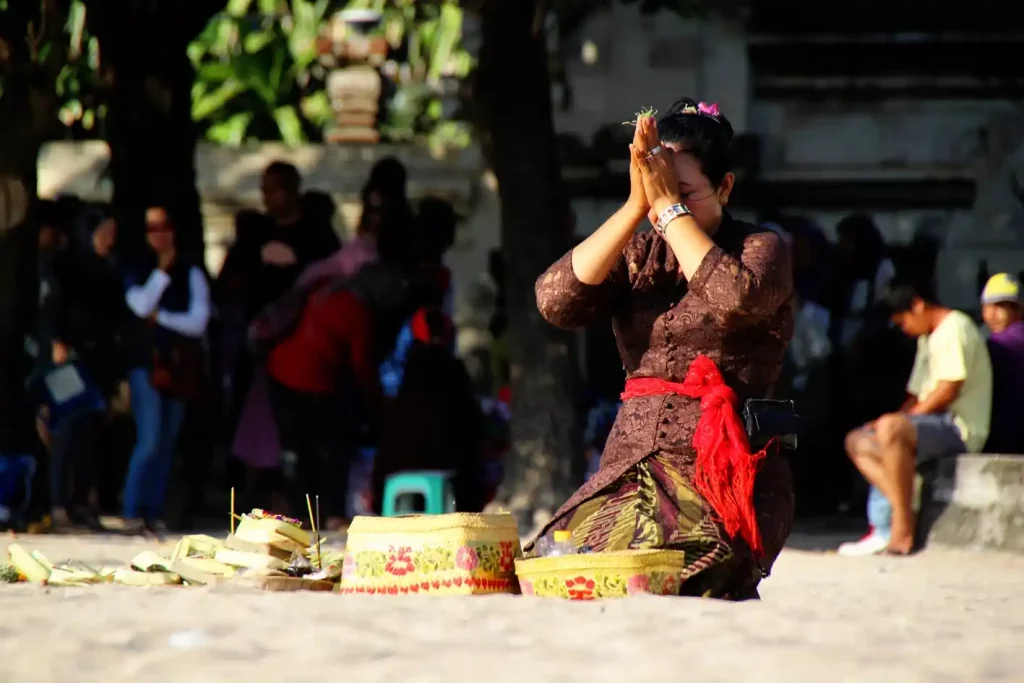
The University of British Columbia Museum of Anthropology explains that these daily offerings are placed around the home, in the family shrine, or by the roadside, as an expression of gratitude and devotion.
Please note:
Simple does not mean insignificant.
Simple means suited to everyday life.
And therefore fundamental.
The visible and the invisible: why offerings are everywhere in Bali
A key to understanding lies in the coexistence of two dimensions:
- the visible
- the invisible
Academic work explains that rituals and offerings are used precisely to connect people with beings from the non-visible world.
Put another way:
The offering acts as a bridge.
It creates a link between realities that Balinese culture considers complementary.
And this link is not limited to the temple.
It exists:
- in the home
- in the courtyard
- in the shop
- in the fields
- in workplaces
For travellers who wish to go to Bali, understanding this logic profoundly changes how you perceive everyday life.
What offerings will bring you during your stay in Bali: gratitude, balance and protection
From the outside, you might think an offering is only used to ask for something. In reality, it fulfils several functions at the same time.
1. Saying thank you
The register of gratitude is central.
Giving thanks:
- for life
- for food
- for the home
- for peace in the household
- for the protection received
The Museum of Anthropology explicitly describes offerings as a sacred way to express gratitude and devotion.
2. Maintaining harmony (Tri Hita Karana)
Several studies link offerings to the Tri Hita Karana philosophy, which seeks harmony between:
- humans and the divine
- humans with one another
- humans and nature
This logic also appears in Balinese cultural landscapes recognised by UNESCO.
During a family stay in Bali, this notion of balance often helps you better understand Balinese values.
3. Marking a threshold and opening an action
Offerings are also used to accompany important beginnings.
For example:
- before a construction project
- before a ceremony
- before a community activity
An ethnographic study devoted to ogoh-ogoh shows that it is common to place a canang sari in order to symbolically ask permission and support before starting an action.
Sacred plants: a cultural ecology you discover on a trip to Bali
What immediately stands out in Bali is the constant presence of plant life.
Offerings are largely made up of:
- leaves
- flowers
- local plants
Ethnobotanists have documented the use of 125 plant species in the ceremonies of Bali Aga communities.
This richness reflects:
- know-how
- cultural memory
- family transmission
For travellers who come to discover Bali, this reveals another dimension of the Balinese relationship with nature.
Offerings today: a living tradition that evolves with Bali
Recent research also shows that making offerings every day takes time.
A study published by Ganesha University of Education explains that some families now buy their canang sari from specialised vendors.
Offerings remain central.
But how they are made and circulated is evolving with Balinese society.
This is an important point:
Bali is not a frozen postcard.
The tradition continues to live and adapt.
Lamak and large ritual compositions during a holiday in Bali
When travellers think of offerings, they often picture the small baskets placed on the ground.
Yet Bali also uses much more elaborate ritual supports.
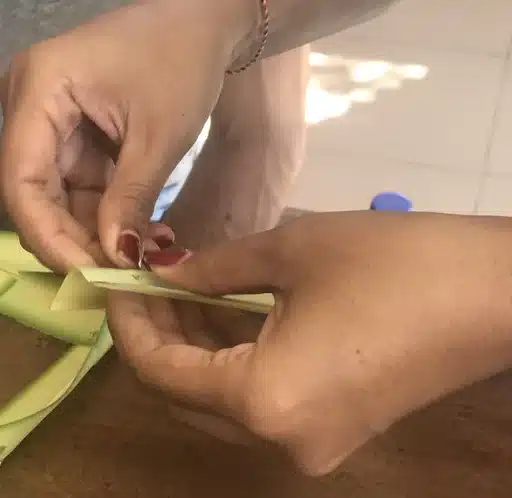
Ethnologist Francine Brinkgreve describes the lamak in particular, a long ritual hanging made of palm leaves used in many rites.
The lamak serves in particular as:
- a support for offerings
- a symbolic interface with ancestors
- a link with the deities
This aesthetic is not only decorative.
The form fully contributes to the effectiveness of the rite.
How to respect offerings on a trip to Bali
You can love Bali deeply without trying to imitate the Balinese.
The most important thing is to avoid missteps.
A few simple habits:
- do not deliberately step on offerings
- watch where you put your feet
- avoid moving offerings to take a photo
- remain discreet around altars and sacred places
The official guide for tourists from Badung Regency explicitly reminds visitors not to step on canang sari placed in public spaces.
And if it happens by accident?
It can happen.
The right response is simply to remain respectful and carry on calmly.
Bali is also felt in these small everyday gestures
If we had to sum it up, Balinese offerings are a true grammar of everyday life. They speak of balance, a relationship with the living world, respect for thresholds, a link with the invisible, and a spirituality that is made as much as it is thought.
And for you, travellers, it is a chance: because it is precisely in these details that Bali stops being an “exotic” backdrop and becomes an island you begin to understand.
That is exactly what our travel agency in Bali aims to create: trips where you do not “consume” Bali, but approach it with the right codes, at the right pace, and with clear explanations so you can feel without disturbing, and leave with something more than photos.