 Skip to content



You would like to take a trip to Indonesia but you do not know which luggage to choose. For a trip to Bali, the choice will not be the same as if you are travelling to Flores or Sumatra. Likewise, the means of transport will determine the type of luggage you should take, between suitcases and a backpack. In short, it all depends on your itinerary: to choose your luggage for Bali, you mainly need to consider hotel changes and their locations. In general, one or more wheeled suitcases are suitable. However, if you plan to visit other nearby islands, it is best to take an extra bag with belongings for two or three days and leave your suitcases at our agency: it will be simpler and you will not be burdened.
As soon as your trip to Indonesia includes two or three islands, your choice of luggage becomes more important. While one or more suitcases may be suitable for Bali, discovering Sulawesi and/or Sumatra will require more travel, using transport that is not necessarily designed for travellers with wheeled suitcases. That is where backpacks come in.
Between a high-mountain backpack and a large wheeled suitcase, it is not always easy to find your way. Yet choosing the type of luggage you will take with you is important if you do not want to regret it later. A wheeled suitcase can indeed slow you down considerably if you have decided to climb a volcano.

Your luggage is your travel companion and it simply needs to be suited to the type of trip, taking into account its duration and theme. For those who are used to travelling, it is always practical to have several types of luggage, from a 20-litre backpack to a large wheeled suitcase, so that you can leave with the format that suits you perfectly.
Choosing your luggage based on the length of your stay in Indonesia
For short stays in Indonesia, a small cabin suitcase of 40 to 56 cm maximum is preferable. This will save you time when boarding and disembarking during your flights. It is important to check in advance, as some domestic airlines, such as WOWAIR, limit dimensions to 42 x 32 x 25 cm. In addition, as a savvy traveller, you will check that there is no surcharge even for cabin baggage: this can also happen with some low-cost airlines. A backpack, if it is a reasonable size, is easier to carry and may allow you to slide it under the seat.
If your stay lasts one to two weeks, it is preferable to opt for a larger suitcase, 65 to 75 cm. For 3 weeks, you can go up to 81 cm, but beware of the weight trap: the larger the suitcase, the more you fill it, which can cause problems depending on the checked baggage allowance. Moreover, while airlines often allow an average of 20 kg, a second flight with a different airline may limit baggage to 15 kg, which will force you to pay an extra fee.
Choosing your luggage for your trip to Indonesia: suitcase or backpack?
Depending on the theme of your stay and the direction of your itinerary, it is important to choose your luggage carefully, otherwise it may become a burden that you will have to drag around with you. Luggage selection is too often neglected, which ultimately turns smooth, simple planning into constant logistical considerations:
- What should you do with the suitcases?
- Why carry a huge backpack for a jungle walk that was meant to be simple and enjoyable?
- Will the paths and roads we are going to take be suitable for our wheeled suitcases?
- Do I need to take my large suitcase on the boat that will take me on a stopover before returning to the same hotel?
It is up to you to determine what suits you best, keeping in mind that your luggage will then be handled by carriers. If you prioritise your comfort at the expense of porters and ease of getting around, you risk waiting indefinitely for your luggage and/or having it become more of a source of problems and inconvenience than of practicality.
Choosing to travel with one or more suitcases?
Your luggage must above all be suited to your stay and the type of terrain. If you have chosen a seaside stay, there is no need to worry about your luggage: once in the room, it will not move again until your departure. A few hotel-to-hotel stops? In that case too, depending on where they are located, a suitcase can be a good option, combined with a small extra backpack.

Prefer that each participant in the trip is responsible for their own suitcase, even children, who can have a small wheeled suitcase, such as a “Dora the Explorer” style. This will help them feel included and involved in organising the trip.
This will allow you to:
- in case of loss, avoid having several people’s clothes disappear at the same time,
- check more easily that all suitcases are present,
- have lighter suitcases and therefore make transport easier,
- share responsibility for luggage instead of concentrating it on one person.
Small tip: as a family or group, always plan to take a cabin suitcase or a bag that brings together a change of clothes for each family member, plus the essentials already in the individual suitcases (medication, copies of important documents, a credit card, and some cash). This organisation will ensure that, in the event of loss, forgetting, or damage to your luggage, you always have a plan B.
What type of suitcase: soft or hard?
Soft suitcases have the advantage of being lighter. They also offer greater flexibility thanks to their integrated expansion gussets and, depending on the model, they can be easier to store. The downside is that they are more fragile and not all of them are truly waterproof. Fabric suitcases are certainly cheaper, but they are not water-resistant and stain easily. Moving upmarket, ballistic nylon or Cordura fabric helps limit abrasion and tearing. There are also soft suitcases in leather or nylon, which remain sensitive to impacts and scratches. Example model: EASTPAK Tranverz L, 121 litres.
Hard suitcases, on the other hand, are sturdier. The volume is not adjustable and they are heavier, but they are waterproof and protect the contents effectively. They can be made of ABS (acrylonitrile butadiene styrene), a material that does not withstand “clumsy” handling by airport staff and can crack. As the range has evolved, suitcases made of polycarbonate or polypropylene (slightly higher price) are now available; their particularity is that they deform on impact and return to their original shape under opposing pressure. Some materials mix polyacrylate and ABS, but they perform less well than 100% polyacrylate. Example models: Alex by HAUPTSTADTKOFFER, 70 litres, or Samsonite S’Cure suitcase, 102 litres.
In both cases, check all options, accessories, and interior pockets carefully. Test the strength of the zips and locking systems. Look at the quality of the inner lining, stitching, and straps for holding clothes in place. The overall impression should be one of reliability. You will have the choice between 4 wheels, which are easy to manoeuvre, and 2 wheels, which offer more interior space. As for colour, choose bright colours: you will find your luggage more easily on airport carousels. If you prefer discretion, add a coloured ribbon or stickers to personalise it: this will be useful for recognising it at the hotel and describing it in case of loss.
If, on the contrary, you are setting off on an adventurous, itinerant trip—from island to island, in the jungle or the mountains—a backpack will be more suitable: wheels are not practical in sand or on trails.
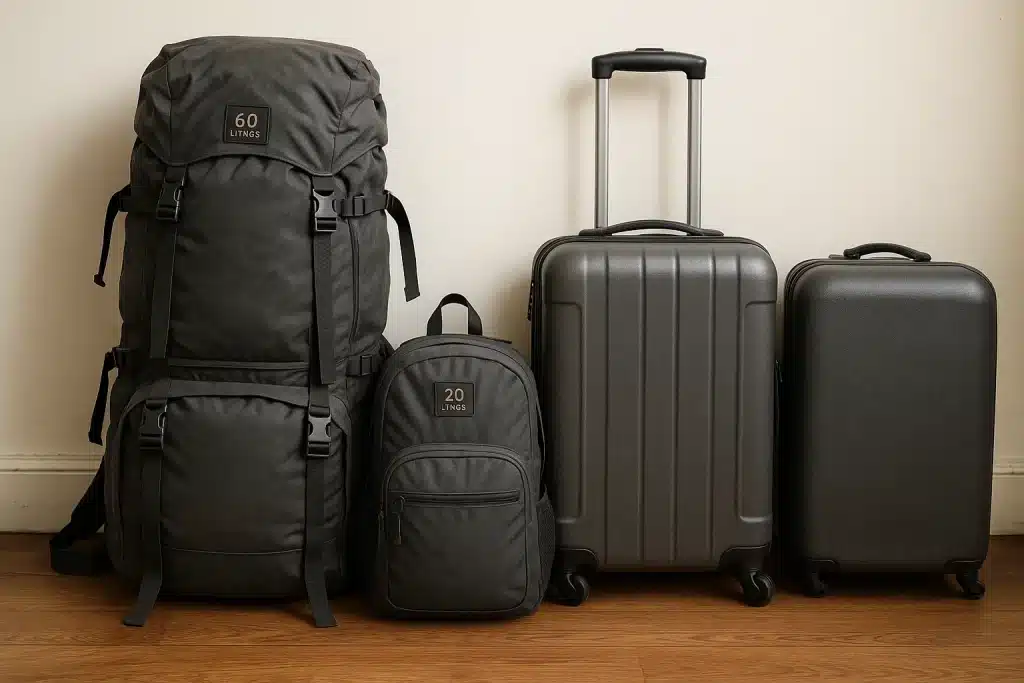
Travelling with a backpack
You have an idea of your itinerary in Indonesia and you know that you will often change locations and sites, with many transfers that are sometimes unpredictable. You want to be mobile and agile, you like being independent, and carrying weight on your shoulders does not bother you: a backpack is your friend. You still need to choose it well.
Choosing your backpack
There are three types of backpacks:
- small ones, with a volume of 10 to 20 litres,
- medium ones, from 20 litres,
- large ones, 40 litres and more.
A backpack is above all personal and must be chosen carefully.
- Avoid borrowing one: it must suit your body shape.
- Choose the bag according to your sex: if there are models for men and for women, there are good reasons for that.
- Prioritise comfort: sturdy adjustment straps, padded shoulder straps, all easily adjustable.
- Try your bag before buying it: it should not pull on your shoulders or fit the lower back poorly.
- Check that it is waterproof, with sturdy fastenings and strong stitching.
- Think about the contents before choosing the size: too big or too small, it will become a problem.
- Open the bag, test the closures, look at the compartments and how easy it is to access the pockets.
- Compare direct and indirect access: some bags open from the top, others from the front.
In our own Amanaska selection, for our scouting trips and travels, we use, depending on conditions: the Quechua MH500 40 litres, the Stratos or Atmos range from Osprey (lifetime warranty), the AIRCONTACT 55+10 from Deuter, or the 50-litre Travet 500 Forclaz for women.
Note: if your itinerary is a mix of adventure and a more sedentary stay, you can opt for a compromise: a wheeled backpack. It does not have the function of a classic hiking backpack, but on difficult terrain or over short distances, where wheels no longer work, switching to the straps can be very practical. In our selection, we recommend: the Osprey Packs Sojourn wheeled luggage and the Osprey Meridian 60 Unisex, which has the advantage of offering an extra daypack.
Ultra-light, compressible daypacks
Ideally, you should have one backpack per person, plus a smaller bag that, once you have put your bags down at your accommodation, will be used to carry the essentials. These daypacks are truly practical and have the advantage of being sold in a lightweight, easily compressible version, such as the ultra-compact 20-litre backpack from Forclaz or the Osprey Ultralight Stuff Pack Unisex. These small bags allow you, in any situation, to add volume to your initial storage, have a waterproof and durable bag available, and, if needed, enjoy a small cushion for transport.