 Skip to content



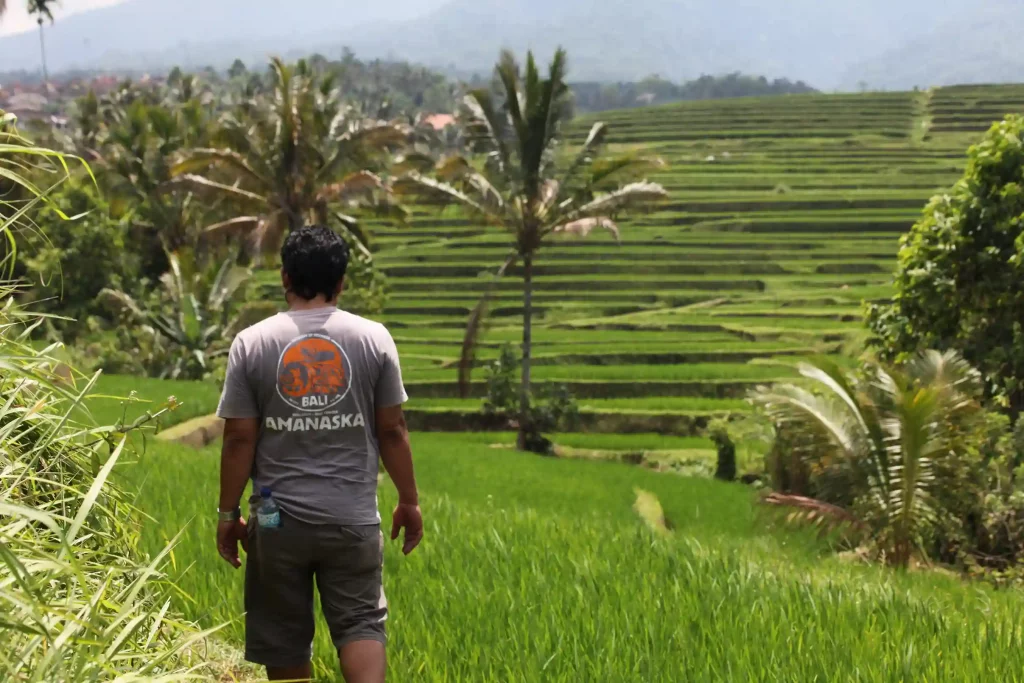
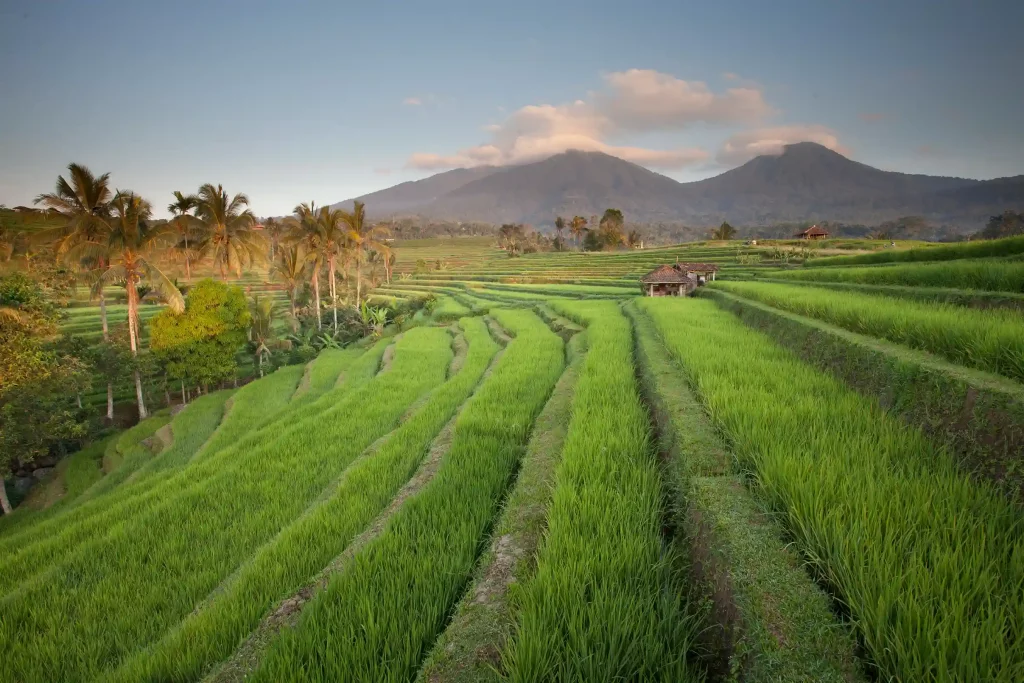
During your trip to Bali, you will inevitably pass by rice paddies that are magnificent scenes under the sun of the Island of the Gods.
Yet, a question has persisted since time immemorial: “But how can this perfect cascade of water and greenery function for a millennium without modern dams?”
Did you know that a simple bell chime, a handful of flowers, and a village meeting can determine the exact moment each plot will be flooded?
And that the same bell also serves as a religious reminder, an economic sharing rule… and even an ecological “contract”?
If these questions intrigue you — whether you are preparing a trip to Bali, a tour of Bali, or are simply curious to understand what brings the “Island of the Gods” to life — delve into the world of the Subak.
You will discover:
- How a system born in the 11th century still regulates water, the agricultural calendar, and social relations today.
- Why each watering is preceded by a prayer called Mapag Toya and protected by the Pura Ulun Suwi temple.
- How the hydraulic distribution follows the same “triad” principle as Balinese architecture, prayer, and even cuisine.
- What the Subak can teach us, as modern visitors or agronomists, about sustainability and shared governance.
Ready to understand how Bali combines engineering, spirituality, and solidarity?
Then let’s continue: the water begins to flow, and each terrace has a story to tell.
The Subak: Hydraulics, Calendar, and Spirituality of a Balinese Rice Paddy
Historical Birth of a Unique System
The first written records of the Subak date from a royal charter of 1071 AD., found in the Gianyar district; it already mentions the distribution of water among “rice paddy brothers” and the duty to maintain the Pura Ulun Suwi (water temple).
Everything suggests that the system is older: it relies on dikes, canals, and sharing rules that were already mastered in the 9th century in the Warmadewa kingdoms.
In 2012, UNESCO inscribed five Subak landscapes and their temples on the World Heritage List, deeming the system a “masterpiece of communal engineering and religious ecology.”
Definition and Conceptual Foundations
A Subak is both:
- A hydraulic territory: all terraces irrigated by the same water diversion;
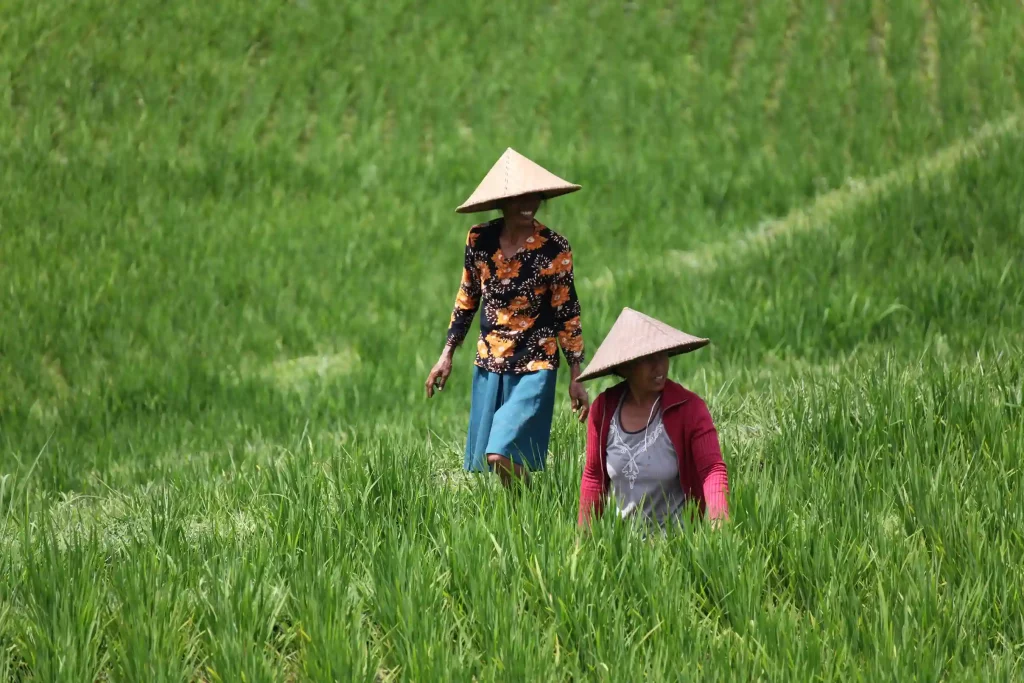
- A farmers’ cooperative: all owners whose fields receive this flow are members (krama subak);
- A ritual body: the Subak finances offerings, processions, and repairs of the associated temple.
The guiding principle is the Tri Hita Karana doctrine: balance between humans, gods, and nature. Water, perceived as a blessing from Wisnu and Dewi Sri, must therefore be shared without harming protective deities or neighbors.
Cultural Originality of Bali
Unlike most canals in Asia, water is not allocated by a landowner or a state, but by the community itself; the elected leader, the Pekaseh, acts on an assembly mandate.
Each decision combines three dimensions: technical (flow), legal (customary law awig-awig), and religious (calendar of offerings).
It is this hydraulic-ritual fusion that makes the Subak unparalleled: it aligns the flooding of a terrace with the date of a ceremony and, conversely, triggers a collective prayer when a water intake is modified.
Practical Organization
- Hydraulic Hierarchy:
The main intake (weir) captures a mountain river.
The mother canal feeds distribution boxes (temuku) cut to a 1:2:1 ratio; the upstream receives more than the downstream, but cedes part of its quota during the dry season. - Elected Functions:
Pekaseh (chief), Petajuh (deputy), Penyabih (treasurer). Mandates last three years. - Meetings
The assembly is held every Kajeng Kliwon (every fifteen days of the Pawukon calendar). Fines or community service are voted on by show of hands. - Sanctions
Cutting off a neighbor’s water is punished with a fine in rice or free participation in earthwork chores.
Agricultural but also Environmental Utility
The Subak regulates:
- Soil moisture: water flows in a thin film, limiting mosquitoes and acidification;
- Temperature: one meter of water stores daytime heat and protects young plants at night;
- Biodiversity: between two cycles, farmers raise carp, eels, and frogs; these species eat pest larvae.
This technical-ecological synergy explains why a trip to Bali or a tour of Bali focused on rice paddies is so different from a simple visit to terraced plantations elsewhere in Indonesia.
The Main Rules
- Collective Opening: no one can flood their plot alone; the first watering must be communal.
- Unified Calendar: everyone sows and harvests at the same time to deprive birds of refuge and reduce pests.
- Mandatory Rest: three weeks of hydraulic fallow (“rest of the earth”) after harvest.
- Proportional Offering: the larger the plot, the more flowers, rice, or oil the family must provide for the temple.
Detailed Agricultural Calendar of the Subak
The Subak follows two markings.
Sasih Lunar Calendar (12 months of 29 to 30 days)
- Sasih Kasa (July): canal repair;
- Sasih Karo (August): first watering;
- Sasih Ketiga (September): transplanting;
- Sasih Kelima (November): flowering;
- Sasih Kesanga (March): harvest, before Nyepi.
Pawukon Calendar (210 days) for Rites
Each phase of rice (young, tillering, heading, milky grain, maturity) corresponds to a sacred week: Kalabang, Sinta, Landep, etc.
In northern Bali (Buleleng), the opening often occurs in December; in the south (Tabanan, Badung), April-May is preferred to avoid tourist competition during the high season — useful for those traveling with family to Bali outside the European summer.
Pura Ulun Suwi: The Source Temple
Each Subak is attached to a Pura Ulun Suwi (“temple of the origin of waters”). Located near the intake or a sacred spring, it serves as a “ritual counter.” Members must:
- Clean the basins once a month;
- Replace the thatched roof of the central sanctuary every three years;
- Provide oil and wicks for clarified butter lamps.
Mapag Toya or the Great Prayer for the Opening of Water
Before the first flood, the community organizes the Mapag Toya ceremony (“welcoming the water”):
- Women carry gebogan of fruit to the temple;
- A Brahmin recites the Gayatri mantra facing the intake;
- The Pekaseh plunges a wooden dagger into the water: if the body floats flat, the season will be favorable;
- A canang sari is hung on the central pillar of the dam;
- Three bell chimes give the signal: the sluice gates open; the water reaches the first terrace about twenty minutes later.
This liturgy shows that irrigation is not considered a purely technical act but a permanent negotiation with the invisible.
This is why the Subak fascinates travelers discovering Bali: one can directly observe a hydraulic network regulated… by prayers.
Why the Subak Matters to Travelers Visiting Bali
- For those looking for when to visit Bali, knowing that July-August corresponds to the cutting of the dikes allows them to witness the repairs.
- Fans of a culture-focused stay in Bali can attend the Friday Kajeng Kliwon offerings.
- Families traveling to Bali discover a cooperative model where every child carries a basket of offerings from the age of six.
- Those wishing to organize their Bali tour around UNESCO landscapes can combine Munduk, Jatiluwih, and the Subak Museum in Tabanan in the same itinerary.
What the Subak Reveals to Travelers on Holiday in Bali
Born a thousand years ago, the Subak remains the vital artery of the island: without it, no terraced rice paddies, no source temples, no landscapes featured in “discover Bali” brochures.
The Subak, though ignored by many tourists, transforms the island and gives it its soul, its reason for being.
While it offers agricultural yield, it primarily guarantees social cohesion: water is shared equitably, every drop is counted, blessed, returned.
In an era where sustainable agriculture is debated, the Subak proves that a hydraulic system can nourish, unite, and sanctify all at once — further proof that, on the Island of the Gods, technology remains inseparable from ritual.