 Skip to content



The Structure of Balinese Temples
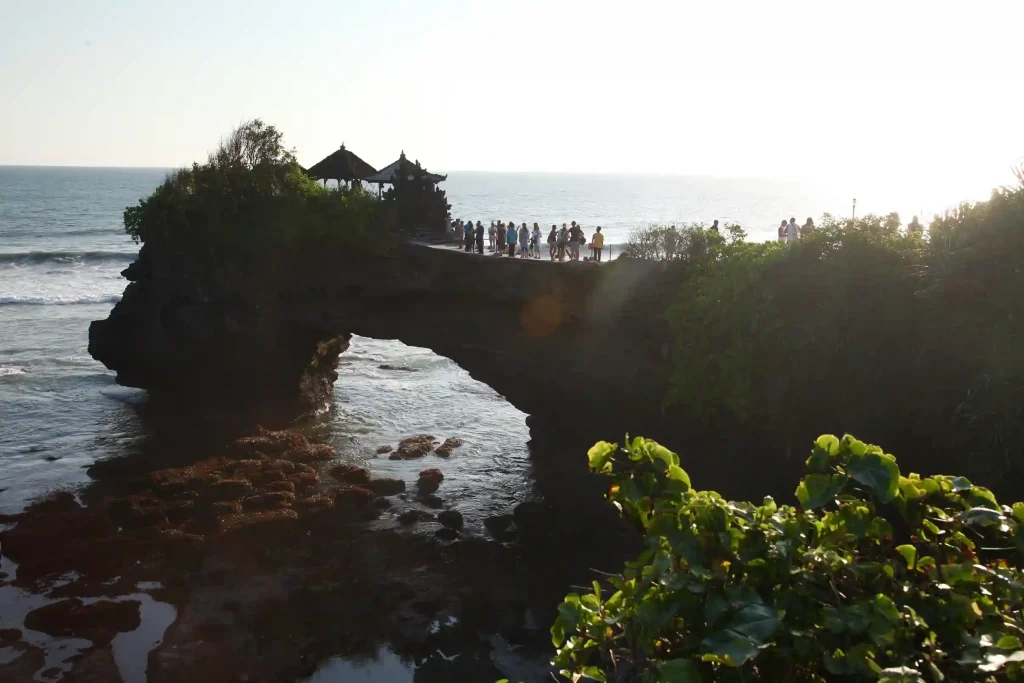
While in Java or India, the aim is to capture and materialize the sacred within the temple, notably through numerous representations of deities and heroes from the Ramayana and the Mahabharata, in Bali, the temple is above all an offering made to the gods. This partly explains the baroque profusion – the small, juxtaposed incrustations without necessarily any links or meaning to interpret them. The temple also serves to welcome the gods during ceremonies.
The fact that temples are roofless and house empty seats where no one sits, the padmasana, bears witness to this. Nevertheless, Balinese temples adhere to the elementary rules of Hinduism. They are divided into three parts, and the various sanctuaries are generally arranged on a flat plane, unlike in Java where terraces are superimposed. Temples are built either from para (black volcanic rock) in the north, or from red brick in the south.
As a travel agency in Bali specializing in tailor-made cultural stays, we encourage our travelers to discover this living architecture through guided tours led by priests or members of the banjar. These encounters help to understand how Balinese spirituality is inscribed in stone, silence, and light.
The courtyards feature small, diverse buildings. The first courtyard often has an open-sided pavilion that was used for cockfighting: thus, Balinese people indulged one of their passions while performing a ritual sacrifice — two in one, so to speak.
Another pavilion is used for ceremonial meals, particularly for consuming offerings which, once presented to the gods, are not left in the sanctuary. In the second courtyard is the esplanade used for the council of the banjar and its associations, and generally the enormous banyan (Indian fig tree) serving as a sacred tree. This part is also used to store offerings and sacred masks.
Our tours in Bali often include a moment of sharing in these temple courtyards, where one can observe the preparation of offerings and participate in a traditional blessing. An authentic experience that only a Bali travel agency deeply rooted in local culture can offer.
It is within the third courtyard that the sanctuary itself is located: empty seats (for the gods) are generally arranged there, and meru, towers with thatched roofs, are erected in their honor. The roofs are always in odd numbers: there are generally eleven for Shiva and nine for Brahma and Vishnu.
An immense serpent (naga) lies at their feet; it symbolizes both Vishnu the protector — who stabilizes the Bedawang turtle carrying the world on its back — and the instrument used by the gods to churn the sacred Mandara mountain to beat the sea and extract the elixir of life, the Tirtha Amertha.
This sanctuary is dedicated both to the gods and to ancestor worship: animism and Hinduism thus coexist in the temple.
The last courtyard of the temple is always oriented Kaja; the gate leading to it is therefore called Kori Agung, meaning “gate to Mount Agung” in Javanese. All parts of the temple are separated by openwork low walls and slightly raised symmetrical gates, whose reliefs primarily depict demons. But rest assured, your children: these are “friendly demons” tasked with frightening away the real ones and repelling them from the temple structure.
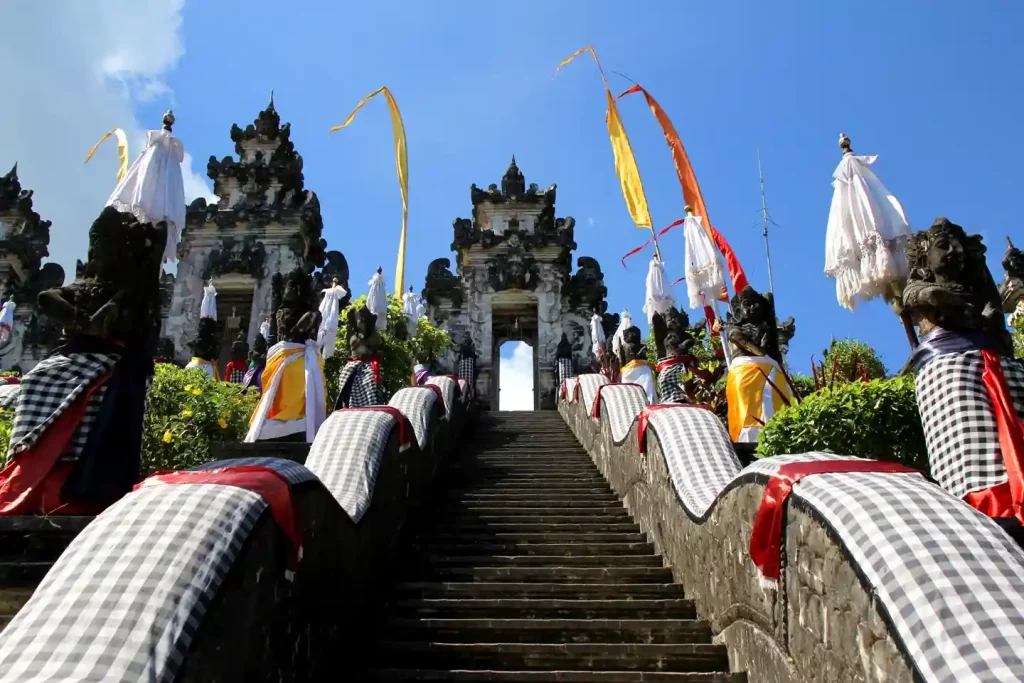
The Temples of a Balinese Village
Each village temple is dedicated to one of the gods of the trinity.
The Pura Puseh, or temple of the founders, is oriented Kaja, meaning towards Mount Agung. It is dedicated to ancestor worship as well as to Brahma.
The Pura Dalem, oriented Kelod (towards the sea), opposite the Pura Puseh, is the temple of the dead, dedicated to Shiva. Those who appreciate reliefs of the Last Judgment and phantasmagorical masks depicting demons and witches will feel at home there.
Finally, the most frequently used temple is in the center: it is the Pura Desa (literally “village temple” in Bahasa), under the protection of Vishnu the protector. This is where the banjar and village associations meet to organize processions and events or to resolve conflicts.
Amanaska, your travel agency in Bali, offers to integrate visits to these temples into itineraries where each stage is designed to connect the spiritual, architectural, and human dimensions. These stops are often an opportunity for privileged encounters with the guardians of the sites or the artisans who restore the volcanic stone sculptures.
It is important to know that Javanese and Balinese Hinduism evoke a supreme god, anterior and substantially different from the trinity of Indian Hinduism. In Bali, this god is named Sang Hyang Widdhi. One day, weary of nothingness, he entrusted his emanations — Shiva, Brahma, Vishnu — with the creation of the world. Only Shiva accepted the task; the others were then repudiated before finally being rehabilitated.
It is also difficult to know whether the padmasana — the empty seat in the most sacred part of the temple, the Kori Agung — is intended for Sang Hyang Widdhi or for Shiva, the two sometimes being confused. You can observe a very beautiful white coral padmasana at the Pura Jagatnatha, on Jalan Sudirman in Denpasar.
Our trips, whether with family or friends, regularly offer visits to this temple, accompanied by a French-speaking Balinese guide who explains the symbolism of the offerings and the link between the Kori Agung and Hindu cosmology. This sensitive and respectful approach, central to the mission of a Bali travel agency aware of its cultural role, transforms a simple visit into a spiritual experience.
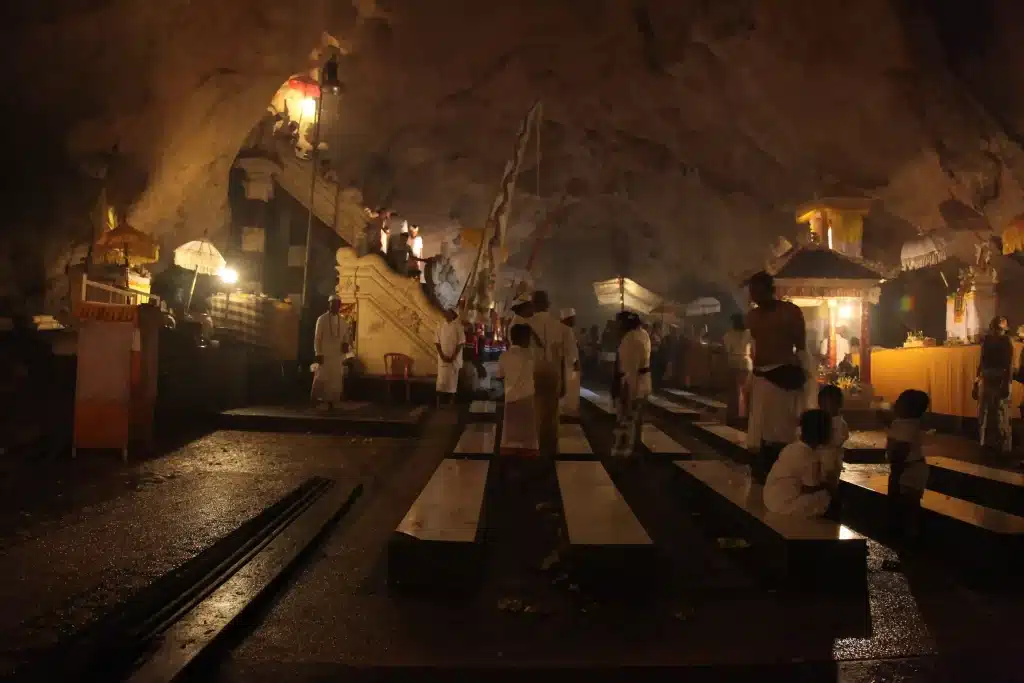
The Nine Balinese Directional Temples
In Bali, orientation has a religious connotation. Balinese people orient themselves primarily in relation to Mount Agung (Kaja), the highest and most sacred on the island, and in relation to the sea (Kelod). Kaja and Kelod therefore take on different meanings depending on whether one is north or south of Mount Agung.
As in all civilizations, the east symbolizes light and life, while the west, where the sun sets, is more associated with death — which may partly explain the east-west imbalance in terms of population distribution, even if geography and climate remain predominant factors.
In Balinese performances, for example, you will see evil characters enter from the south or west, and saviors or good princes from the east or north.
In ceremonies, the priest stands on the Kelod side and the faithful face him.
There are also nine directional temples in Bali located at the cardinal points, allowing inhabitants to orient themselves more easily:
- Pura Luhur Uluwatu — southwest of the Bukit Peninsula
- Pura Masceti — on the south coast, near Ketewel
- Pura Pasar Agung — on the southern slopes of Gunung Agung, in eastern Bali
- Pura Ulun Danu Bratan — on Lake Bratan in Bedugul, in the center of the island
- Pura Ulun Danu Batur — in Kintamani, on the eastern plateaus
- Pura Besakih — on the western slopes of Gunung Agung, in eastern Bali
- Pura Goa Lawah — on the east coastal road, near Padangbai
- Pura Lempuyang — on the slopes of Gunung Lempuyang, near Amlapura
- Pura Luhur Batukaru — on the southern slopes of Gunung Batukaru, in central Bali
Tourist circuits often include some of these directional temples, true spiritual anchors of the island. Traveling with a Bali travel agency like Amanaska means following the invisible thread that connects these sacred places and understanding how each temple symbolically protects a direction of the world and an aspect of the soul.