 Skip to content



If you dream of a trip to Flores where adventure meets cultural encounters, if you long to discover Flores beyond its giant dragons, or simply if you are still hesitating about the very idea of traveling to Flores, we will guide you. Here, roads hug narrow volcanic ridges, Catholic masses coexist with animist rituals, and at every turn, a piece of history can be read in the blue of the sea or the black of a smoking basaltic cone.
The name Flores often evokes, at best, the gateway to Komodo National Park. Yet, this long and thin strip of land stretched between Sumbawa and Timor hides treasures that general brochures overlook: volcanoes with multicolored craters, villages perched in the mist, coral reefs of staggering vitality, not to mention the footprint of a miniature hominid that revolutionized paleoanthropology. For travelers accompanied by an agency specializing in trips to Flores and throughout Indonesia attentive to the cultural dimension, Flores reveals a rawer, more intimate Indonesia.
The Island of Flores: A birth shaped by the depths
To understand the island, one must first dive into the depths of the globe. Flores belongs to that transition zone called Wallacea, neither truly Asian nor completely Australian. Technically, it is where the Australian plate slides under the Timor micro-plate, a movement of about seven centimeters per year which, for two million years, has raised a veritable wall of volcanoes: Egon, Inerie, Ebulobo, Iliwerung, to name but the most active.
This line of fire generates regular earthquakes, hot springs scattered throughout the hinterland, and basaltic soils that nourish an almost fluorescent green during the rainy season. Surprises sometimes emerge from this terrain; in 2003, in the Liang Bua cave, archaeologists unearthed the remains of Homo floresiensis, a hominid as tall as a four-year-old child but capable of crafting tools and perhaps controlling fire. Its existence confirms that during the Ice Age, when sea levels were lower, the island already played the role of an evolutionary laboratory, notably hosting pygmy elephants and, even today, the famous Komodo dragons.
Discovering Flores: From the arrival of the Portuguese to a mosaic of cultures
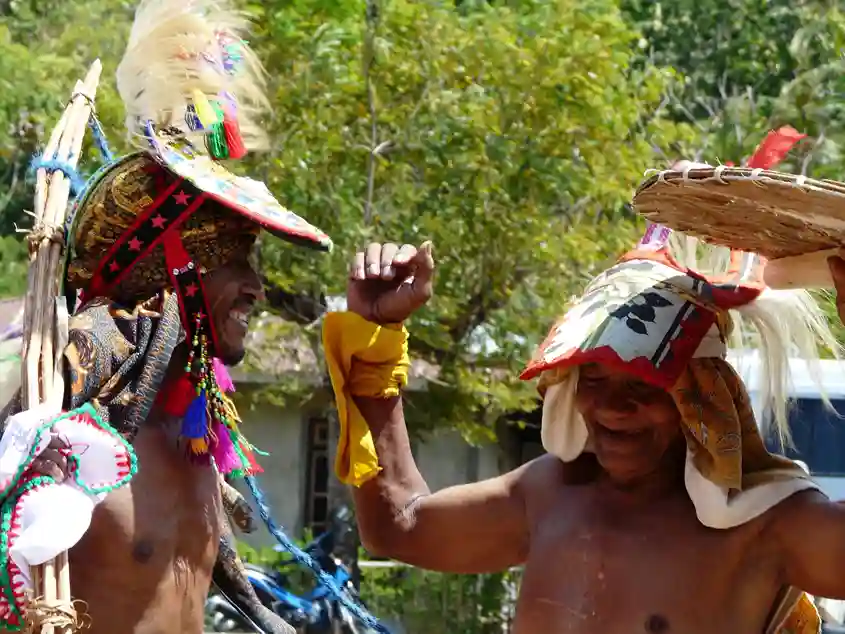
Flores means “flowers” in Portuguese, a name given by Lusitanian sailors who landed on the east coast in the 16th century in search of sandalwood. They left behind words, a few bell towers, and above all a Catholic fervor which, combined with local animism, produced a unique syncretism: Holy Week processions in the small town of Larantuka, open-air masses on promontories buffeted by trade winds, and virgins crowned with flowers at the doors of Lio or Sikka houses.

Each ethnic group—the Manggarai in the west, the Ngada in the center, the Ende and Lio around the slopes of Kelimutu, the Lamaholot in the east—possesses its own language, ikat weaving, ceremonial calendar, and even ritual topography. A standing block of rock will be masculine, a miniature wooden sanctuary feminine, and the balance of the village depends on the harmony between these poles. Spending even a single night under the conical roof of a Wae Rebo house, at an altitude of 1,200 meters, is enough to grasp this subtlety: the central fire does not only warm bodies, it nourishes the memory of the ancestors.
From arrival at Komodo Airport to the call of the open sea and dragons
The vast majority of travelers arrive at Komodo Airport in Labuan Bajo, at the western tip of Flores. The small bay fringed by arid hills already breathes a scent of adventure: diving boats heading for Batu Bolong, wooden schooners announcing a multi-day cruise to Rinca and Komodo, and underwater equipment shops neighboring panoramic cafes where the sun sets in a blaze of gold.
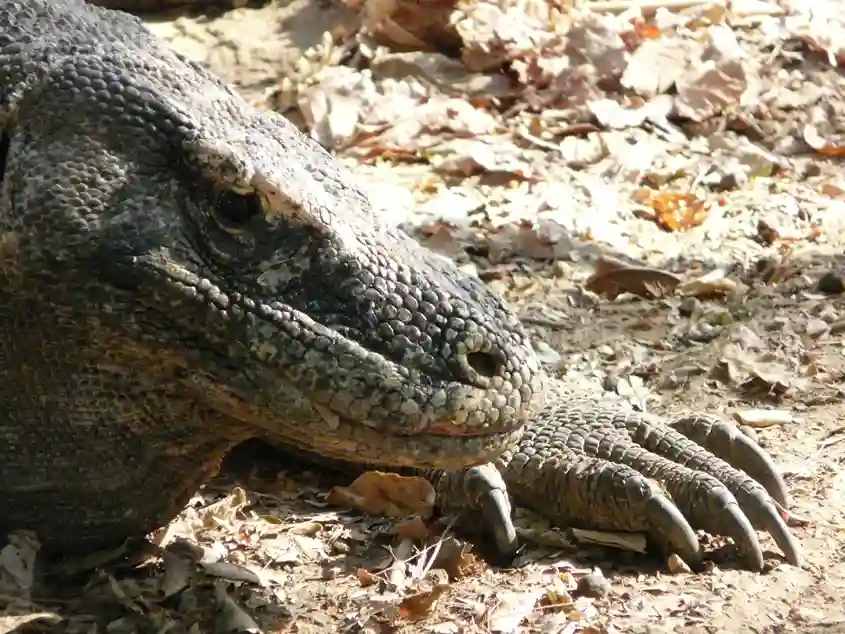
Traveling to Flores without a day at sea to encounter the dragons—monitor lizards that can exceed three meters—would be a missed appointment with natural history. Yet, one only needs to rent a scooter and climb the bends of Bukit Cinta to understand that Labuan Bajo is more than just an embarkation pier: experimental vineyards, cashew orchards, and hamlets where arak is still distilled complete the discovery.
The village of Wae Rebo in Flores: Seven roofs pointing to the sky
In the heart of a basin lost in the mist, the Manggarai village of Wae Rebo looks like a fairy tale. Seven conical houses covered in black thatch form a circle around a sacred drum.
Access has not changed: three hours of bumpy road from Labuan Bajo, then a three-hour walk through a primary forest rustling with cockatoos. Here, there is no electricity, just a few solar bulbs; no Wi-Fi, but a cosmos of legends that the elders tell over coffee as they unroll their long indigo ikats. Spending the night on the mats of the common floor, listening to the rain drumming on the palm leaves, is to discover Flores in its purest form.
Ruteng and the spider-web rice fields
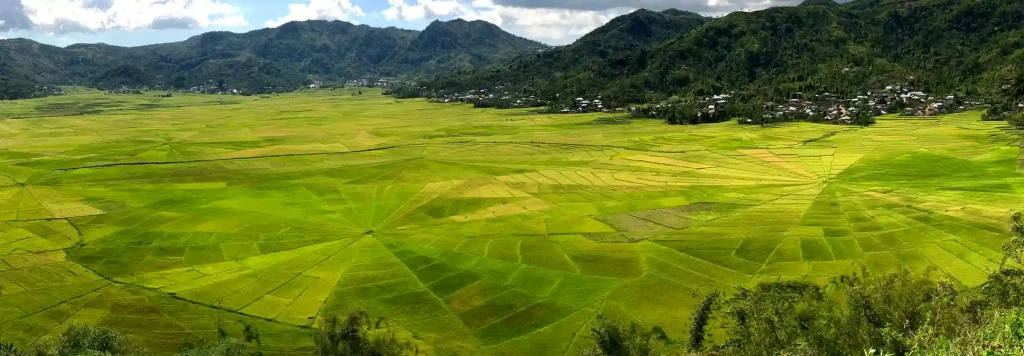
Leaving the forest for the highlands, you reach Ruteng, a small town dominated by the Poco Ranaka massif. Its surroundings celebrate a unique art of agricultural planning: the lingko rice fields, whose radiating layout resembles a spider web from the sky. This geometry is not merely aesthetic; it reflects the equitable distribution of water and land among lineages. A few kilometers away, the Liang Bua cave displays casts and videos explaining the excavation site of Homo floresiensis; one only needs to linger there to feel the shift in time, from the Pleistocene to the Anthropocene.
Discovering Flores and Bajawa: Smoking volcanoes and megaliths
Continuing east leads to Bajawa, situated at over a thousand meters and nestled under the pyramidal silhouette of the Inerie volcano. In the morning, the mountain is adorned with salmon-colored clouds; at its foot, the Ngada villages of Bena and Gurusina exhibit megaliths, masculine sanctuaries, and feminine pavilions of carved wood, guarded by bleached buffalo skulls. One understands here why traveling to Flores appeals to the anthropologist: every stone, every alignment, every roof tells of the alliance or rivalry between clans. The ascent of Inerie at dawn offers an unclouded view of the entire central isthmus; in the afternoon, the Malanage hot springs wash away fatigue in a cloud of sulfur scented with wild jasmine.
Riung 17 Islands, an almost secret coral garden to discover the flora and fauna of Flores
To the north, the coast suddenly shifts into turquoise transparency. At the sleepy port of Riung, a few fishermen offer their wooden hulls; in twenty minutes of navigation, you are surrounded by a constellation of deserted islets, white sand beaches, and mangroves fringed by giant flying foxes that take off by the hundreds at dusk. Beneath the surface, colonies of hard corals remain intact; turtles, batfish, and triggerfish live there without fear of crowds. Few tours include Riung, yet one encounters authentic smiles, rustic accommodations, and a light that, at dawn, seems to paint every wave with a touch of living silver.
Kelimutu: The alchemy of the three lakes of Flores
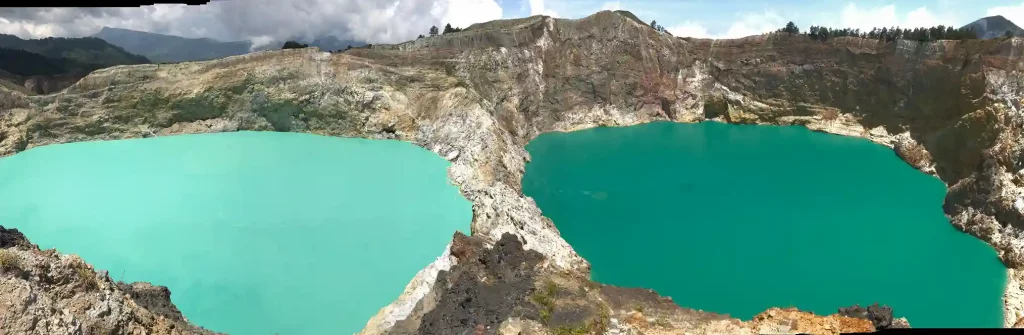
Further east, the road winds through Arabica coffee plantations before anchoring at the village of Moni. At four in the morning, you climb in the golden chill to the Kelimutu plateau. There, three lakes fill the craters; they carry the souls of the ancestors, say the Lio. The first, Tiwu Ata Mbupu, welcomes the elders; the second, Tiwu Nuwa Muri Koo Fai, receives the virtuous youth; the third, Tiwu Ata Polo, serves as a resting place for troubled spirits. The colors fluctuate, sometimes within a few months; turquoise has been seen to turn to chocolate, and apple green to jet black. Geologists speak of oxidation-reduction reactions, but the Balinese see in these metamorphoses a sign that souls are still in dialogue with the world of the living.
Between Ende, Maumere, and Larantuka: Blue beaches, ikat, and processions
The southeast coast of Ende boasts sapphire-colored sand; a little further on, the town has preserved Soekarno’s house of exile, decorated with quotes on freedom. In Maumere, the sea repaints the seabed with highly colorful corals; there, one learns the art of ikat weaving in the village of Watublapi, where each pattern tells of the arrival of missionaries or the path of the ancestors.
Finally, Larantuka, at the eastern tip, celebrates Semana Santa every year; during the night of Good Friday, a statue of the Virgin nicknamed Tuan Ma crosses the bay on a flotilla of illuminated boats, while the faithful chant a rosary in archaic Portuguese.
Traveling to Flores and Bali with Amanaska
Flores presents itself like a novel of stone and water: each chapter reveals a secret, from the Hobbit of Liang Bua to the buffaloes trained for the Makepung race, from the chameleon lakes of Kelimutu to the conical villages perched between sky and jungle.
A trip to Flores is never a linear stroll; it is a succession of turns, measured risks, and encounters with weavers, fishermen, and impromptu volcanologist guides. This type of profound and nuanced itinerary is only offered by a travel agency in Bali specializing in off-the-beaten-path explorations in Indonesia.
If one decides to travel to Flores, one must be prepared to forgo absolute comfort to gain a treasure of authenticity. Those who accept this trade-off will see a dragon cross the dry savannah, smell the acrid scent of a smoking crater, and hear the bell of a Portuguese chapel rising above a Manggarai rice field.
And when it is time to leave, they will understand that they have not just visited an island; they have journeyed through a living book where geology, spirituality, and hospitality intertwine.
Do not forget to contact us so that we can tell you about this island and help you discover it through a truly off-the-beaten-path program.