 Skip to content



If you come to Bali in “checklist” mode—beaches, temples, Instagram spots, a couple of clubs, three sunsets—you’ll see things… but you’ll miss the essential.
Why isn’t Bali visited like other islands? Because Bali is not just scenery.
It’s an island where daily life is woven with the sacred, community, scents, sounds, silences, and invisible balances.
And this cannot be “consumed”: it must be felt.
For many travelers who come on a tour or stay in Bali, the real shock is not visual. It is sensory, human, and almost instinctive.
Feeling Bali does not mean becoming an expert in Balinese religion. It means grasping a logic, a profound atmosphere, a rhythm of life.
And when you understand it, your trip to Bali changes: you no longer “do” Bali, you inhabit it, even for just a few days.
1) In Bali, the sacred is not a moment: it’s the infrastructure of daily life
The first mistake travelers make is believing that Balinese spirituality is limited to temples.
In reality, it structures the way life is organized: the home, the village, agriculture, and social relationships.
A clear reference point: Tri Hita Karana, a philosophy that connects three dimensions:
- the spiritual
- the human world
- nature
This is not a tourist slogan: it is a principle recognized as foundational, particularly in the cultural landscape of rice terraces and the subak system inscribed on the World Heritage list.
Simple translation: here, balance is not a “wellness” concept. It’s a method of cultural survival.
And this is felt everywhere.
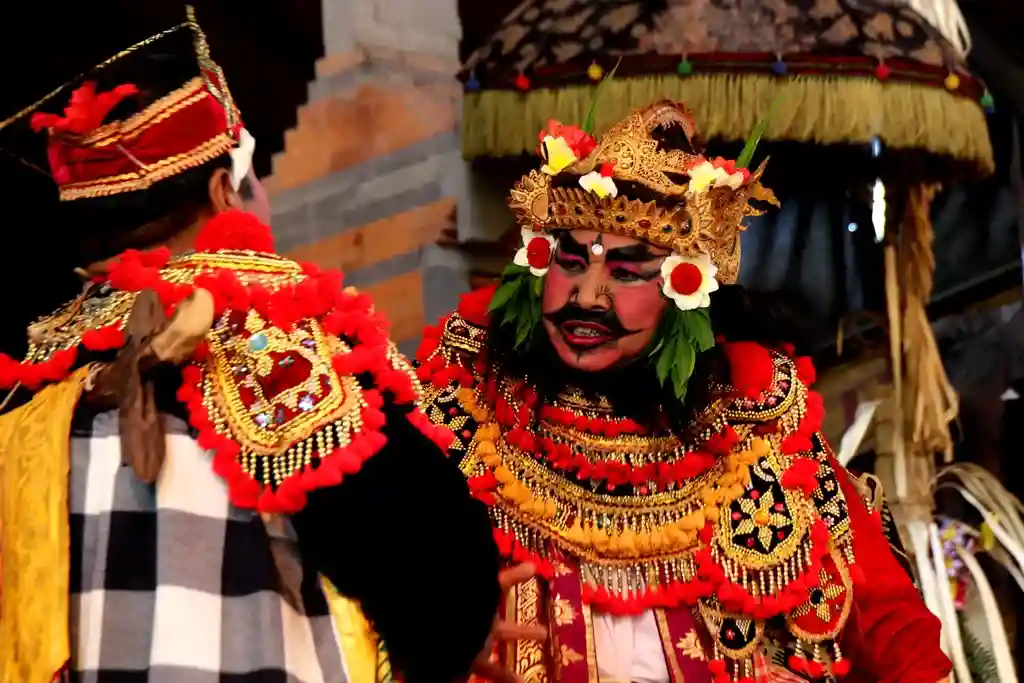
2) You feel Bali even before you understand it during a vacation in Bali
Bali is an island of scents and micro-signals.
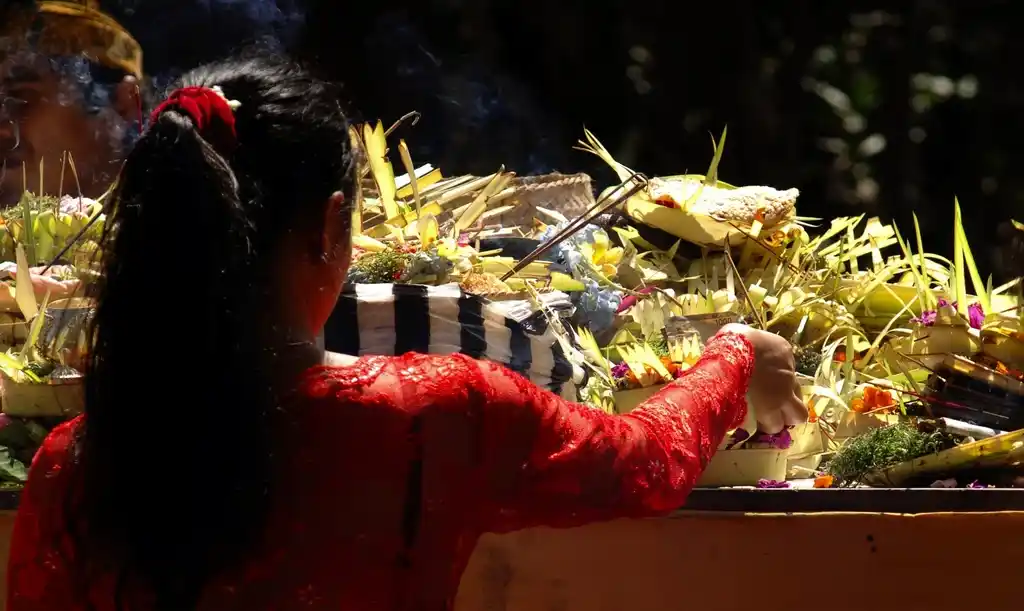
In the morning, you smell incense.
You see fresh flowers.
You hear a prayer.
You notice an offering in front of a shop, a scooter, or a hotel.
These small daily offerings, often canang sari, are a gesture of gratitude and balance repeated every day, without staging.
And there, you understand something important.
In Bali, culture is not “something they tell you about.” It settles beneath your feet.
If you’re in a hurry, you only see small baskets.
If you slow down, you see a relationship with the world:
- giving thanks
- soothing
- protecting
- restoring order
During a vacation in Bali, it is often these tiny details that leave the most lasting impression on travelers.
3) Sekala / Niskala: understanding Bali differently through the visible and the invisible
To feel Bali, you must understand a very Balinese mental filter: two planes coexist.
- Sekala: what is visible, concrete, measurable
- Niskala: what is invisible, felt, energetic, spiritual
This “seen / unseen” duo is a key to understanding widely cited in explanations of the Balinese worldview.
Concretely, this changes the way you interpret what you experience:
- a temple is not “a monument,” it’s a point of connection
- a ceremony is not “a spectacle,” it’s an action that restores balance
- a silence is not “empty,” it is full
Even if you don’t embrace everything, you sense that the people around you live as if the invisible matters as much as the visible.
This creates density. Depth.
4) Community: the true heart of Bali
Many travelers seek “authenticity” in an isolated place.
But Bali is understood primarily through its community life.
The village and neighborhood are organized around the banjar, a local association that manages part of collective life:
- mutual aid
- neighborhood rules
- organization of ceremonies
This explains why you see so many collective mobilizations.
Everyone cooks, prepares, carries, sets up, prays, cleans, starts again.
Here, the sacred passes through the social.
And the social passes through the sacred.
You want to feel Bali?
Watch how people do things together.
It’s not folkloric. It’s a system.
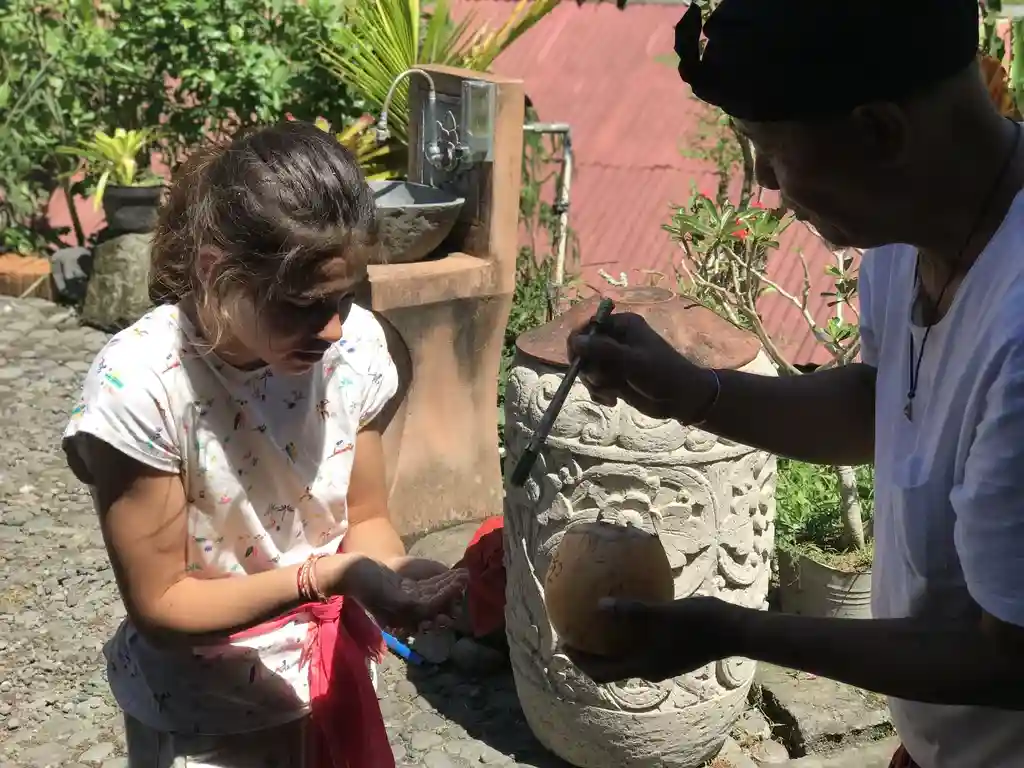
5) Balinese time: a rhythm that changes your way of traveling in Bali
In the West, we like to control:
- planning
- schedules
- optimization
In Bali, your stay confronts another reality: the ceremonial calendar.
You had planned a visit?
A road is closed.
You had planned an appointment?
There’s a ceremony in the village.
And this is not unexpected, it’s normal.
The best symbol of this is Nyepi, the “day of silence,” a day when the island slows down radically with strong restrictions known as Catur Brata Penyepian.
Nyepi is not just a tradition.
It’s a collective experience that says:
- we can stop
- we can be silent
- we can withdraw
- and we can do it together
Even if you don’t come during Nyepi, the spirit is there.
Bali teaches you that time is not only productive.
It is also ritual, relational, and restorative.
> More information on Nyepi or on the Balinese calendar
6) Places take on a different meaning when you discover Bali differently
Yes, Bali is photogenic.
But when you begin to feel the island, you stop seeing places as spots.
- the rice terraces tell a social and spiritual organization linked to water and water temples
- a volcano represents a presence, an orientation, and a power
- Mount Agung profoundly structures the Balinese imagination
The same goes for temples.
Pura Tirta Empul, for example, is not an attraction.
It’s a place where sacred water is central to practice.
If you go there only for the photo, you see water.
If you go there respecting the rhythm of the place, you feel something else:
- a quiet gravity
- a collective intensity
- a form of inner silence
7) What transforms you during a trip to Bali is your posture
The phrase “Bali is not visited, it is felt” may seem abstract.
In reality, it means something very concrete.
The island reflects back to you your way of being.
If you arrive:
- in haste
- in control
- in constant comparison
- in consumption of experiences
… you will “do” Bali without truly encountering it.
But if you arrive:
- in presence
- in respectful curiosity
- in deliberate slowness
… you begin to grasp tiny things that become immense:
- a smile that expects nothing
- a gesture of offering
- a procession in the distance
- a way of speaking softly
- a way of organizing as a community
And there, Bali does you good.
Not because it’s “paradise,” but because it puts your attention in the right place.
8) How to concretely feel Bali before leaving for Bali
No need to become perfect.
Often it’s enough to change a few reflexes.
- Deliberately slow down: fewer places, more time in each place.
- Observe before acting: in a temple, a ceremony, or a village.
- Respect local codes: attire, silence, and gestures.
- Accept that not everything is optimized: that is precisely Bali.
- Choose stops that have meaning, not just places “to see.”
- Avoid cynicism. Yes, tourism exists in Bali. But the culture remains profoundly alive.
For travelers who go through a travel agency in Bali, building a slower and more coherent itinerary often allows them to feel the island much more intensely.
Conclusion: Bali gives you primarily what you are capable of receiving
You can spend a week in Bali and return with 200 photos.
Or return with something else:
- a rhythm
- a calm
- a sense of right place
- a different way of looking at the world
Bali is not limited to Canggu, Ubud, or Seminyak.
These are points on a map.
The real Bali is in what you feel between these points:
- balance
- the sacred in daily life
- the strength of the collective
- that invisible presence that gives depth to the real
Understanding this profoundly transforms a stay in Bali.