 Skip to content



You are soon departing for your Indonesian discovery, so why not make your trip to Bali a responsible one?
You are starting to pack your bags, and we have all developed the habit of overpacking “just in case” and taking everything that seems essential. Most likely, it is the desire to avoid any mistakes.
However, do not forget that if you are traveling to Bali, you will find many things locally.
Our travel agency is located in Indonesia, and specifically in Bali, to be precise. Amanaska has adopted an eco-responsible approach, and today we would like to share some ideas and practices that will allow you to become or remain a responsible traveler.
Sustainable travel begins before you leave
While packing your bags for Bali, keep in mind that your goal is to leave no waste at the destination you are visiting. Indeed, Indonesia, for example, does not practice selective waste sorting, and anything you leave behind will be difficult to dispose of.
You are therefore left with only two solutions:
- Bring a minimum of products that will end up as waste…
- … and take back with you what you cannot dispose of locally, so that no trace of your visit remains.
Packing eco-responsible luggage
- Remove all packaging from your products.
- Remove the plastic wrapping from your disposable razors (taking only the necessary number).
- Remove labels from your new clothes.
- Take only the necessary medications in a single box, having taken the precaution of photographing the instructions.
- Obviously, do not take any plastic bags, large or small.
- Ban all disposable products such as plastic cutlery.
- Do not bring cotton pads, paper towels, or cotton swabs.
- Bring one or two reusable water bottles and avoid plastic bottles.
- Check your children’s luggage and involve them in the “planet hero” game, leaving no trace behind.
- Before putting clothes in your luggage, check the pockets to remove plastics, tissues, and wrappers.
- If you are a smoker, bring a small box with you to store your cigarette butts.
- Do not take any single-use products.
- Choose an environmentally friendly sunscreen, specifically one that is reef-safe (e.g., Biotherm’s Waterlover range).
Traveling with respect for locals and traditions
Here you are in immersion, ready to discover a new culture and ancestral traditions. It is time to let go: you are no longer at home, the reference points are different, and you must adapt to the rhythm of the country and its customs, not the other way around.
- Learning a few words of the local language will allow you to make yourself understood or, at the very least, to ask politely and say thank you.
- Observe how locals behave before imposing your culture in a public or private place. For example, shoes are removed before entering a Balinese home, and one must always be lower than the priest during a ceremony.
- Always ask for permission before taking a photo, whether of a person or their belongings. Some beliefs, once very deep-seated throughout Asia, consider that a photo can “steal” the soul.
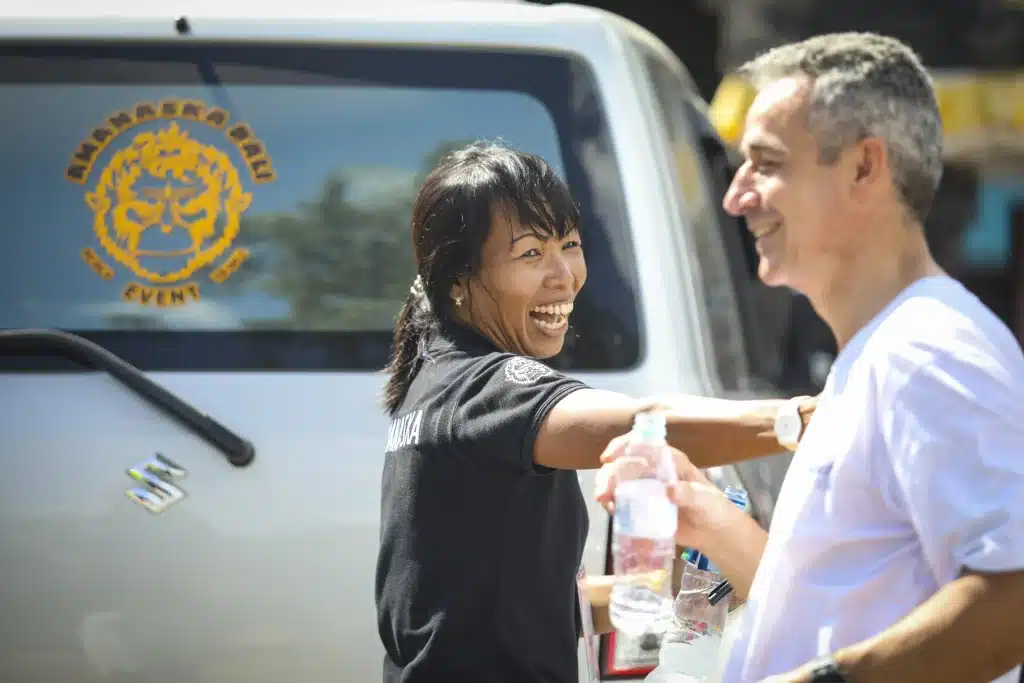
Adopting a courteous attitude
Remain polite and courteous, even if the situation is not in your favor. Anger, shouting, or losing control will not help and will create a negative image. In many Asian countries, anger is perceived as a weakness, and your interlocutors will simply stop speaking to you.
Reducing your plastic impact
- Avoid plastic straws. Opt for alternatives like bamboo or metal straws, which are widely available in Bali.
- Bring your own reusable water bottle. Initiatives like RefillMyBottle allow you to find drinking water refill points on the island.
- Use a cloth tote bag for your shopping and purchases. A plastic bag takes about 450 years to degrade and kills many marine animals and birds every year.

Respecting resources
- In your accommodation, reuse your towels several times to limit water and energy consumption related to washing.
- Leaving a small tip is appreciated. Check the exchange rate with your currency to avoid mistakes.
- Do not lecture the locals: be an example through your behavior.
Negotiating with respect
Negotiation is part of the local culture, but it should be done in good spirits. The first price announced in Bali’s markets, stalls, and shops is often double or triple the final rate. Be curious, use gestures, and if the transaction does not go through, remain smiling.
An Indonesian proverb could be translated as follows:
“Paying to travel, eat, and sleep is normal, but the traveler must not behave like a king in a conquered country, at the risk of being banished from the kingdom themselves.”