 Skip to content



A library etched into chlorophyll
Long before Bali became a travel destination and gamelan rang out for tourists, the island’s sages were already engraving their knowledge onto dried palm leaves. The word lontar combines ron (leaf) and tal (palm) in Old Javanese. For a local travel agency in Bali like Amanaska, understanding this heritage makes it possible to offer a more authentic stay.
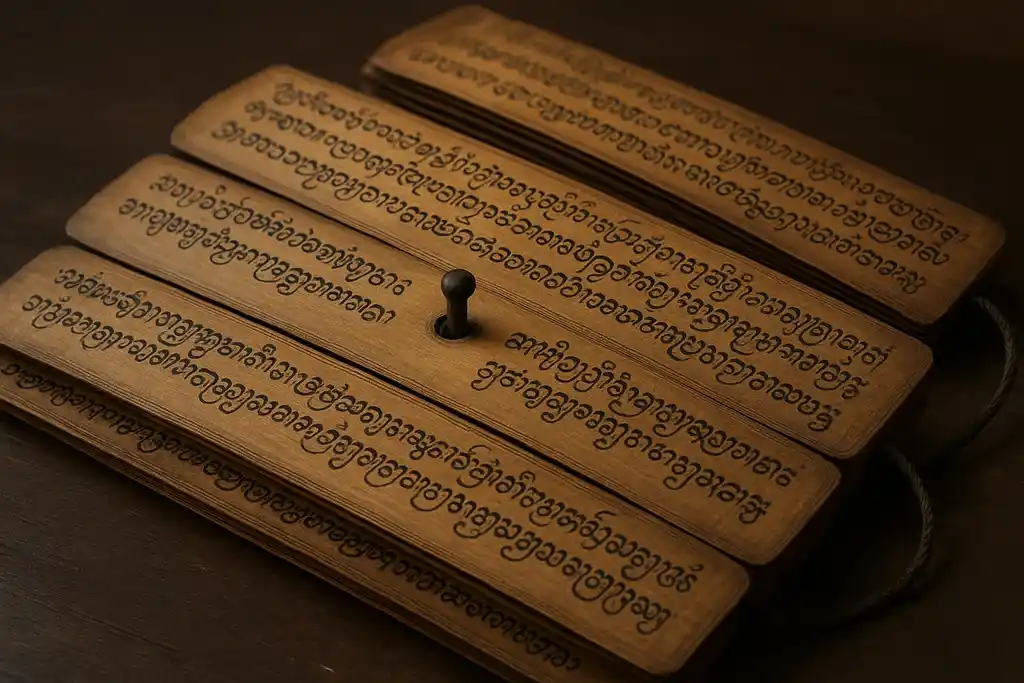
For more than a thousand years, these organic pages have carried the memory of Balinese Hindu cosmology, medical treatises, ritual calendars, as well as love stories and magic recipes. On a family trip to Bali or a trip with friends, discovering them offers a fascinating immersion in local culture. Each time you open a lontar codex, you are literally unrolling a brioche of chlorophyll browned by time: no paper, no screen provides that same tactile and olfactory thrill.
Trip to Bali: from harvesting to preservation, the cycle of a palm-leaf page
It all begins with the Borassus flabellifer palm. Its immense leaves are picked green, boiled to drive out moisture, then sun-dried until they shift from a soft green to a golden beige. They are sometimes smoked with aromatic herbs to keep insects away.
Each leaf is then cut into strips 3 cm wide and 20 to 50 cm long, and polished with pumice stone.
Once ready, the strips are pierced with two holes through which a cotton or rattan cord will pass. The leaves are then stacked: the unbound manuscript is nothing more than this flexible bundle. It copes very poorly with humidity, sea air and excessive handling; this is why Balinese libraries, often teak chests, are placed in the attic of houses or in a “manuscript tower” (Pepaosan), on the mountain side and always above the level of human feet.
Engraving tools and techniques
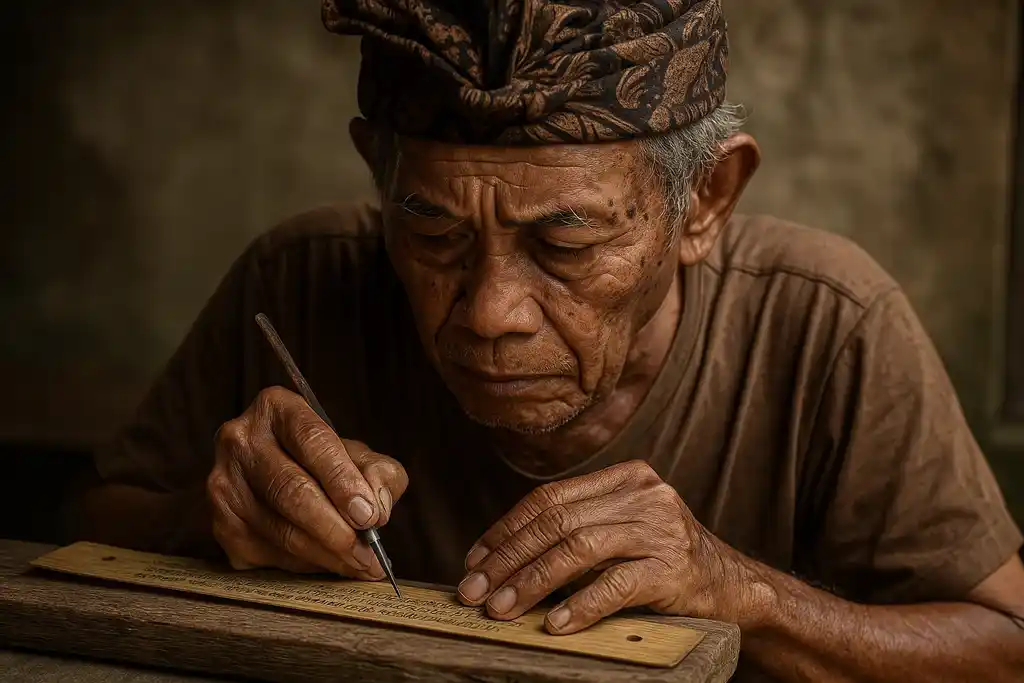
To write, the scribe (Juru Tulis) uses a small iron stylus called pengkraf. The tip, as fine as a pin, incises the surface of the leaf; you do not draw continuous lines but prick (like micro-engraving). After engraving, the page is rubbed with a mixture of candlenut ash and oil: the black powder settles into the incisions while the surface remains light. The contrast then appears, as if by magic. Experienced scribes produced up to six pages a day — a work of patience.
Discover Bali: the Balinese alphabet between a syllabary and sacred calligraphy
The bali aksara descends from Indian Brahmi via Javanese Kawi. It is an abugida: each character carries a consonant and an implicit a, modified by diacritics to produce e, i, o, u, etc.
| Shape | Sound | Distinctive feature |
| ᬧ | pa | a rounded loop that evokes the frangipani flower |
| ᬓ | ka | resembles a trident, symbolising the three worlds |
| ᬤ | da | depicts a crescent moon, associated with royal speech |
| ᬮ | la | like two leaves brought close together, a sign of fertility |
The script is read from left to right without spaces; a special sign (pangangge suara) marks the end of the sentence. Mantras stand out through tighter ligatures: the act of writing becomes ritual, each curve being meant to channel divine energy.
Literary genres engraved on lontar
- Kakawin: epics in Sanskrit metres, such as the Ramayana Kakawin adapted to the Javanese-Balinese context (but without addressing the Ramayana exclusively from a Balinese point of view).
- Wariga: practical astrology, calculating auspicious days to build a house or celebrate a wedding.
- Usada: traditional pharmacopoeia, listing roots, bark and healing mantras.
- Babad: historical chronicles mixing facts and myths, invaluable for historians.
- Tantri: animal moral tales, ancestors of fables.
Reading these texts means moving from a ginger compress recipe to a cosmic battle, then to advice on planting rice — all within a few dozen leaves trembling like an ancient fan.
Stay in Bali: where can you admire and handle these manuscripts today?
- Gedong Kirtya, Singaraja
A former royal library founded in 1928, it preserves more than 4,000 codices. Researchers can consult the original; the public leafs through facsimile copies and attends engraving demonstrations. - Museum Puri Lukisan, Ubud
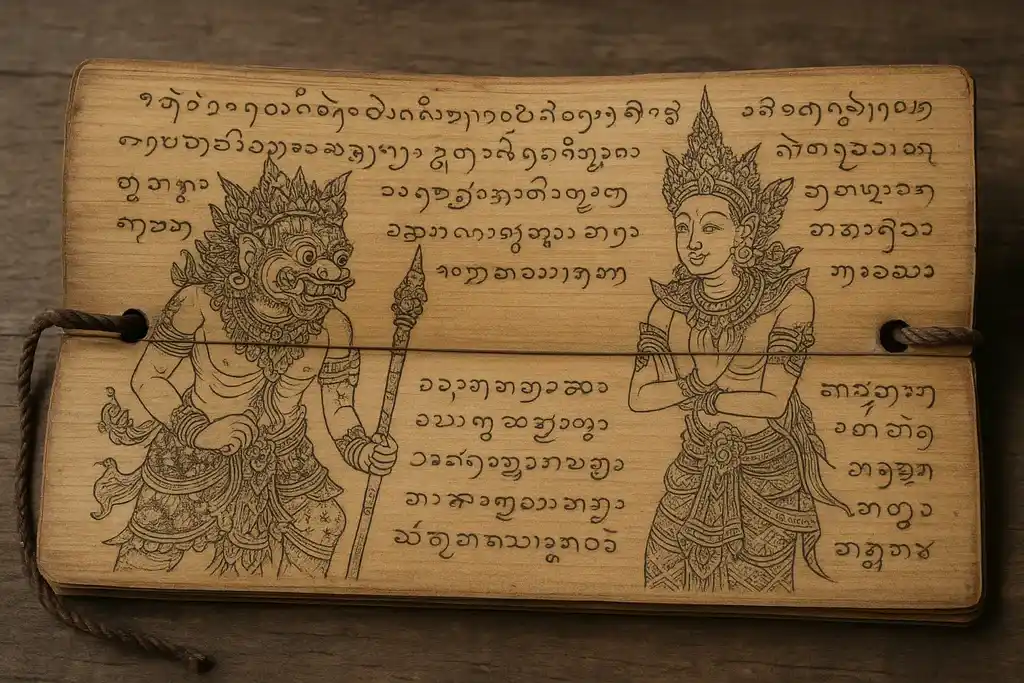
An air-conditioned room displays rare illustrated lontar, including an 18th-century Usada with dreamlike demons. Touchscreens translate (into English) a passage from the Babad Dalem. - Tihingan Village, Klungkung
Several families keep the engraving tradition alive. You can order a personalised bookmark (5 × 15 cm) with your first name transcribed in the Balinese alphabet: a lasting, lightweight souvenir to slip into your suitcase. - Udayana University, Denpasar
The philology lab digitises the manuscripts, downloadable as high-definition PDFs; perfect for continuing your reading after you return.
Decipher at home: resources for beginners
- “Aksara Bali” app (Android/iOS): virtual keyboard and recognition exercises.
- Online Balinese–Indonesian dictionary (Kam-us Bali): helps translate common words.
With a month of practice, you can read your first name and recognise around thirty symbols, just enough to savour a couplet from Tantri.
Preservation issues and climate challenges
Lontar, an organic material, crumbles when exposed to humidity and termites. Power cuts in air-conditioned libraries accelerate ageing. Conservators now coat the strips with a clove-based balm, a natural insecticide.
“Crowd scanning” projects mobilise volunteers to photograph each page; but JPG compression erases the fine detail of secondary incisions. The ideal solution: dual digital archiving + airtight chests with silica gel.
Why discovering lontar on your trip to Bali changes your perspective
Handling a palm-leaf manuscript means touching the continuity of a civilisation that has never stopped writing despite tropical rain, invasions and now the digital era. A travel agency in Bali can easily integrate this discovery into an off-the-beaten-track cultural itinerary.
Each engraved line reveals the hand of a patient ancestor and the voice of an entire village. When you return from your trip to Bali, this thin strip scented with coconut oil becomes more than a souvenir: a tangible bridge to an intangible heritage.
Learning a few characters will allow you, on a future visit, to decipher the inscription on a temple door or the name of a carved Barong mask. Lontar is not a frozen relic; it is a lexicon of Balinese life. The more of us who read it and protect it, the longer it will sing in the discreet rustle of its turning leaves.